Quokka
Setonix brachyurus
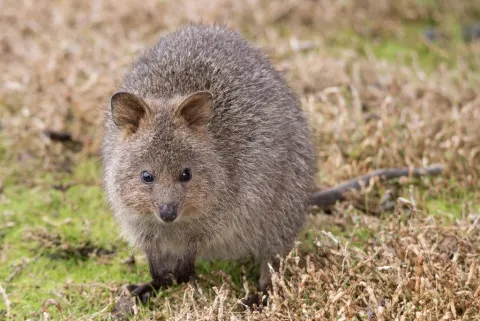
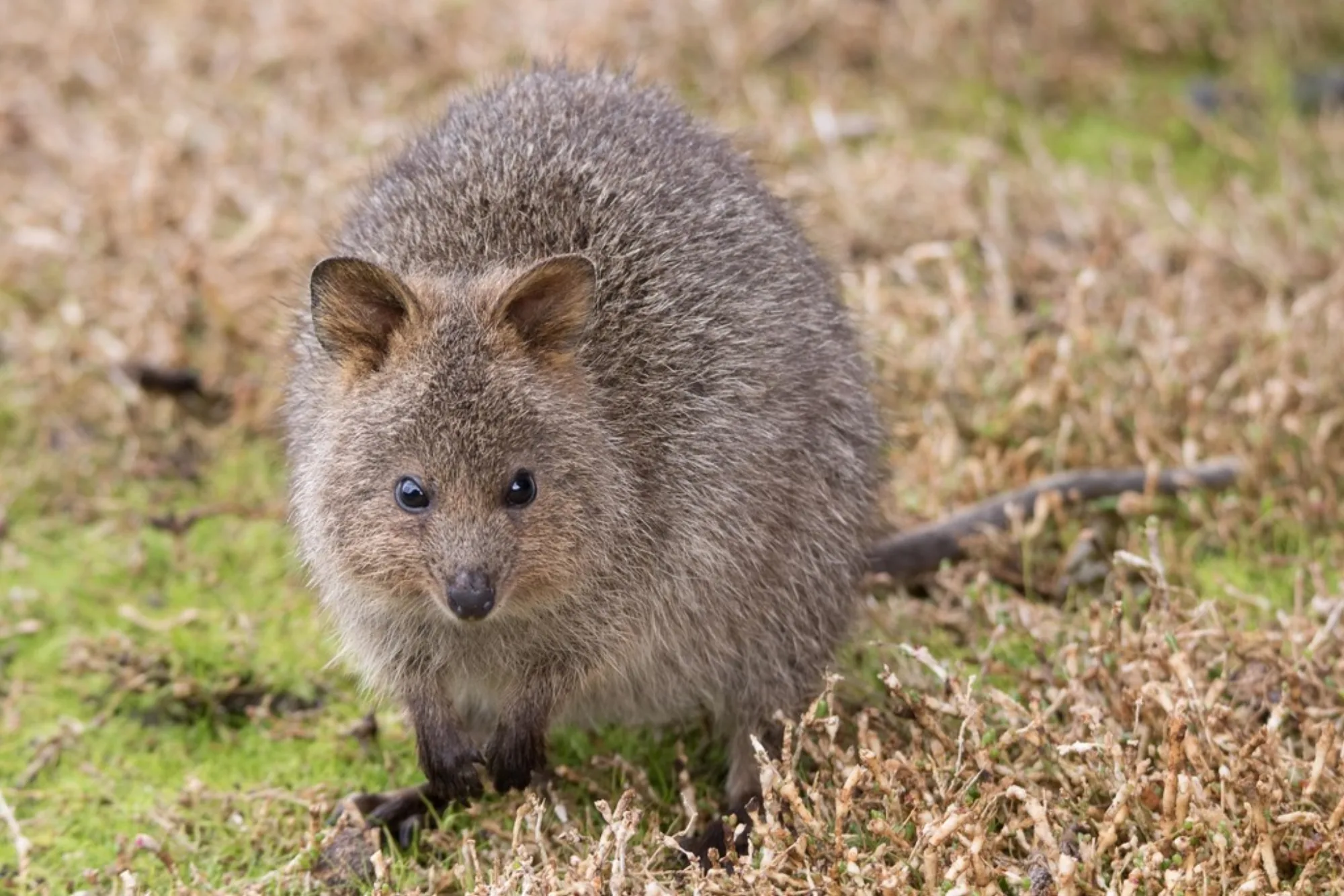
About the size of a domestic cat, the Quokka has a stocky build, rounded ears and a short, broad head. Its coarse coat is grizzled brown, fading to buff underneath, and its strong hind legs give it the look of a small kangaroo. It weighs 2.5 to 5.0 kg and measures 40 to 54 cm in body length, with a tail 25 to 30 cm long. In the wild, it lives within a small part of southwestern Australia, including Rottnest Island, Bald Island and scattered pockets of mainland forest and coastal heath. On Rottnest, it uses habitats from semiarid scrub to cultivated gardens, and may approach people closely.
Quokkas are mainly active at night and shelter by day among prickly Acanthocarpus plants. They can climb small trees and shrubs, and eat grasses, sedges, leaves and other vegetation. Much of their water comes from their food, an asset on Rottnest, where fresh water is relatively scarce. Visitors are urged not to feed them: bread and other human foods can leave quokkas dehydrated and malnourished. A female gives birth to a single joey after a month of gestation. The joey stays in her pouch for 6 months and continues to depend on her milk until it is weaned at around 8 months.
On the mainland, quokkas need dense vegetation for food and refuge from predators, including introduced foxes, cats and dogs. Logging, agriculture, housing and the clearing and burning of swampland have reduced their habitat. Severe bushfires pose another threat, while on Rottnest seasonal losses of vegetation and surface water can lead to starvation.
Written from the English Wikipedia article Quokka (CC BY-SA 4.0).
- Records
- 208
- Countries
- 1
No atlas park has a record of the Quokka in or around it yet.
These are open occurrence records, so they show where people looked for and recorded the Quokka as much as where it lives. Cells are up to 25 km across, and every location is generalised to its cell.
Generalised encounter areas, not exact locations. Each shape is a grid cell coloured by how likely the species is there.
- Very likelyAustralia25 km zone · high confidence · 208 records · updated 80 days ago
Conservation status not assessed here yet, so every location is generalised to its grid cell.