Yellowtail Kingfish
Seriola lalandi
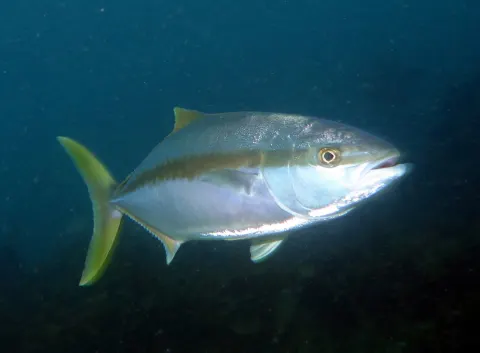
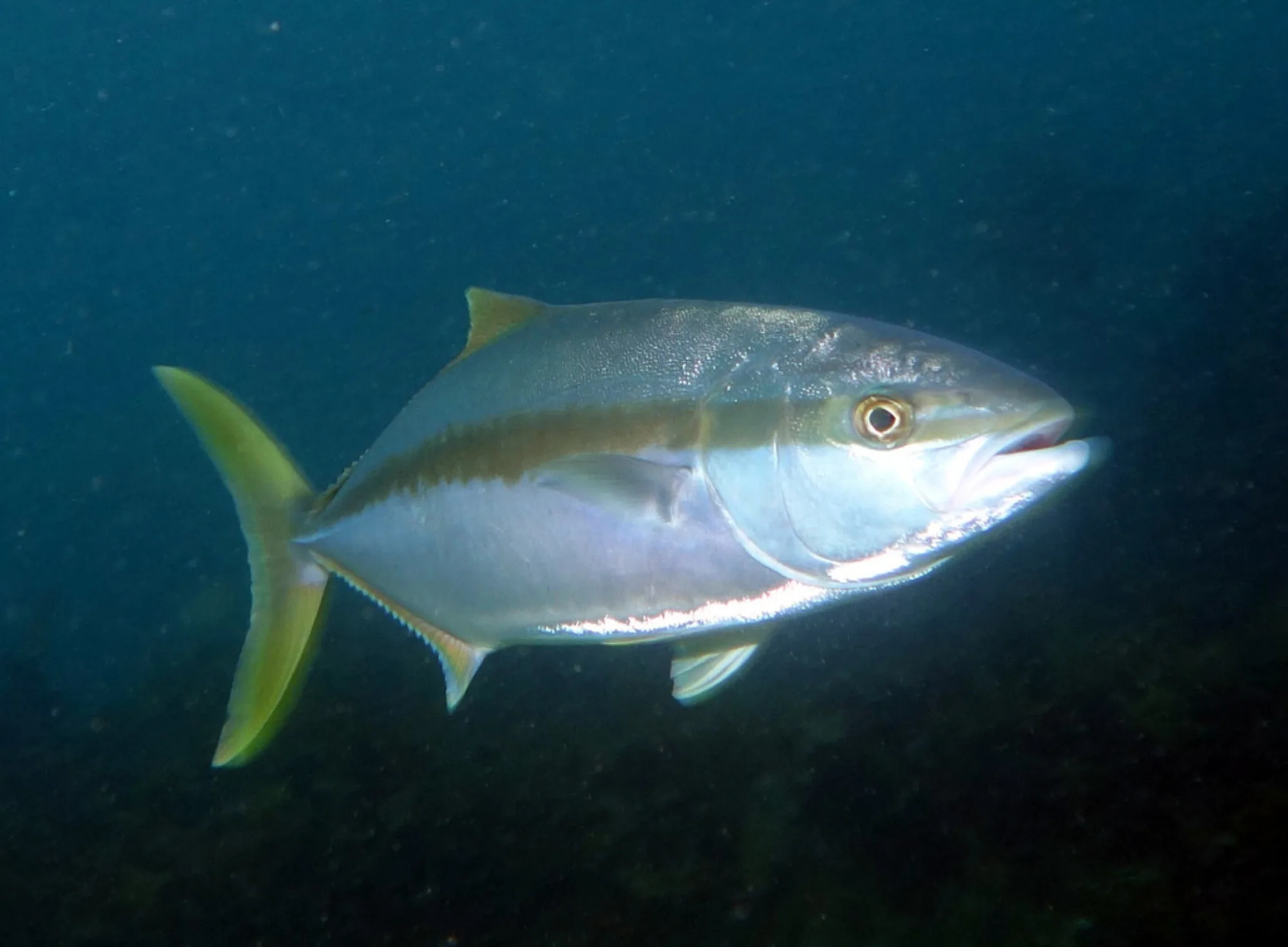
A large, mobile fish of southern oceans, the Yellowtail Kingfish is also known as the yellowtail amberjack. Young fish are yellow with black bands, a pattern that fades as they grow; by about 30 cm, they have taken on their adult colouration. Maximum length is often reported as 180 cm, and large specimens taken off Port Augusta, South Australia, have weighed between 40 and 50 kilograms. Juveniles are rarely seen, often sheltering far from land among floating debris or weed that camouflages them. Closer to shore, young fish weighing up to 7 kg can gather in shoals of several hundred.
Yellowtail Kingfish inhabit tropical and temperate waters, with records in Australia from Queensland around to Western Australia and south to Tasmania. They favour rocky reefs and nearby sandy areas, sometimes entering estuaries; bigger fish tend to occur near offshore islands and reefs in deeper water. They occur from shallow water to around 50 m, although some have been caught deeper than 300 m. Active predators, they usually hunt in schools or pairs, feeding on fish, squid and prawns. They can be curious around vessels and often accompany stingrays in harbours and estuaries, taking advantage of the rays' ability to sense fish. Little is known about their breeding behaviour in the wild.
Fishing has put pressure on kingfish populations. Commercial traps introduced in Sydney Harbour in the 1970s were so effective that some studies suggested they might have removed up to 60% of the area's larger amberjack. The traps were later prohibited in the harbour, and kingfish remain popular with recreational anglers and are also fished commercially.
Written from the English Wikipedia article Yellowtail amberjack (CC BY-SA 4.0).
- Records
- 82,595
- Countries
- 10
- Atlas places
- 3
These are open occurrence records, so they show where people looked for and recorded the Yellowtail Kingfish as much as where it lives. Cells are up to 25 km across, and every location is generalised to its cell.
Generalised encounter areas, not exact locations. Each shape is a grid cell coloured by how likely the species is there.
- Very likelyUnited States25 km zone · high confidence · 71559 records · updated 80 days ago
- Very likelyNew Zealand25 km zone · high confidence · 6235 records · updated 80 days ago
- Very likelyAustralia25 km zone · high confidence · 4582 records · updated 80 days ago
- LikelyMexico25 km zone · medium confidence · 99 records · updated 80 days ago
- LikelyMozambique25 km zone · medium confidence · 81 records · updated 80 days ago
- LikelyFrench Southern Territories25 km zone · medium confidence · 13 records · updated 80 days ago
- PossibleBrazil25 km zone · medium confidence · 9 records · updated 80 days ago
- PossibleNorfolk Island25 km zone · medium confidence · 7 records · updated 80 days ago
- PossibleSouth Africa25 km zone · medium confidence · 5 records · updated 80 days ago
- PossibleUnnamed area25 km zone · medium confidence · 3 records · updated 80 days ago
Conservation status not assessed here yet, so every location is generalised to its grid cell.