Greater Amberjack
Seriola dumerili
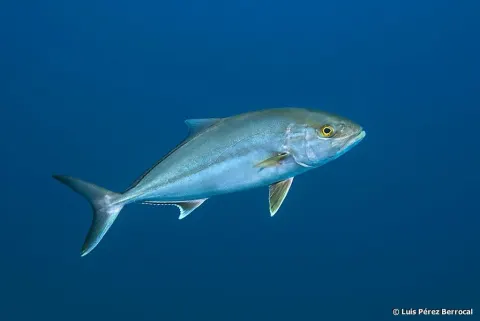
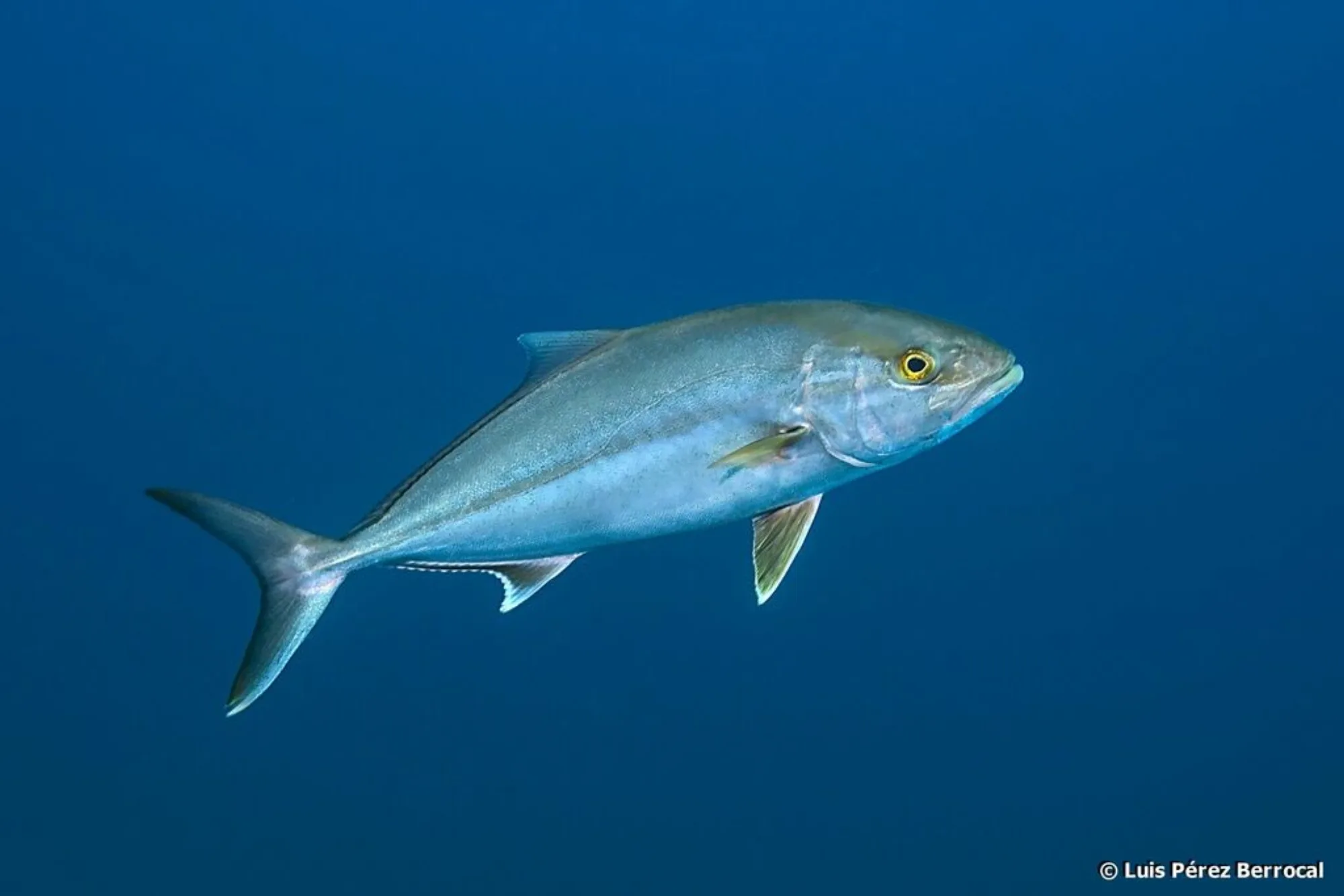
Built for life in open water and around reefs, the Greater Amberjack is a large predatory fish and the biggest member of the jack and pompano family. Its long body is brownish to bluish-grey above and silvery-white below, with dusky fins and dark stripes across the head and back. Some have a pale yellow to reddish-brown stripe along their sides. Small juveniles look different, with clear fins and vertical bands. A typical fish measures 100 cm, though the largest recorded reached 190 cm.
Greater Amberjack range widely across the world's warm and temperate seas. They may be seen alone or in small to moderate-sized schools near reefs, rocky outcrops, drop-offs, deep offshore caves and wrecks. They sometimes enter coastal bays, while juveniles can shelter among floating algae and debris far out at sea. Smaller fish can be found in shallow water, but larger ones favour deeper water, normally 18 to 72 m. Adults hunt opportunistically, taking fish, cephalopods and crustaceans, while young fish start out feeding on plankton. As they grow, juveniles shift towards larger prey and move from open water into more coastal areas.
Spawning takes place over reefs and shipwrecks, with timing varying by region: it peaks in April and May off Florida and occurs in June and July in the Mediterranean. In one spawning season, a single female can produce between 18 and 59 million eggs; these fish can live for up to 17 years. Larger fish and seabirds prey on amberjacks, while people catch them commercially and for sport. Anglers also catch them incidentally while fishing the seabed for snappers and groupers.
Written from the English Wikipedia article Greater amberjack (CC BY-SA 4.0).
- Records
- 1,147
- Countries
- 26
- Atlas places
- 2
These are open occurrence records, so they show where people looked for and recorded the Greater Amberjack as much as where it lives. Cells are up to 25 km across, and every location is generalised to its cell.
Generalised encounter areas, not exact locations. Each shape is a grid cell coloured by how likely the species is there.
- Very likelyUnited States25 km zone · medium confidence · 607 records · updated 80 days ago
- Very likelyFrance25 km zone · medium confidence · 169 records · updated 80 days ago
- Very likelyAustralia25 km zone · medium confidence · 123 records · updated 80 days ago
- Very likelyJapan25 km zone · medium confidence · 53 records · updated 80 days ago
- Very likelySpain25 km zone · medium confidence · 37 records · updated 80 days ago
- Very likelyU.S. Outlying Islands25 km zone · medium confidence · 36 records · updated 80 days ago
- Very likelyMozambique25 km zone · medium confidence · 33 records · updated 80 days ago
- Very likelyCroatia25 km zone · medium confidence · 14 records · updated 80 days ago
- Very likelyGreece25 km zone · medium confidence · 13 records · updated 80 days ago
- LikelyMexico25 km zone · medium confidence · 10 records · updated 80 days ago
Conservation status not assessed here yet, so every location is generalised to its grid cell.