Atlantic Canary
Serinus canaria
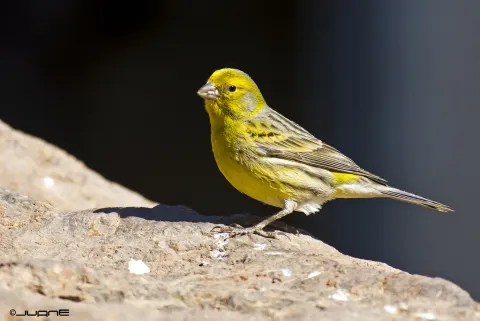
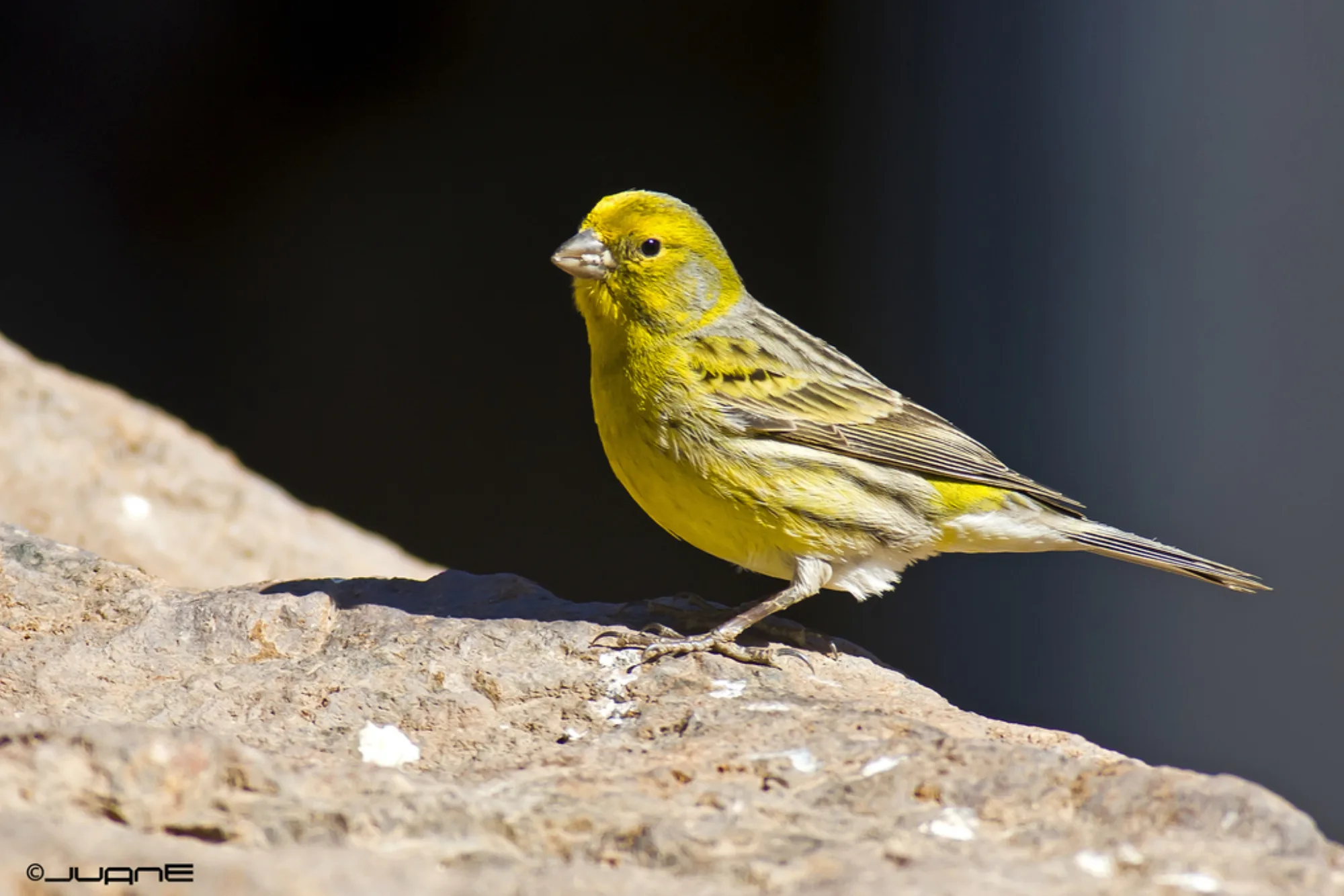
A small finch with a silvery twittering song, the Atlantic Canary is mostly yellow-green in the wild, with brownish streaks across its back. Males have a yellower face and forehead, while females are duller, with a greyer head and breast. Young birds are largely brown with dark streaks. Adults range from 10 to 12 cm long, and their wingspan is 21 to 23.7 cm.
The bird comes from Madeira, the Azores and the Canary Islands, where its habitats include sandy dunes as well as forests of pine and laurel. Look for it especially in semi-open places with small trees, including orchards and copses, as well as in parks and gardens. Among the Canary Islands, it is common on El Hierro, La Palma, La Gomera and Tenerife, though more local on Gran Canaria. It is common across Madeira and the Azores, as well as on the Desertas Islands and Porto Santo. Introduced birds have also become established on Midway Atoll.
Atlantic Canaries are sociable and usually feed in flocks, searching the ground and low vegetation. Seeds from weeds, grasses and figs make up much of their diet, alongside other plant material and small insects. Pairs often nest in groups, each defending a small territory. Their cup-shaped nests are concealed in trees or bushes and lined with soft materials, including hair and feathers. Breeding dates vary across the islands: in the Canary Islands, eggs are laid from January to July. In Bermuda, an introduced population declined after scale insects devastated the Bermuda cedar population, and had died out by the 1960s.
Written from the English Wikipedia article Atlantic canary (CC BY-SA 4.0).
- Records
- 65,427
- Countries
- 18
No atlas park has a record of the Atlantic Canary in or around it yet.
These are open occurrence records, so they show where people looked for and recorded the Atlantic Canary as much as where it lives. Cells are up to 25 km across, and every location is generalised to its cell.
Generalised encounter areas, not exact locations. Each shape is a grid cell coloured by how likely the species is there.
- Very likelyPortugal25 km zone · high confidence · 43012 records · updated 80 days ago
- Very likelySpain25 km zone · high confidence · 20635 records · updated 80 days ago
- Very likelyU.S. Outlying Islands25 km zone · high confidence · 1680 records · updated 80 days ago
- PossibleUnited States25 km zone · medium confidence · 23 records · updated 80 days ago
- PossibleCanada25 km zone · medium confidence · 20 records · updated 80 days ago
- PossibleBelgium25 km zone · medium confidence · 14 records · updated 80 days ago
- PossibleGermany25 km zone · medium confidence · 11 records · updated 80 days ago
- PossibleAustralia25 km zone · medium confidence · 7 records · updated 80 days ago
- PossibleBrazil25 km zone · medium confidence · 4 records · updated 80 days ago
- PossibleMorocco25 km zone · medium confidence · 4 records · updated 80 days ago
Conservation status not assessed here yet, so every location is generalised to its grid cell.