Ovenbird
Seiurus aurocapilla
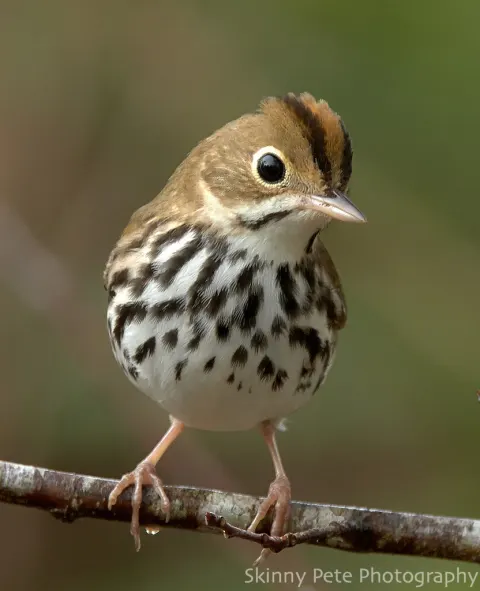
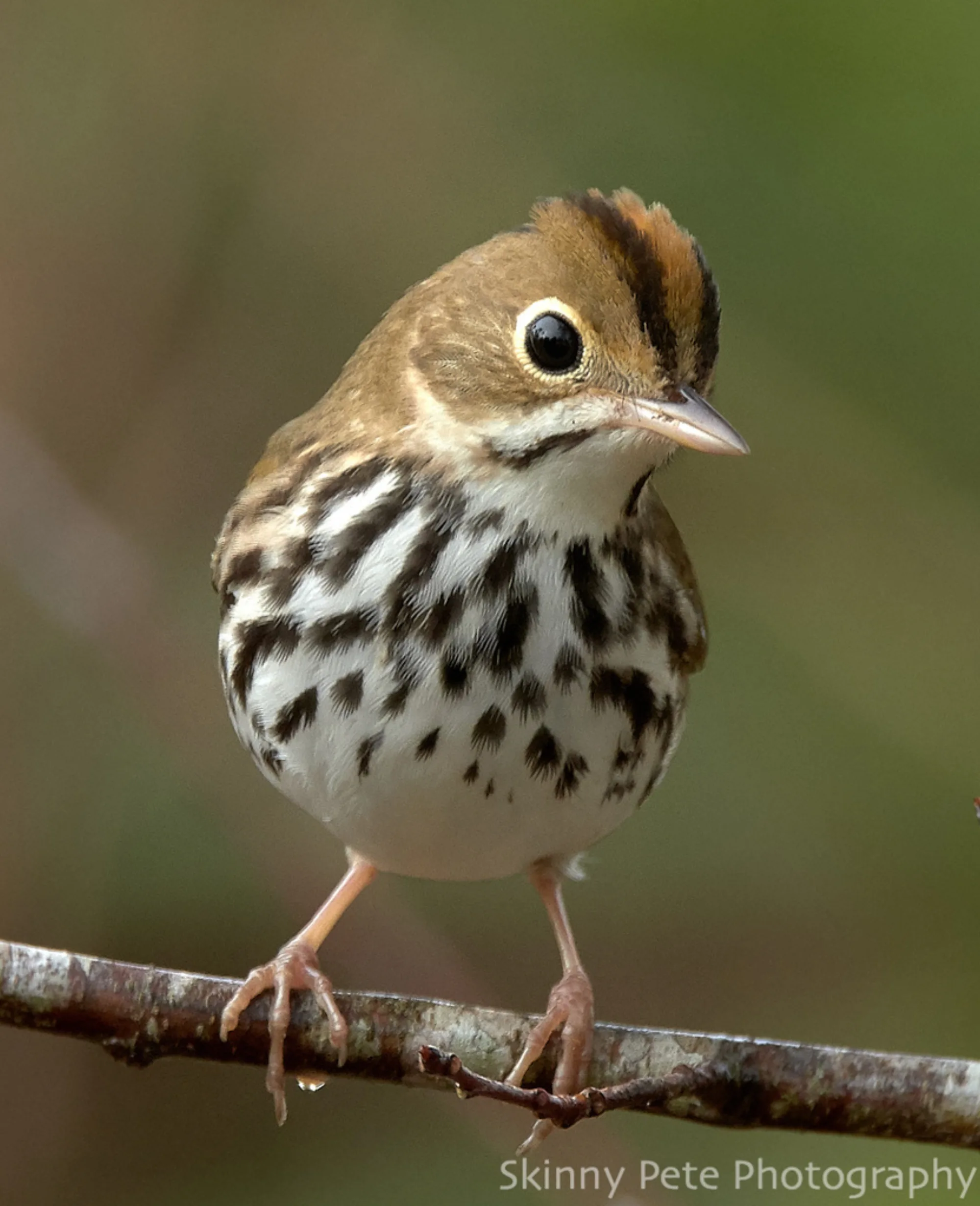
Look for the Ovenbird on the forest floor, where it walks through dead leaves in search of food. This small New World warbler has olive-brown upperparts, heavily black-streaked white underparts and a white ring around each eye. An orange stripe runs over its head, edged in dark brown, and can be raised into a small crest. Males and females look alike, and adults measure 11 to 16 cm long. Its main song is a repeated series of rather low, strident notes that grows louder, with a sharp accent on the second syllable.
Ovenbirds breed in mature deciduous and mixed forests across Canada and the eastern United States, particularly where the undergrowth is sparse. For feeding, they favour woodland with plenty of shrubs and do best in a mixture of primary and secondary forest. Their migration takes them from the southeastern United States and Caribbean islands south through Mexico to northern South America. Birds usually hold territories alone or as breeding pairs, although they travel in larger groups during migration. In winter they mainly occupy lowlands, but in Costa Rica they may reach 1,500 m. While walking, an Ovenbird often bobs its head and tilts its tail upwards. It eats mainly ground-dwelling arthropods and snails, adding fruit in winter, and sometimes catches insects in flight.
The bird takes its name from its domed ground nest, woven from vegetation with an entrance at the side. The female usually lays 4 to 5 speckled eggs and incubates them alone, while both parents feed the young. Ground nesting exposes the brood to snakes, red squirrels and chipmunks, which can burrow into nests to eat the young. A female may feign injury near the nest to distract a potential predator. Brown-headed cowbirds also parasitise Ovenbird nests and are becoming more numerous in some areas.
Written from the English Wikipedia article Ovenbird (CC BY-SA 4.0).
- Records
- 925,552
- Countries
- 3
- Atlas places
- 3
These are open occurrence records, so they show where people looked for and recorded the Ovenbird as much as where it lives. Cells are up to 25 km across, and every location is generalised to its cell.
Generalised encounter areas, not exact locations. Each shape is a grid cell coloured by how likely the species is there.
- Very likelyUnited States25 km zone · high confidence · 815580 records · updated 80 days ago
- Very likelyCanada25 km zone · high confidence · 104533 records · updated 80 days ago
- Very likelyBermuda25 km zone · high confidence · 5439 records · updated 80 days ago
Conservation status not assessed here yet, so every location is generalised to its grid cell.