Channel-billed Cuckoo
Scythrops novaehollandiae
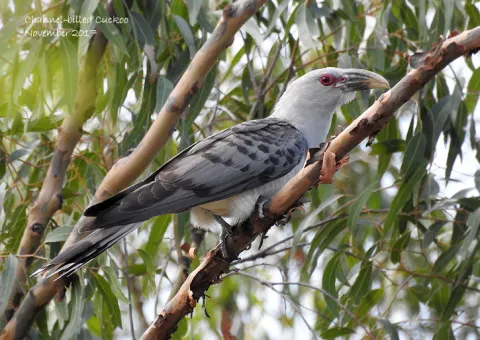
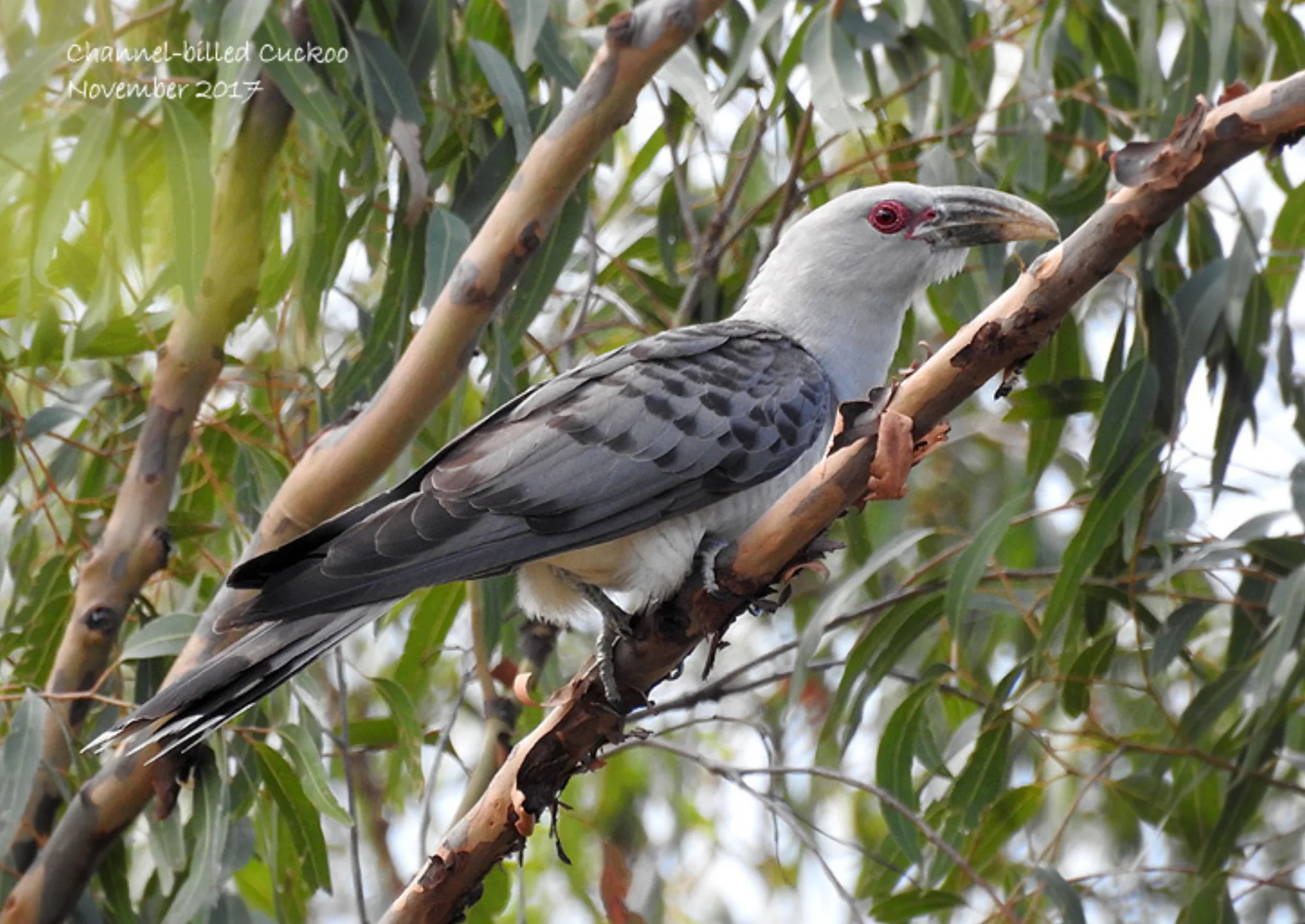
A huge, curved bill gives the Channel-billed Cuckoo a profile reminiscent of a hornbill. The world's largest cuckoo measures 56 to 70 cm long, with a grey bill that fades to straw colour at the tip. Adults are mostly pale grey, with darker wings, red skin around the eye and a dark tail marked with a black band and white tip. In flight, its cross-shaped silhouette can look almost hawk-like.
Look for it in northern and eastern Australia, as well as New Guinea and the Bismarck Archipelago; its Indonesian range reaches west to Sulawesi. It feeds in the canopy of large trees and can be shy, so its loud, raucous call may reveal it before you see it. It is most active in the early morning and evening, sometimes feeding in groups or alongside other fruit-eating birds. Fruit makes up a major part of its diet, including figs and mulberries, but it also eats insects, bird eggs and nestlings. Crows, miners and other birds may swoop or chase it.
Some populations stay in the same place year-round, while birds breeding in Australia migrate north after the breeding season and return in August and September. The cuckoo lays its eggs in other birds' nests, often choosing ravens, currawongs, butcherbirds or Australian magpies. Its chicks do not eject the host's eggs or kill its young, but the host chicks seldom survive because the cuckoo chick can monopolise the food supply. Human activities are not considered a threat to the species; in some areas its numbers have risen as gardens around Australian cities have supported more host birds.
Written from the English Wikipedia article Channel-billed cuckoo (CC BY-SA 4.0).
- Records
- 88,291
- Countries
- 3
- Atlas places
- 5
These are open occurrence records, so they show where people looked for and recorded the Channel-billed Cuckoo as much as where it lives. Cells are up to 25 km across, and every location is generalised to its cell.
Generalised encounter areas, not exact locations. Each shape is a grid cell coloured by how likely the species is there.
- Very likelyAustralia25 km zone · high confidence · 86777 records · updated 80 days ago
- Very likelyIndonesia25 km zone · high confidence · 804 records · updated 80 days ago
- Very likelyPapua New Guinea25 km zone · high confidence · 710 records · updated 80 days ago
Conservation status not assessed here yet, so every location is generalised to its grid cell.