King Mackerel
Scomberomorus cavalla
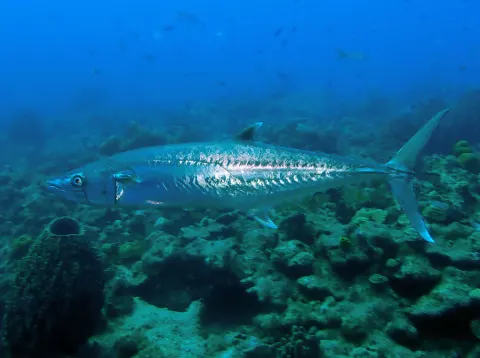
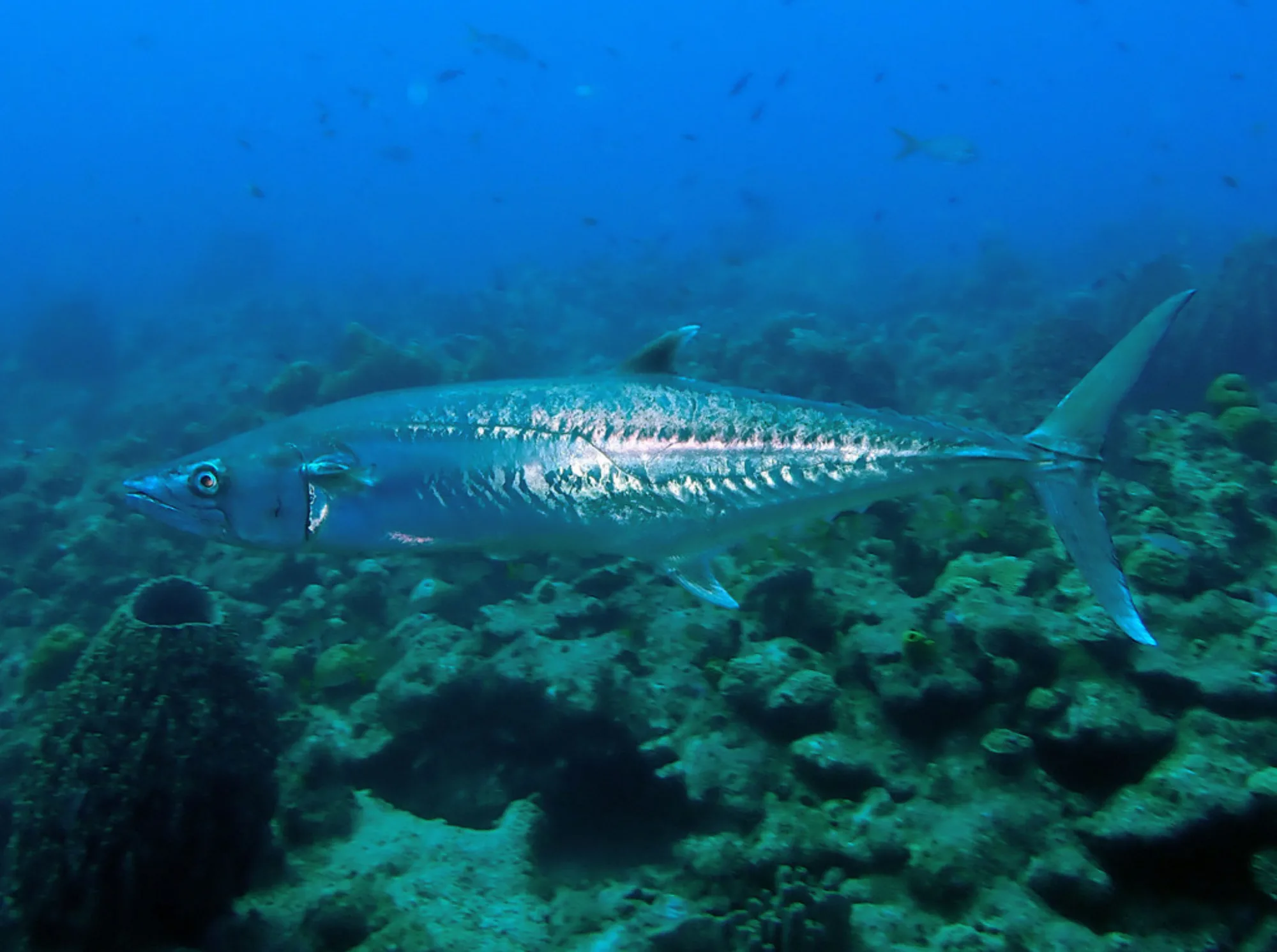
Olive along its back and silver on its sides, the King Mackerel has a rosy sheen that fades to white beneath. This migratory fish is usually encountered at weights of 5 kg to 14 kg, although it can exceed 40 kg. Smaller fish have yellowish-brown spots on their sides, which fade as they grow. A line along the side drops sharply halfway down the body, helping to distinguish it from similar mackerel. Its small scales are barely visible, and its large teeth have cutting edges.
King Mackerel live in the western Atlantic and Gulf of Mexico, and are common along the coast from North Carolina to Brazil. They prefer water between 20 and 29 °C and are usually found at depths of 12 to 45 m. Larger fish often come inshore, including to the mouths of inlets and harbours. As water temperatures and food supplies change, they travel in large schools, moving north in summer and south in winter. From November to March, fish from the South Atlantic and Gulf of Mexico gather in a winter mixing zone off the southern Florida Keys.
Opportunistic hunters, King Mackerel eat prey that varies with their size, location and the season. Their food includes squid, menhaden, anchovies, jacks and other fish. During the spawning season, a female may release 50,000 to several million eggs, depending on her size; fertilised eggs hatch in about 24 hours. Fishing is a source of pressure: King Mackerel are sought by recreational anglers and are also caught commercially, including with gill nets and trolling gear.
Written from the English Wikipedia article King mackerel (CC BY-SA 4.0).
- Records
- 210
- Countries
- 10
- Atlas places
- 1
These are open occurrence records, so they show where people looked for and recorded the King Mackerel as much as where it lives. Cells are up to 25 km across, and every location is generalised to its cell.
Generalised encounter areas, not exact locations. Each shape is a grid cell coloured by how likely the species is there.
- Very likelyUnited States25 km zone · medium confidence · 153 records · updated 80 days ago
- Very likelyBelize25 km zone · medium confidence · 23 records · updated 80 days ago
- LikelyMexico25 km zone · medium confidence · 10 records · updated 80 days ago
- LikelyGuadeloupe25 km zone · medium confidence · 9 records · updated 80 days ago
- PossibleCanada25 km zone · medium confidence · 4 records · updated 80 days ago
- PossiblePuerto Rico25 km zone · medium confidence · 3 records · updated 80 days ago
- UncommonFrench Guiana25 km zone · medium confidence · 6 records · updated 80 days ago
- UncommonColombia25 km zone · medium confidence · 2 records · updated 80 days ago
- RareBrazil25 km zone · low confidence · 0 records · updated 80 days ago
- RareCuba25 km zone · low confidence · 0 records · updated 80 days ago
Conservation status not assessed here yet, so every location is generalised to its grid cell.