Eurasian Woodcock
Scolopax rusticola
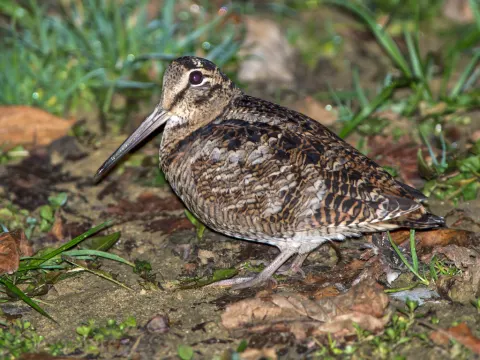
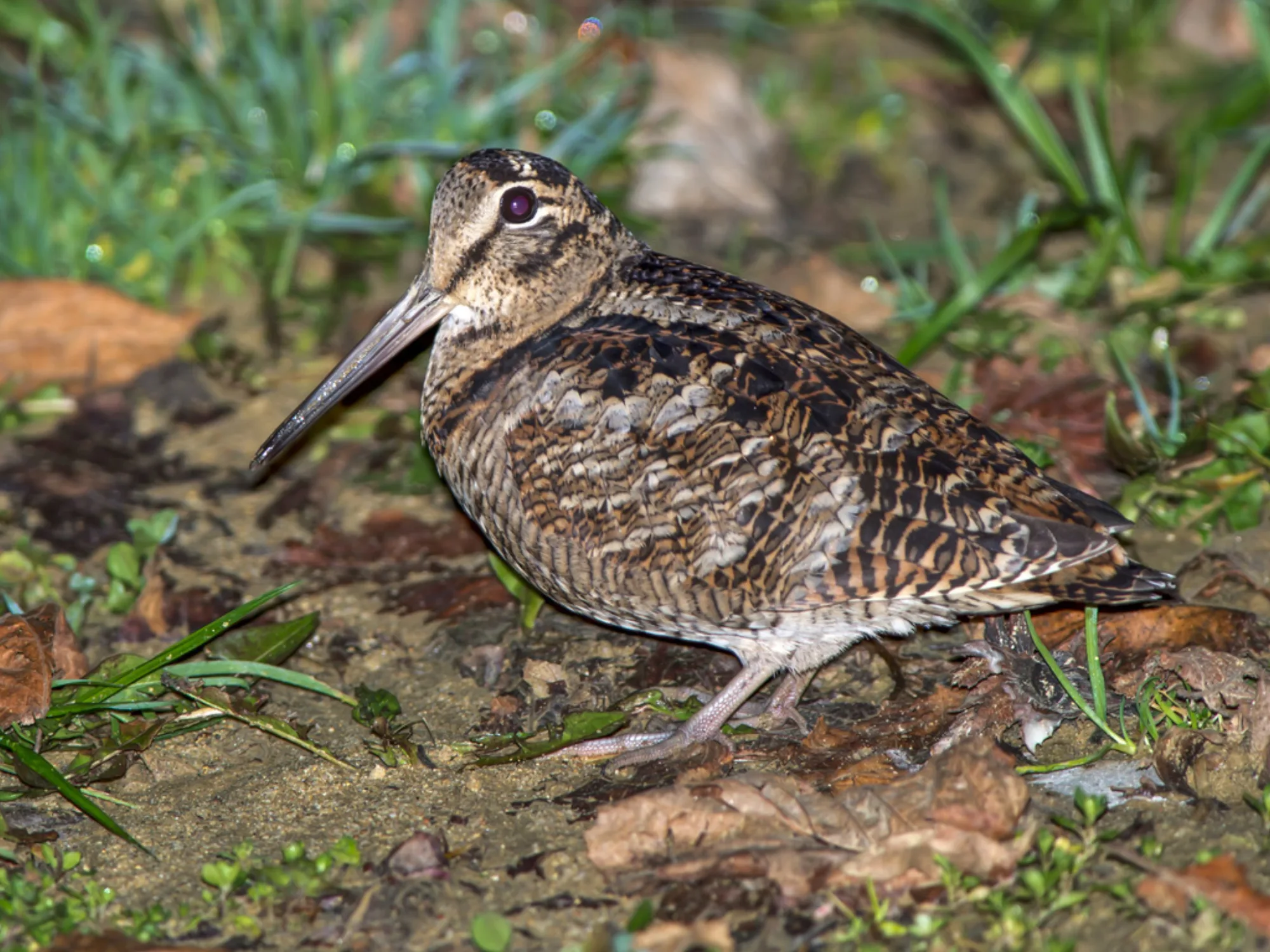
Camouflaged against the woodland floor, the Eurasian Woodcock is a medium-small wading bird with patterned reddish-brown upperparts, buff underparts and a long, straight bill. Black bars mark its head, and its rounded wings make a whirring sound when it is flushed. It occurs across much of temperate and subarctic Eurasia, breeding from western Europe to Russia and from Fennoscandia to the Mediterranean and Canary Islands. Northern birds migrate to southern Europe, while Asian populations move to the Indian subcontinent; some birds in milder western Europe and on Atlantic islands stay year-round.
For breeding, woodcock need large, unbroken areas of broadleaved or mixed forest with dense undergrowth, damp feeding places, dry resting spots and clearings for flight. In winter they also use scrubland by day, and may turn to intertidal mud when the weather freezes. Most active at dawn and dusk, they are usually solitary and can be difficult to see as they search for food in soft soil beneath thick cover. Earthworms make up much of their diet, alongside insects, larvae, freshwater molluscs and some seeds. At night they feed in frost-free pasture or grass meadows, favouring fields close to woodland where they can rest during the day. From April to June, males make courtship flights at dusk, a display known as roding. Females nest on the ground in low woodland cover or tall heather, and the young leave the nest immediately after hatching.
Fragmentation of woodland threatens breeding habitat, while the loss of permanent grassland and more intensive farming pose problems at other times of year. Frozen ground can prevent woodcock from probing for food, and they are also hunted as game in many countries.
Written from the English Wikipedia article Eurasian woodcock (CC BY-SA 4.0).
- Records
- 124,042
- Countries
- 12
No atlas park has a record of the Eurasian Woodcock in or around it yet.
These are open occurrence records, so they show where people looked for and recorded the Eurasian Woodcock as much as where it lives. Cells are up to 25 km across, and every location is generalised to its cell.
Generalised encounter areas, not exact locations. Each shape is a grid cell coloured by how likely the species is there.
- Very likelyFrance25 km zone · high confidence · 41431 records · updated 80 days ago
- Very likelyNorway25 km zone · high confidence · 40624 records · updated 80 days ago
- Very likelyBelgium25 km zone · high confidence · 19403 records · updated 80 days ago
- Very likelyPortugal25 km zone · high confidence · 8471 records · updated 80 days ago
- Very likelyUnited Kingdom25 km zone · high confidence · 5005 records · updated 80 days ago
- Very likelyFinland25 km zone · high confidence · 4195 records · updated 80 days ago
- Very likelyNetherlands25 km zone · high confidence · 2129 records · updated 80 days ago
- Very likelySpain25 km zone · high confidence · 1303 records · updated 80 days ago
- Very likelySweden25 km zone · high confidence · 392 records · updated 80 days ago
- Very likelyCzechia25 km zone · high confidence · 372 records · updated 80 days ago
Conservation status not assessed here yet, so every location is generalised to its grid cell.