American Woodcock
Scolopax minor
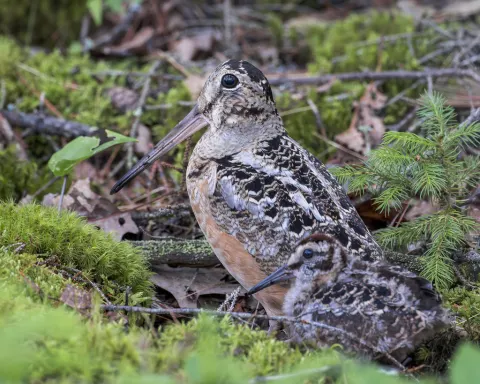
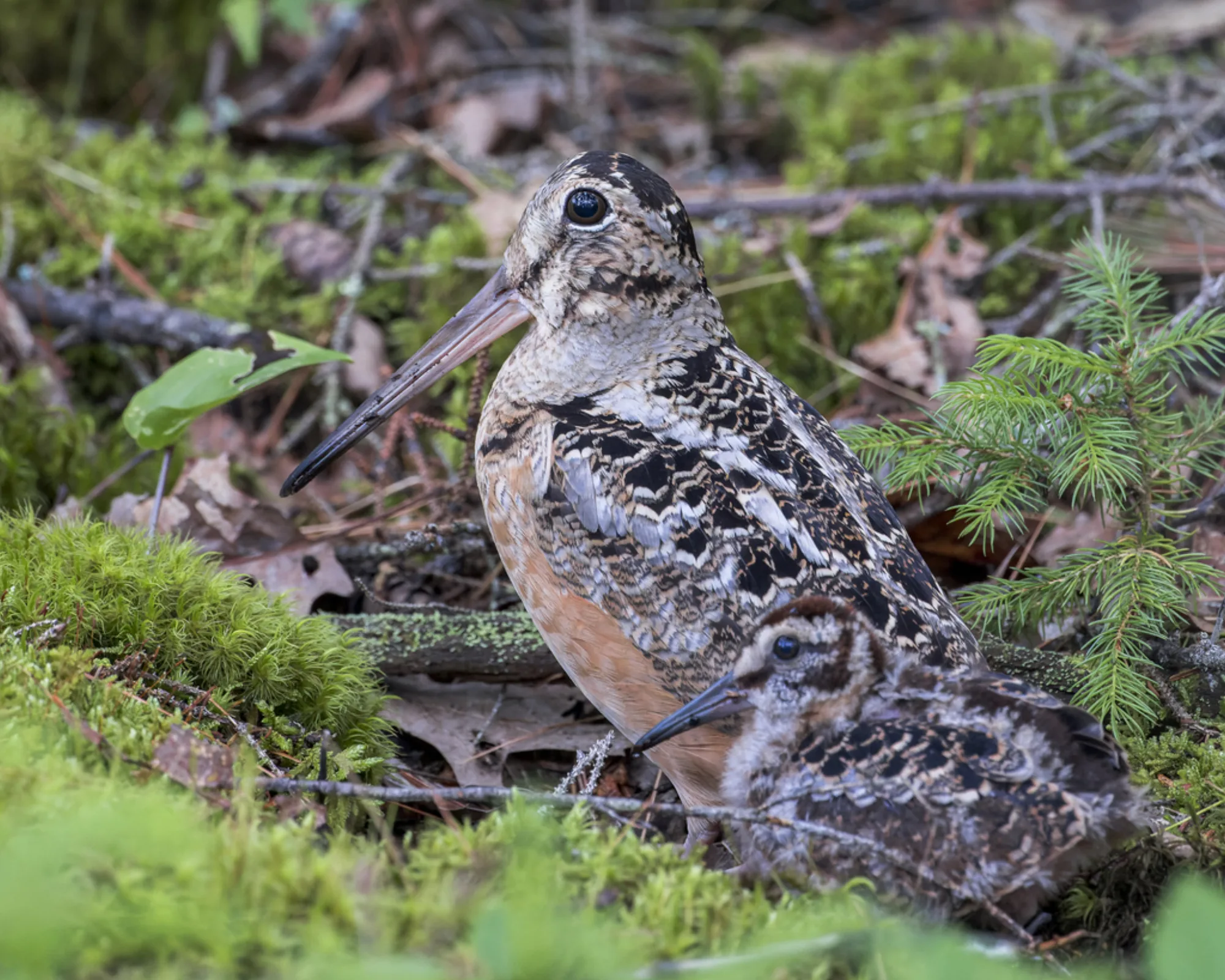
Well hidden among leaves and earth, the American Woodcock is a plump, short-legged shorebird with a rounded head and a long, straight bill. Its mottled brown, grey and black plumage blends into the ground, while its chest and sides range from yellowish-white to rich tan. Adults measure 25 to 30 cm long, and females are considerably larger than males. Found mainly in eastern North America, this bird lives largely in upland areas, spending much of its life beneath the cover of young, brushy woods. It also uses wet thickets, moist woods and brushy swamps, favouring places where abandoned farmland and young growth mix with forest.
Woodcocks are most active at dawn and dusk. They probe moist, soft soil for food, especially earthworms, usually keeping hidden in thickets. Their diet also includes insect larvae, snails, spiders and beetles, with a small amount of seeds. Sometimes a woodcock walks slowly while rocking back and forth; the reason for this behaviour remains uncertain. In spring, males call from openings near brushy cover with a short, buzzy peent, then rise into a spiralling display flight. Females nest on the ground among leaves and twigs, usually laying four eggs. The downy young leave the nest within hours of hatching, and the female feeds and broods them.
Woodcocks migrate at night, flying low alone or in small, loose flocks. Most spend the colder months in states along the Gulf Coast and the southeastern Atlantic seaboard. Their population has declined as young, brushy habitat has matured into older forest or given way to urban development. The species is also hunted, with about 540,000 killed annually in the United States.
Written from the English Wikipedia article American woodcock (CC BY-SA 4.0).
- Records
- 161,599
- Countries
- 2
- Atlas places
- 2
These are open occurrence records, so they show where people looked for and recorded the American Woodcock as much as where it lives. Cells are up to 25 km across, and every location is generalised to its cell.
Generalised encounter areas, not exact locations. Each shape is a grid cell coloured by how likely the species is there.
- Very likelyUnited States25 km zone · high confidence · 128330 records · updated 80 days ago
- Very likelyCanada25 km zone · high confidence · 33269 records · updated 80 days ago
Conservation status not assessed here yet, so every location is generalised to its grid cell.