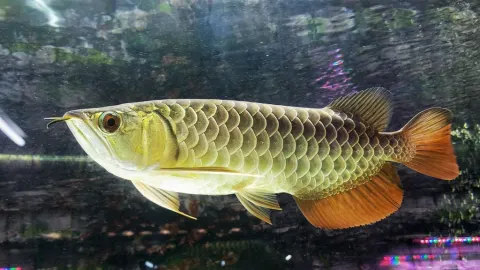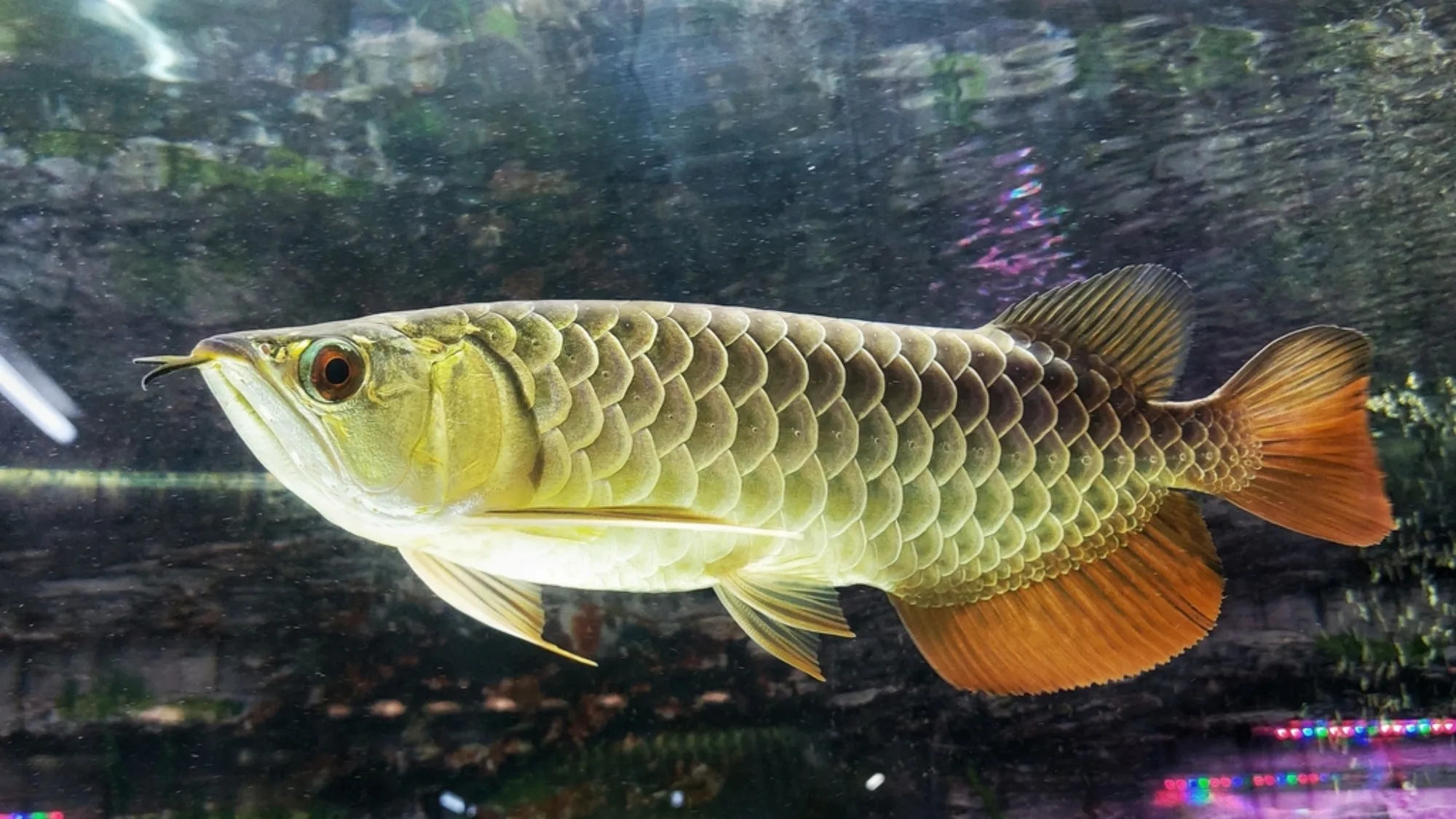
Asian Bonytongue
Scleropages formosus
Long-bodied and large-scaled, the Asian Bonytongue is a freshwater fish native to Southeast Asia. It can grow to 90 cm and has a wide mouth, a prominent lower jaw and two barbels at the tip. Its large scales form a mosaic pattern and, in some varieties, have a metallic colour. Colours vary by region: green fish have dark backs and silvery or golden-green sides, while mature red-tailed golden fish develop metallic gold scales and gill covers. Mature super reds have metallic red scales, gill covers and fin membranes, ranging from gold-tinged to deep red.
Look for these fish in blackwater rivers and other slow-moving waters among forested swamps and wetlands. The green variety has the widest distribution, occurring in places including Indonesia, Vietnam, Thailand and Malaysia. Red fish are known only from western Indonesian Borneo, in the upper reaches of the Kapuas River and lakes close to it. By day, Asian Bonytongues shelter among Pandanus roots or other structures; they feed at night and are usually seen alone or in small groups. Adults eat other fish, while young fish feed on insects. Females produce relatively few large eggs, and the male shelters both the fertilised eggs and larvae in his mouth.
Habitat loss is a major threat and is thought likely to be more serious than collection for aquariums. On the Malay Peninsula, environmental destruction has left the fish uncommon where it was once widespread. Aquarium collectors have also harvested it heavily, and the less common red and gold varieties are in particularly high demand.
Written from the English Wikipedia article Asian arowana (CC BY-SA 4.0).
- Records
- 1
- Countries
- 1
No atlas park has a record of the Asian Bonytongue in or around it yet.
These are open occurrence records, so they show where people looked for and recorded the Asian Bonytongue as much as where it lives. Cells are up to 25 km across, and every location is generalised to its cell.
Generalised encounter areas, not exact locations. Each shape is a grid cell coloured by how likely the species is there.
- Very likelySingapore25 km zone · medium confidence · 1 record · updated 80 days ago
Conservation status not assessed here yet, so every location is generalised to its grid cell.