Fox Squirrel
Sciurus niger
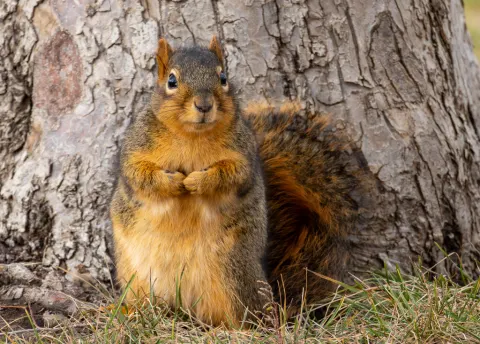
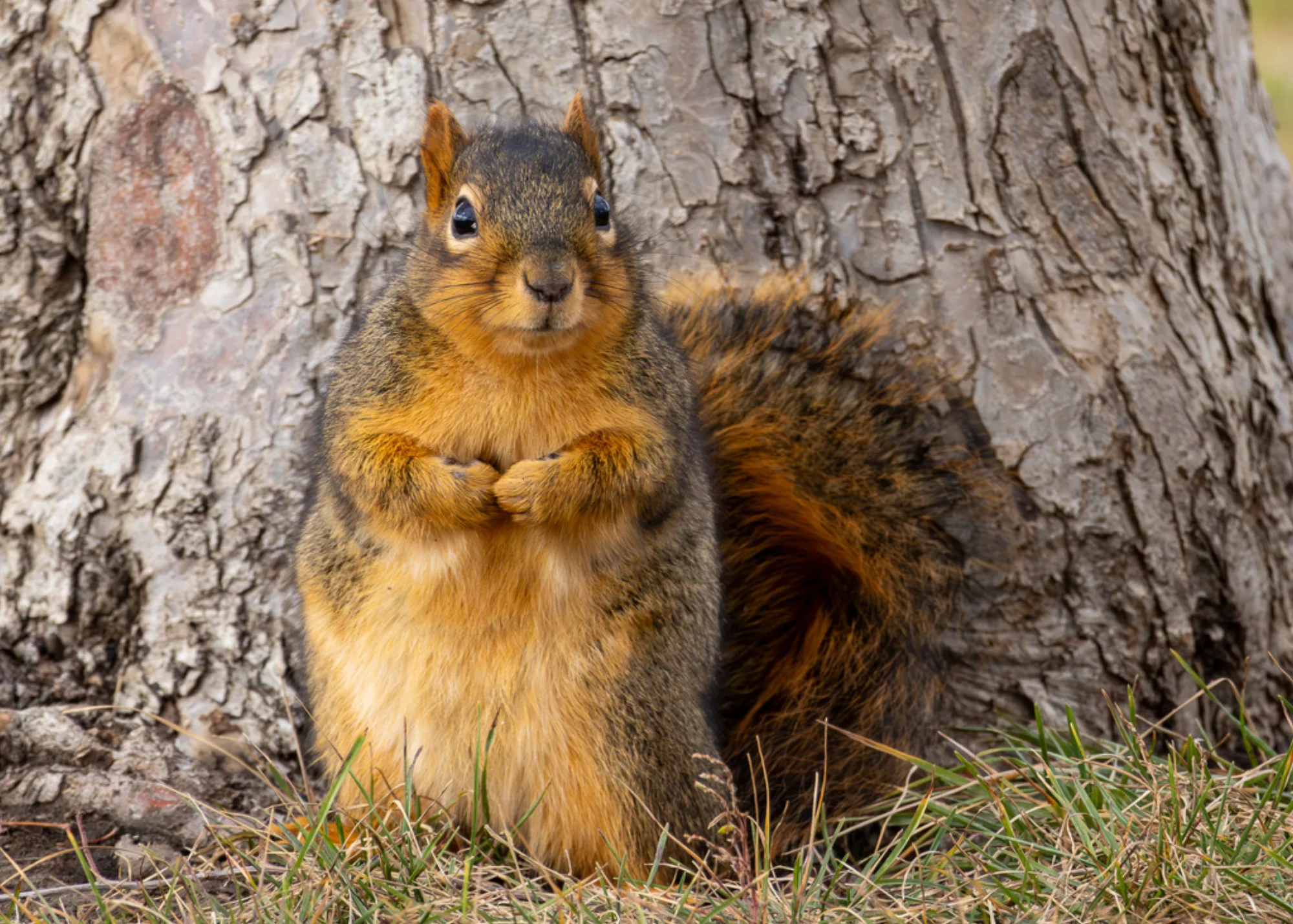
North America's largest native tree squirrel, the Fox Squirrel has a long tail and a coat that varies across its range. In most places it is brown-grey to brown-yellow above, with a brownish-orange underside. Some eastern animals are dark brown and black, with bands of white across their faces and tails, while some southern populations and others along the Missouri River have entirely black coats. Its total length is 50.8 to 76.2 cm.
Its natural range covers much of the eastern United States, reaching into the southern prairie provinces of Canada and northern Mexico. It has also been introduced to parts of the western United States and Canada. Look for it in open woodland, at forest edges or in tree-filled urban neighbourhoods. It favours areas with little undergrowth and often forages on the ground, sometimes several hundred metres from the nearest woodlot. Active during the day, it climbs with agility and spends more of its time on the ground than most tree squirrels do. Its varied diet includes nuts, tree buds, insects, fungi and bird eggs. It buries food for later, including acorns and other nuts.
Fox squirrels shelter in tree cavities or leaf nests, favouring cavities in winter and when raising young. Females normally have two litters a year, with most births in mid-March and July. The young are born blind and without fur, and may remain dependent until 16 weeks. Overhunting and the loss of mature forests threaten fox squirrels, while mange mites and severe winter weather also contribute to population declines. Young squirrels are especially vulnerable to climbing predators, including raccoons and snakes.
Written from the English Wikipedia article Fox squirrel (CC BY-SA 4.0).
- Records
- 11,693
- Countries
- 2
- Atlas places
- 1
These are open occurrence records, so they show where people looked for and recorded the Fox Squirrel as much as where it lives. Cells are up to 25 km across, and every location is generalised to its cell.
Generalised encounter areas, not exact locations. Each shape is a grid cell coloured by how likely the species is there.
- Very likelyUnited States25 km zone · medium confidence · 11654 records · updated 80 days ago
- Very likelyCanada25 km zone · medium confidence · 39 records · updated 80 days ago
Conservation status not assessed here yet, so every location is generalised to its grid cell.