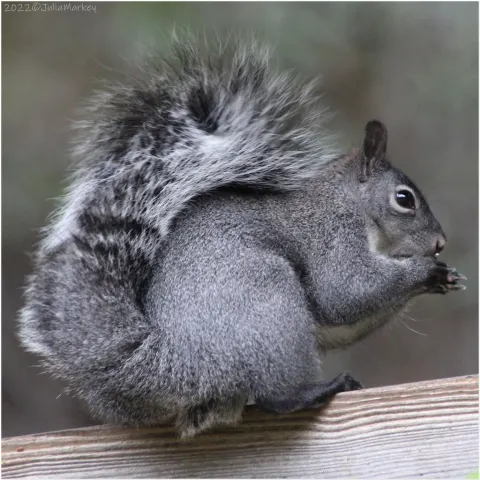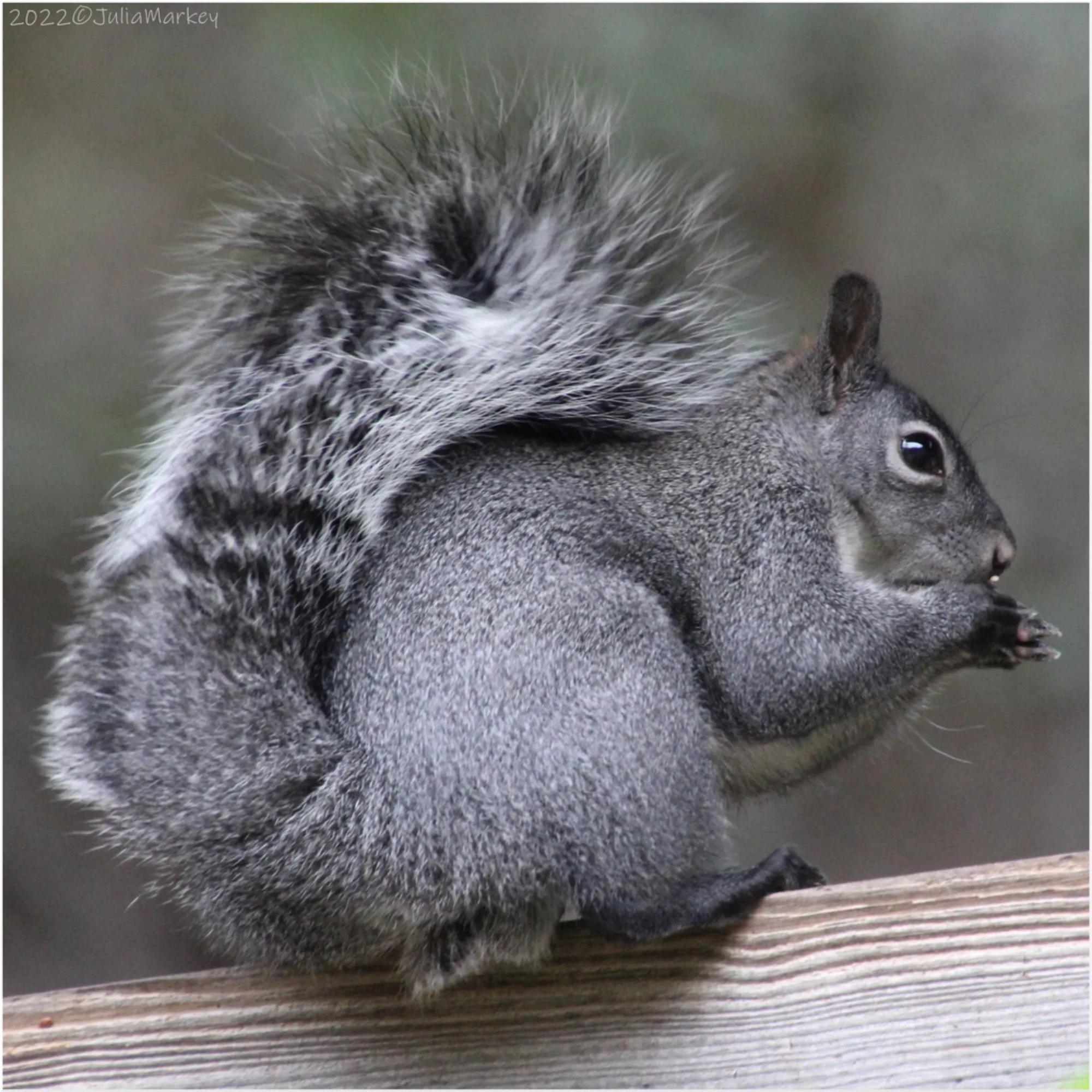
Western Gray Squirrel
Sciurus griseus
Look for solid grey fur across the back and sides of the Western Gray Squirrel, a tree squirrel found in Mexico and along the United States' western seaboard. Including its tail, it measures 43 to 61 centimetres and weighs about .35 to 1 kilogram. Shy when disturbed, it usually climbs a tree and calls with a hoarse chirp. An alarmed squirrel may also face the perceived threat, wave its tail and make repeated chucking sounds.
Western Gray Squirrels favour mixed conifer and hardwood forests, especially those with oaks, large seed-producing trees and connected canopies that offer escape routes. In Washington's Klickitat region, they occur among oak and conifer forests along streams; in southern California, they are generally found in mountains and surrounding foothill communities. They forage mainly on the ground, rarely straying far from trees or crossing open spaces. Active mostly during the day, they alternate between feeding or other activity and rest, and tend to stay near their nests in windy or stormy weather. Their food includes oak and conifer seeds, berries, nuts, bird eggs and fungi. In California, truffles and similar fungi make up over half their diet.
Females rear their young in covered stick nests or tree cavities, and may move them between nests. Litters contain one to six young, most of which leave the nest between March and August. Habitat loss and fragmentation, road deaths and disease threaten the squirrel. Urban development, wildfires, fire suppression and overgrazing have all contributed to habitat loss or degradation. Mite-caused mange can kill squirrels and cause population collapses, while expanding populations of other species also compete with them.
Written from the English Wikipedia article Western gray squirrel (CC BY-SA 4.0).
- Records
- 5,080
- Countries
- 2
- Atlas places
- 4
These are open occurrence records, so they show where people looked for and recorded the Western Gray Squirrel as much as where it lives. Cells are up to 25 km across, and every location is generalised to its cell.
Generalised encounter areas, not exact locations. Each shape is a grid cell coloured by how likely the species is there.
- Very likelyUnited States25 km zone · high confidence · 5078 records · updated 80 days ago
- PossibleMexico25 km zone · medium confidence · 2 records · updated 80 days ago
Conservation status not assessed here yet, so every location is generalised to its grid cell.