Fiery Squirrel
Sciurus flammifer
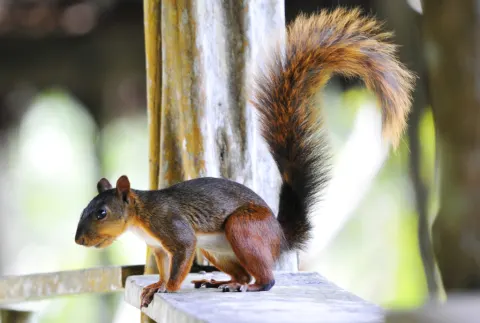
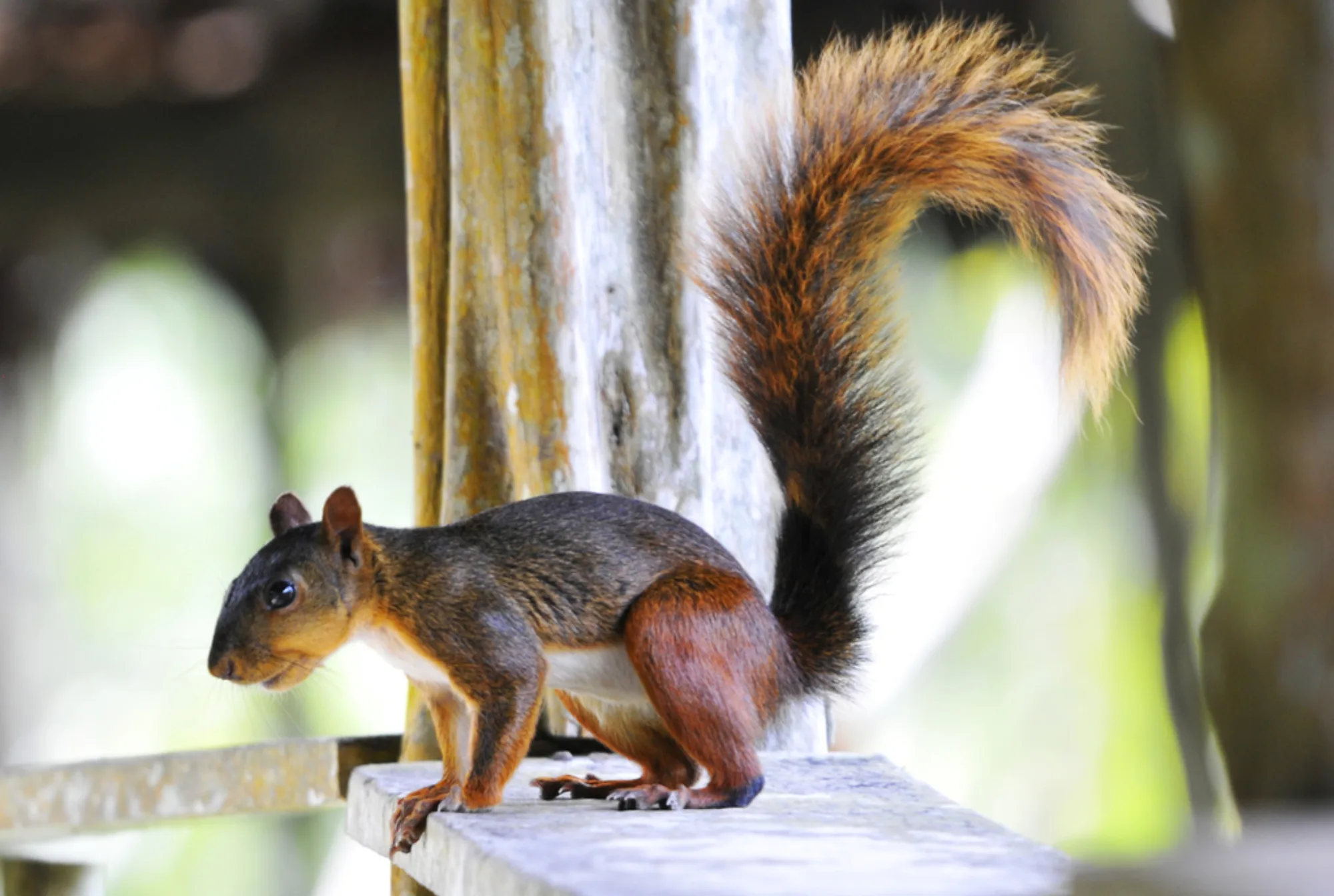
Travellers exploring the Bolivar state of Venezuela, specifically the regions south of the Orinoco River, may encounter the Fiery Squirrel. This large tree squirrel reaches lengths of 60 cm from its head to the tip of its tail. It is a striking rodent with a black back streaked with pale yellow or orange. Its limbs and tail are a bright orange, contrasting with a white belly. To identify it, look for the distinct patches of pale orange fur located behind its ears. While most individuals follow this pattern, some can be entirely black or show signs of partial albinism.
These squirrels prefer the dense environments of closed-canopy lowland rainforests. They are found in both untouched old-growth forests and secondary growth areas that have been disturbed. Because they are highly arboreal, they spend the majority of their time foraging high within the tree canopy, which can make them quite difficult for visitors to spot. They are active during the day and generally live alone, defending their own territory. When they are not moving between the ground and the canopy, they rest in large, spherical nests hidden away in the trees.
The diet of the Fiery Squirrel consists primarily of large nuts from the Attalea palm, along with various other tree nuts, fruits, and beetle grubs. Their range is somewhat restricted, covering areas from the Colombian border to the Brazilian and Guyana borders, including the upper Orinoco drainage. Although their specific habits are not fully documented, they face significant threats from the loss of their habitat. Specifically, the clearing of forests through deforestation is a major concern for the future of this species within its limited geographical range.
Written from the English Wikipedia article Fiery squirrel (CC BY-SA 4.0).
- Atlas places
- 0
These are open occurrence records, so they show where people looked for and recorded the Fiery Squirrel as much as where it lives. Cells are up to 25 km across, and every location is generalised to its cell.
No encounter zones yet
Where and when you can expect to see Fiery Squirrel is calculated from observation density. No zones have been computed for this species yet.
Conservation status not assessed here yet, so every location is generalised to its grid cell.