Eastern Gray Squirrel
Sciurus carolinensis
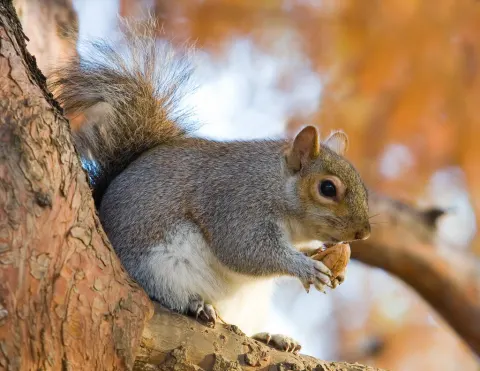
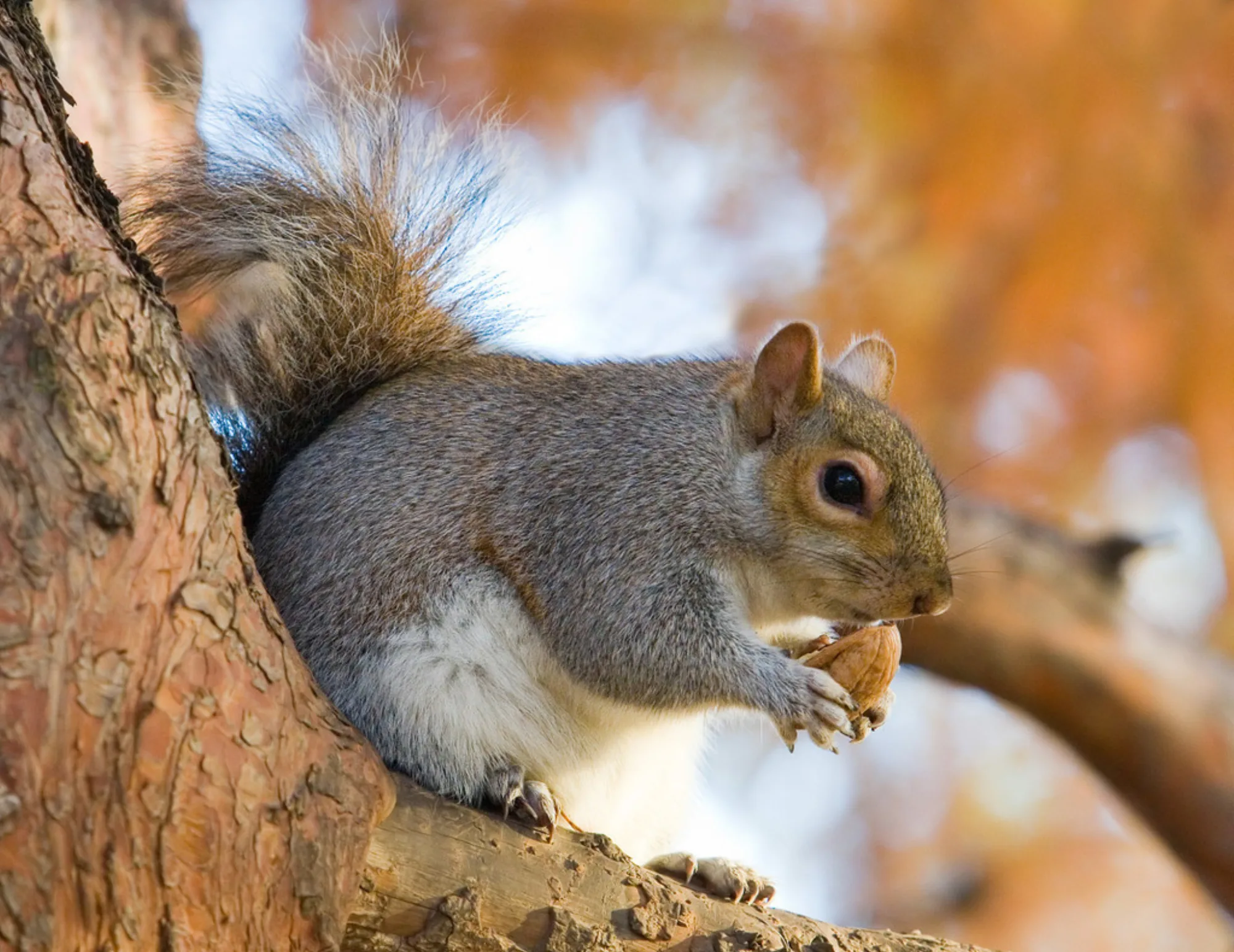
A bushy tail and a pale underside help distinguish the Eastern Gray Squirrel, a tree squirrel whose mostly grey coat has brown spots and streaks. Some individuals are black or white, colours often seen in urban areas. Its head and body measure 23 to 30 cm, with a tail of 19 to 25 cm.
Native to eastern North America, it ranges from parts of Canada south to East Texas and Florida. It favours mature, dense woodland, especially oak and hickory forests, but also lives in parks, gardens and farmland near people. Introduced populations occur in parts of western North America, Britain, Ireland, Italy and South Africa. In Britain it has largely displaced the native red squirrel.
Active during the day or around twilight, depending on the season, it avoids the midday heat in summer and does not hibernate. It can climb down a tree head first and shelters in hollow trees or rounded nests made mainly of dry leaves and twigs. Its varied diet includes seeds, nuts, berries, fungi, insects, eggs and small animals. It buries food in many small caches, using landmarks and smell to find it again. Females can have two litters a year, though younger mothers normally have one in spring. A litter usually contains one to four young, which begin leaving the nest after 12 weeks. Hawks, owls and snakes are among its main predators, while disease and parasites can also kill squirrels. Human hunting and deforestation caused steep declines in the midwestern United States in the past, and programmes in parts of Britain aim to eradicate grey squirrels to help red squirrels recover.
Written from the English Wikipedia article Eastern gray squirrel (CC BY-SA 4.0).
- Records
- 167,872
- Countries
- 4
No atlas park has a record of the Eastern Gray Squirrel in or around it yet.
These are open occurrence records, so they show where people looked for and recorded the Eastern Gray Squirrel as much as where it lives. Cells are up to 25 km across, and every location is generalised to its cell.
Generalised encounter areas, not exact locations. Each shape is a grid cell coloured by how likely the species is there.
- Very likelyUnited Kingdom25 km zone · high confidence · 152381 records · updated 80 days ago
- Very likelyUnited States25 km zone · high confidence · 11943 records · updated 80 days ago
- Very likelyCanada25 km zone · high confidence · 2789 records · updated 80 days ago
- Very likelyIreland25 km zone · high confidence · 759 records · updated 80 days ago
Conservation status not assessed here yet, so every location is generalised to its grid cell.