Abert's Squirrel
Sciurus aberti
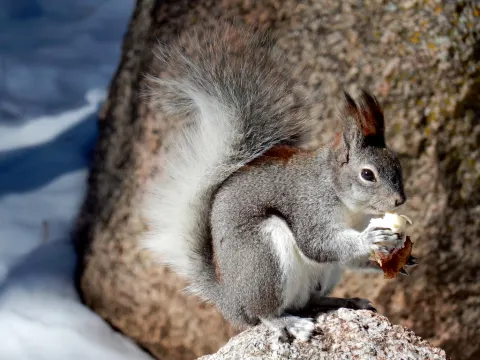
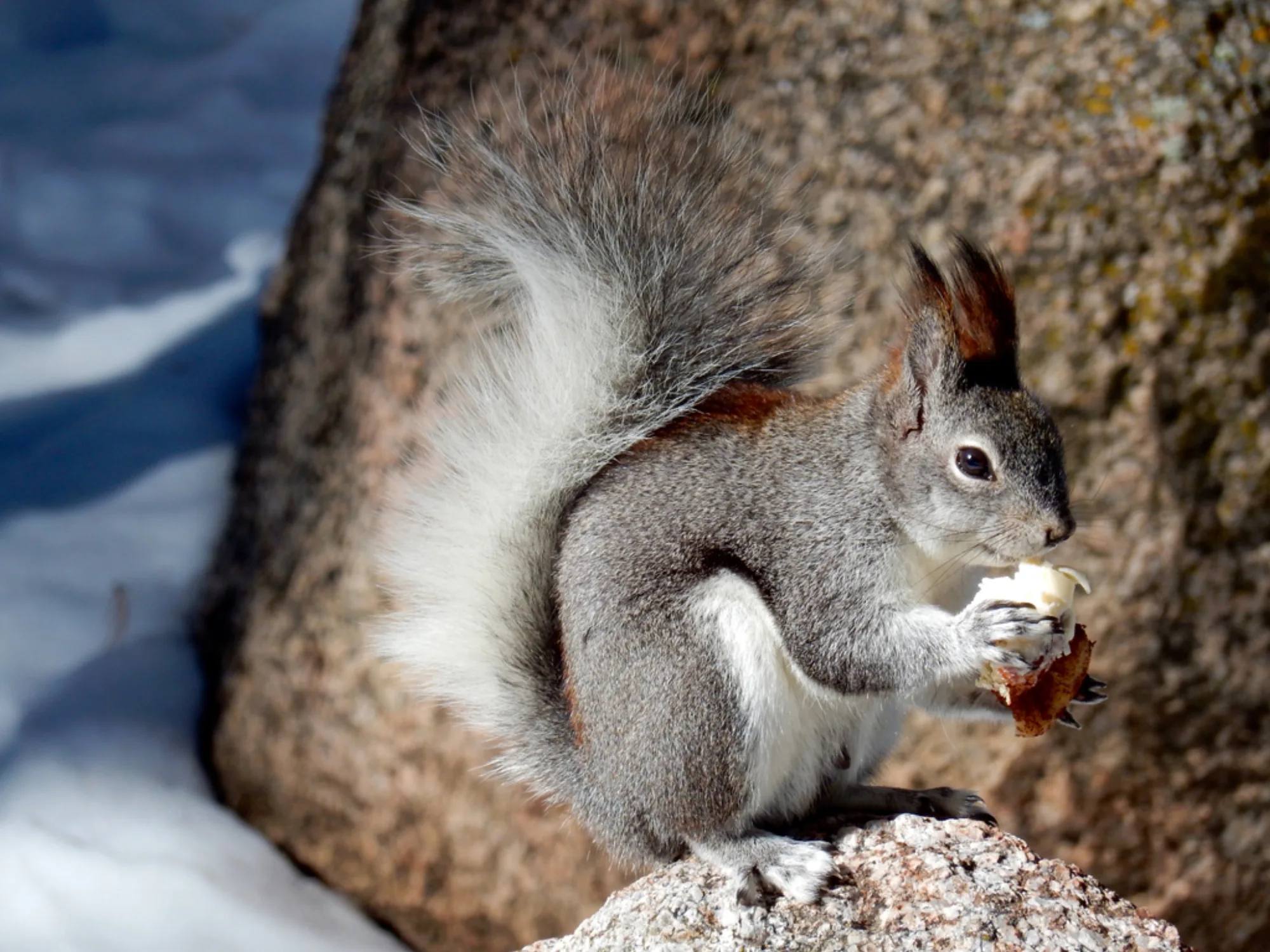
Long ear tufts give the Abert's Squirrel its other name, the tassel-eared squirrel. This tree squirrel is 46 to 58 cm long, including a tail of 19 to 25 cm. Most populations have grey coats, reddish stripes down their backs, dark stripes along their sides and white bellies. Colour varies across the range: some squirrels are entirely black, while those on Arizona's Kaibab Plateau have black underparts and white tails.
Its range stretches across the Colorado Plateau and southern Rocky Mountains, reaching Wyoming in the north and Chihuahua and Durango in Mexico to the south. It is closely tied to mature ponderosa pine forests, favouring dense growth and closed canopies that offer food and shelter from predators. Where Mexico has no ponderosa pines, it lives among a close relative, Pinus arizonica. Look for it during daylight: it may be active before sunrise, feeds at intervals through the day and usually returns to shelter before sunset.
Ponderosa pine provides food throughout the year, from seeds and buds to inner bark. The squirrel also eats fungi and carrion, and favours Mexican pinyon seeds where they are available. It does not store food. Females build roughly spherical nests from pine twigs, usually high in the tree crown, and generally raise one litter a year. A typical litter contains three or four young. Food shortages and injuries, including broken teeth, can cause death, and hawks prey on the squirrels in central Arizona. Logging has removed much of their habitat in Mexico.
Written from the English Wikipedia article Abert's squirrel (CC BY-SA 4.0).
- Records
- 434
- Countries
- 2
- Atlas places
- 2
These are open occurrence records, so they show where people looked for and recorded the Abert's Squirrel as much as where it lives. Cells are up to 25 km across, and every location is generalised to its cell.
Generalised encounter areas, not exact locations. Each shape is a grid cell coloured by how likely the species is there.
- Very likelyUnited States25 km zone · medium confidence · 414 records · updated 80 days ago
- LikelyMexico25 km zone · medium confidence · 20 records · updated 80 days ago
Conservation status not assessed here yet, so every location is generalised to its grid cell.