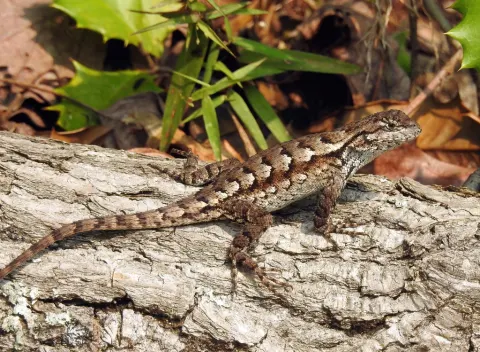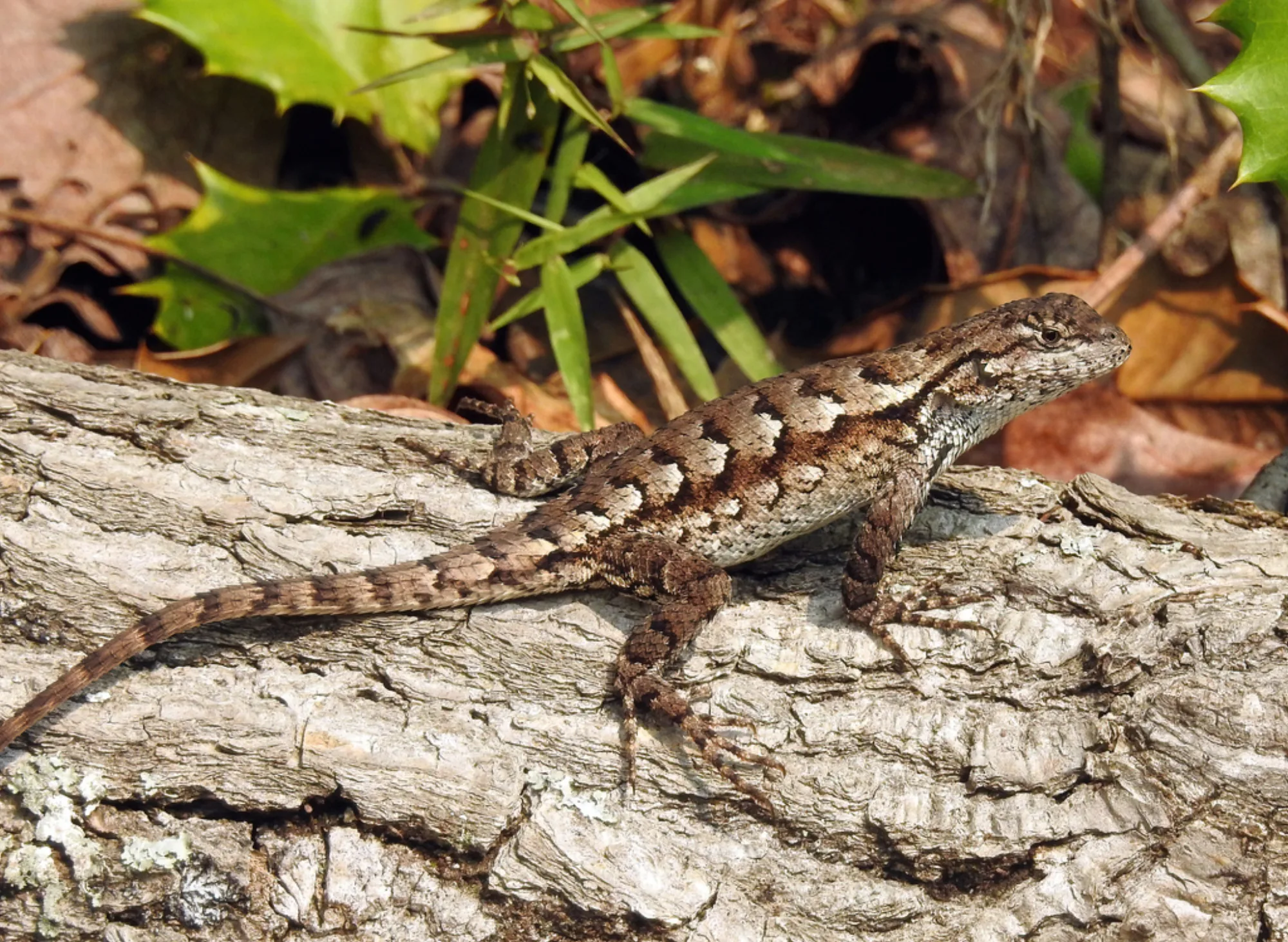
Eastern Fence Lizard
Sceloporus undulatus
Look for the Eastern Fence Lizard on a sunlit stump, rock pile or fence post in the eastern United States. This medium-sized lizard is usually grey or brown and measures 10 to 19 cm from head to tail. Females are generally grey, with dark, wavy markings across the back, while males are usually brown. In summer, males show more greenish-blue and black than females around the throat and along the belly's sides. Young lizards resemble females but are darker and duller.
The species favours open woodland and forest edges, especially sparsely wooded places with plenty of sun, including pine barrens with sandy or loose soil. Adults and juveniles prefer places with plenty of rocks and coarse woody debris. Before the ground has fully warmed, these lizards are at their busiest in the early sunshine; they shelter beneath logs, rocks or woodpiles when it becomes too hot and at night. In early spring, males establish territories and perform push-ups that flash their blue scales to deter rivals. Fence lizards wait in ambush for arthropods, including ants and grasshoppers, and generally forage twice a day. Females lay eggs in a rotting log or another damp place and leave them without further care. The eggs hatch after approximately ten weeks, with young emerging near the end of summer.
Invasive red imported fire ants threaten the lizards with venomous bites, compete for nesting habitat and prey on their eggs. A lizard under attack may twitch to dislodge the ants before fleeing; encounters can be lethal.
Written from the English Wikipedia article Eastern fence lizard (CC BY-SA 4.0).
- Records
- 3,080
- Countries
- 2
- Atlas places
- 3
These are open occurrence records, so they show where people looked for and recorded the Eastern Fence Lizard as much as where it lives. Cells are up to 25 km across, and every location is generalised to its cell.
Generalised encounter areas, not exact locations. Each shape is a grid cell coloured by how likely the species is there.
- Very likelyUnited States25 km zone · medium confidence · 2409 records · updated 80 days ago
- Very likelyMexico25 km zone · medium confidence · 671 records · updated 80 days ago
Conservation status not assessed here yet, so every location is generalised to its grid cell.