Western Fence Lizard
Sceloporus occidentalis
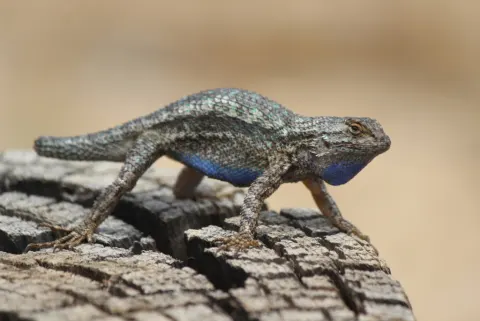
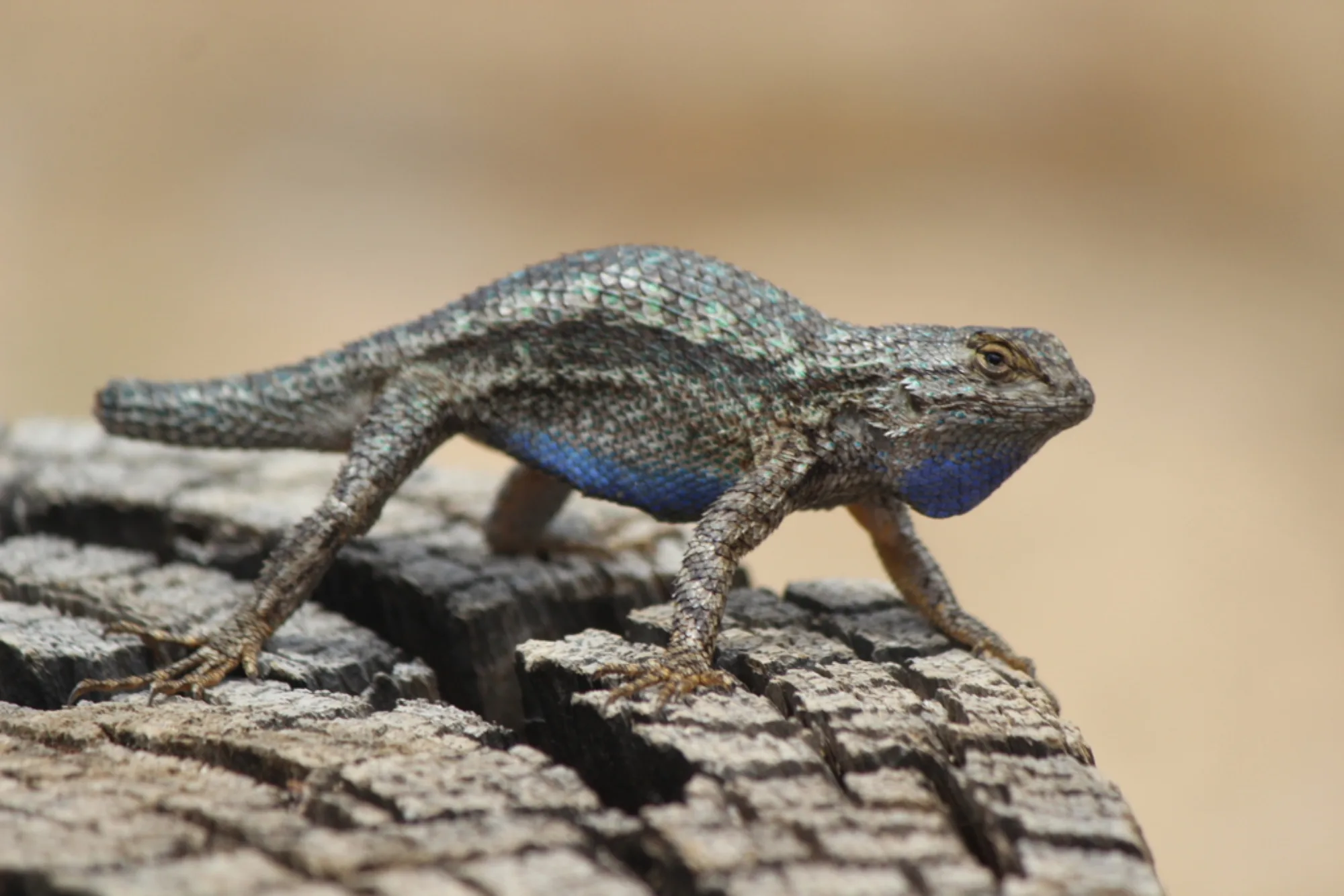
Often spotted on a fence or in a yard, the Western Fence Lizard is a familiar sight across much of its native range. Adults have distinctive blue bellies, earning them the name blue-belly, while females and young have fainter colouring or none at all. Their backs are brown to black, sometimes sandy or greenish, with black stripes, and the undersides of their legs are yellow. Males also have blue throat patches, and some have bright turquoise spots on their backs. The lizard reaches about 21 centimetres in total length.
California lies at the heart of its range, which extends into several other western US states, New Mexico and northern Mexico. It also lives on some islands off California and Baja California. Look for it in grassland, sagebrush, woodland, coniferous forest and farmland, often near water. It generally avoids harsh desert, and in California it is absent from densely forested places. Active mainly by day, it basks on paths, rocks and fence posts, changing from light grey or tan to nearly black as it regulates its temperature. In winter it enters a dormant period, with the timing of its emergence depending on the climate.
Insects make up the main part of its diet, though it also eats spiders and other small ground-dwelling invertebrates. During the breeding season, males defend a home area and display to females and rivals with push-ups. Females dig nests at night beneath a flat surface, laying one to three clutches between April and July. After about 60 days, the young emerge from their eggs. Urbanisation causes habitat loss and changes the surfaces the lizards use; snakes and predatory birds also eat them.
Written from the English Wikipedia article Western fence lizard (CC BY-SA 4.0).
- Records
- 14,946
- Countries
- 2
- Atlas places
- 4
These are open occurrence records, so they show where people looked for and recorded the Western Fence Lizard as much as where it lives. Cells are up to 25 km across, and every location is generalised to its cell.
Generalised encounter areas, not exact locations. Each shape is a grid cell coloured by how likely the species is there.
- Very likelyUnited States25 km zone · high confidence · 14890 records · updated 80 days ago
- LikelyMexico25 km zone · medium confidence · 56 records · updated 80 days ago
Conservation status not assessed here yet, so every location is generalised to its grid cell.