Eastern Phoebe
Sayornis phoebe
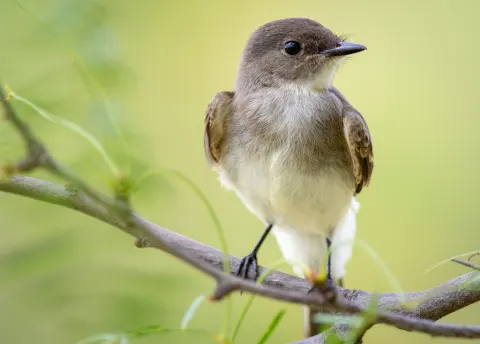
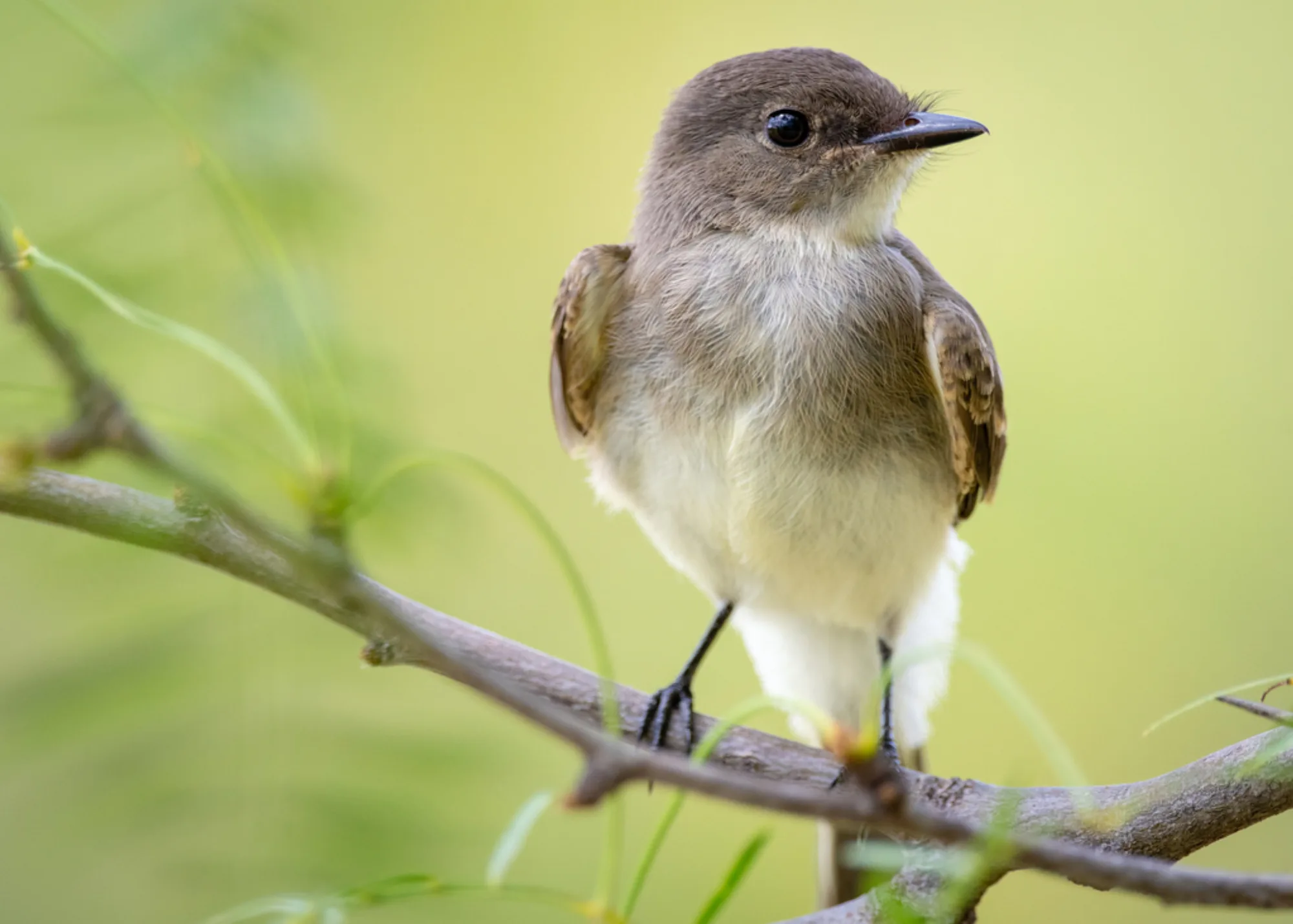
Watch for an Eastern Phoebe perched on a branch, pumping its tail up and down. This small bird has a large-headed appearance, grey-brown upperparts, a white throat and a grey breast. Its buff-tinged underparts become whiter in the breeding season, and its bill is entirely dark. A sharp chip is its call, while its song sounds like fee-bee. The similar eastern wood pewee has more clearly defined wing bars and does not habitually bob its tail.
Eastern Phoebes breed across eastern North America, apart from the southeastern coastal United States, and migrate south for winter to Central America and the southernmost parts of the United States. They use open woodland, farmland and suburbs for breeding, often close to water. Wooded streamsides are favoured, and the birds often choose shelter beneath trees, in brush or under overhangs. Around migration and during breeding, they can also be seen at woodland edges and in other places with plenty of water. They are adaptable to urban surroundings and often place their nests on bridges or buildings.
A phoebe often chooses a conspicuous perch from which to look for food. In summer it eats mostly insects, including small wasps, bees, beetles, flies, bugs and grasshoppers; spiders, ticks and millipedes are also on the menu. Fruit and berries become frequent foods in cooler months. Nesting can begin in early April, with an open cup of mud lined with moss and grass placed in a rock crevice or human-made site. The female lays two to six eggs, both parents feed the young, and two broods are usually raised each year. Brown-headed cowbirds occasionally lay their eggs in phoebe nests as nest parasites.
Written from the English Wikipedia article Eastern phoebe (CC BY-SA 4.0).
- Records
- 2,304,608
- Countries
- 3
- Atlas places
- 4
These are open occurrence records, so they show where people looked for and recorded the Eastern Phoebe as much as where it lives. Cells are up to 25 km across, and every location is generalised to its cell.
Generalised encounter areas, not exact locations. Each shape is a grid cell coloured by how likely the species is there.
- Very likelyUnited States25 km zone · high confidence · 2113560 records · updated 80 days ago
- Very likelyCanada25 km zone · high confidence · 169780 records · updated 80 days ago
- Very likelyMexico25 km zone · high confidence · 21268 records · updated 80 days ago
Conservation status not assessed here yet, so every location is generalised to its grid cell.