European Stonechat
Saxicola rubicola
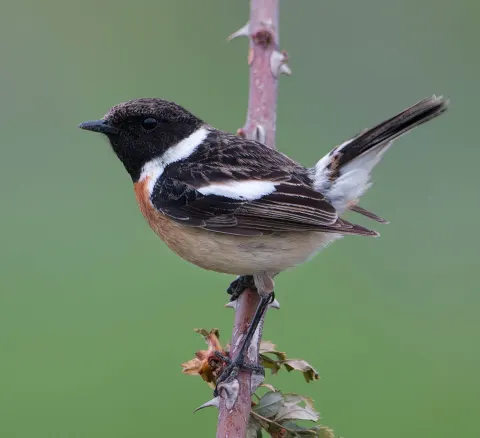
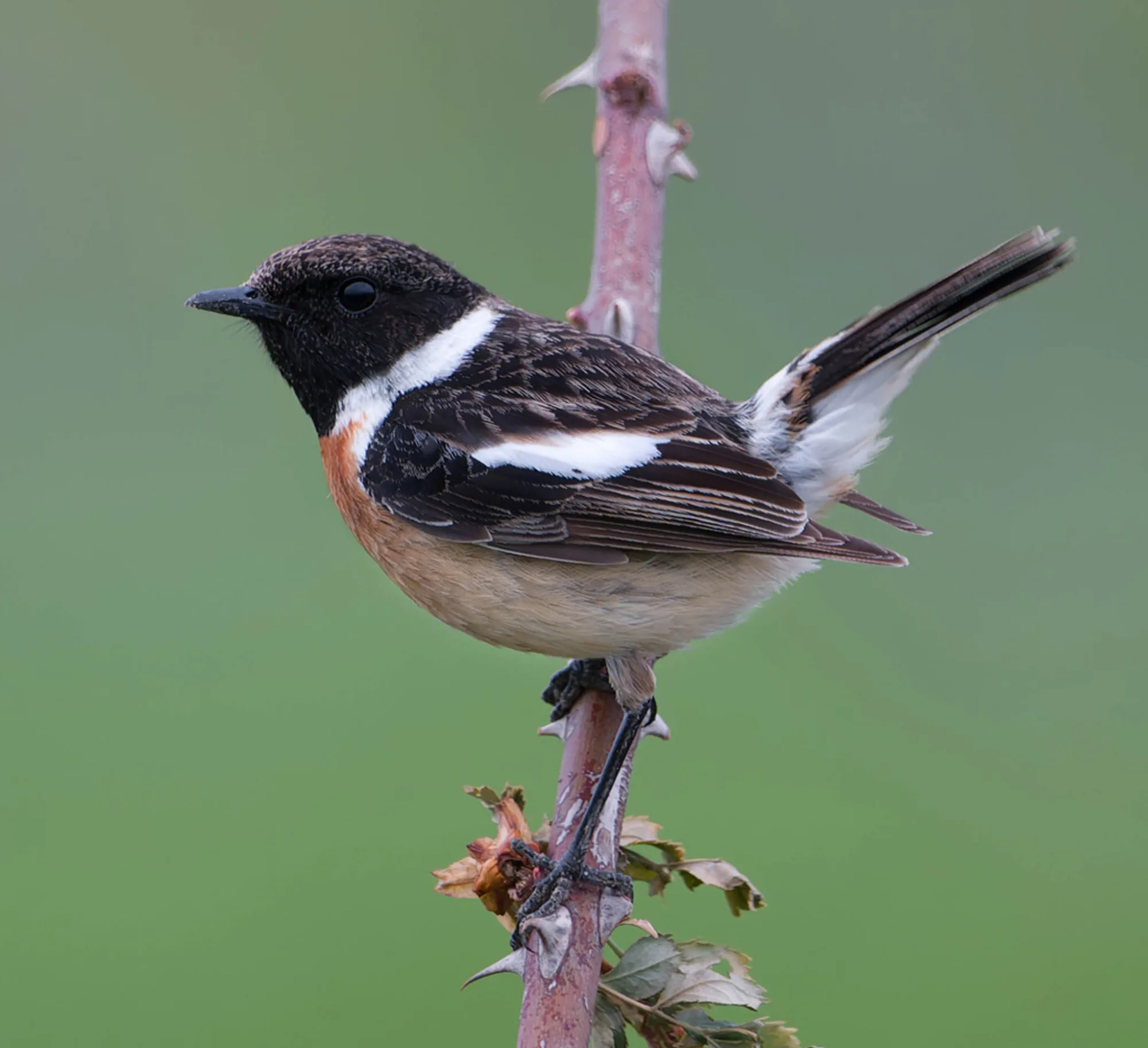
A call like two stones knocking together gives the European Stonechat its name. This small bird measures 11.5 to 13 cm in length and weighs 13 to 17 g, making it slightly smaller than a European robin. In summer, the male has black upperparts and a black head, with orange across his throat and breast above a white belly. White markings on the sides of his neck and a small white patch on each wing add to the pattern. The female has a brown head and upperparts, with dark streaks on paler brown where the male has white on his neck and belly. Her wing patch can be buffy-white. Both sexes have short wings and make the clicking call, while the male sings a high, twittering song.
Look for stonechats across Europe, reaching the South Caucasus and Ukraine in the east, as well as parts of North Africa. Their breeding habitats include coastal dunes, heathland and rough grassland dotted with small shrubs, bramble, open gorse, tussocks or heather. Some stay within their range year-round, while others move south for winter, including birds from the colder northeastern parts of the range. The female builds a loose cup of dried grass close to the ground, concealed in dense vegetation and lined with hair and feathers. A typical clutch contains 4 to 6 pale blue to greenish-blue eggs, marked with red-brown freckles. The female incubates them for 13 to 14 days, and both parents feed the chicks. Young birds fledge between 12 and 16 days after hatching, then receive more food from both parents. A pair raises two or three broods in a season.
Written from the English Wikipedia article European stonechat (CC BY-SA 4.0).
- Records
- 580,279
- Countries
- 72
No atlas park has a record of the European Stonechat in or around it yet.
These are open occurrence records, so they show where people looked for and recorded the European Stonechat as much as where it lives. Cells are up to 25 km across, and every location is generalised to its cell.
Generalised encounter areas, not exact locations. Each shape is a grid cell coloured by how likely the species is there.
- Very likelySpain25 km zone · high confidence · 173488 records · updated 86 days ago
- Very likelyPortugal25 km zone · high confidence · 115287 records · updated 86 days ago
- Very likelyUnited Kingdom25 km zone · high confidence · 89407 records · updated 86 days ago
- Very likelyBelgium25 km zone · high confidence · 61343 records · updated 86 days ago
- Very likelyFrance25 km zone · high confidence · 28392 records · updated 86 days ago
- Very likelyIsrael25 km zone · high confidence · 22884 records · updated 86 days ago
- Very likelyNetherlands25 km zone · high confidence · 15490 records · updated 86 days ago
- Very likelyNorway25 km zone · high confidence · 7765 records · updated 86 days ago
- Very likelyPalestinian Territories25 km zone · high confidence · 6591 records · updated 86 days ago
- Very likelyGermany25 km zone · high confidence · 5860 records · updated 86 days ago
Conservation status not assessed here yet, so every location is generalised to its grid cell.