Salema
Sarpa salpa
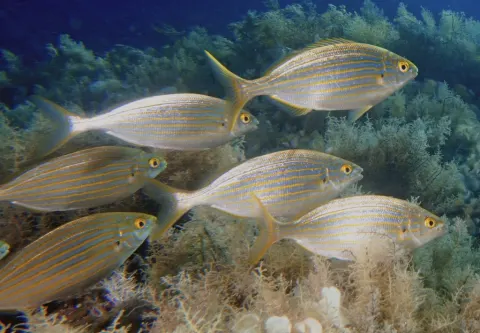
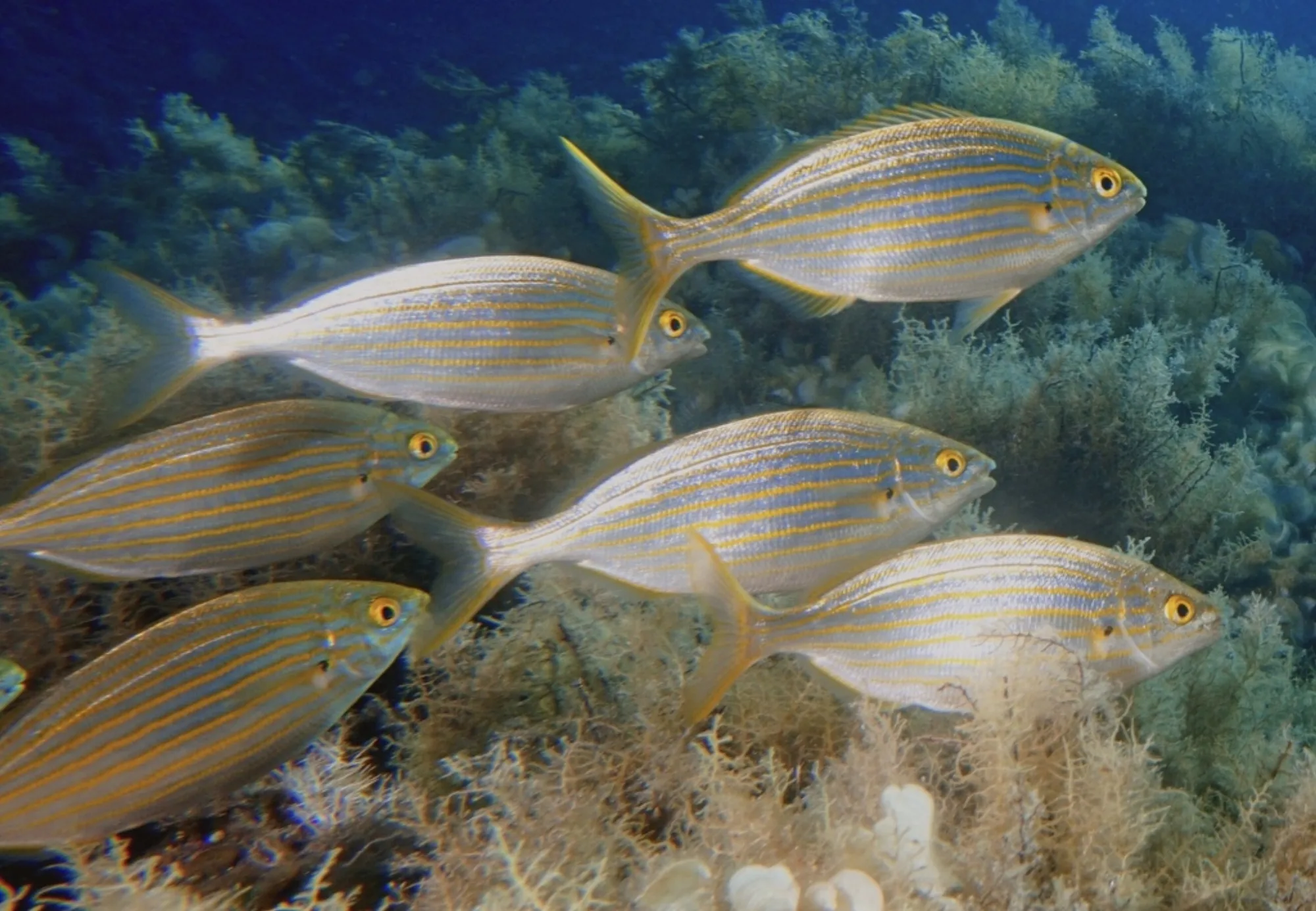
Silver sides marked with 8 to 10 horizontal golden lines make the Salema easy to recognise; a dark spot marks where each pectoral fin meets the body. Its body is moderately slender and oval, and the largest recorded size given is 51 cm. Males are typically 15 to 30 cm long, while females usually measure 31 to 45 cm.
This marine fish lives in the eastern Atlantic, ranging south from the Bay of Biscay as far as South Africa, and in the Mediterranean. It has also turned up occasionally as far north as Great Britain. It occurs from near the surface down to 70 m, and is generally common. Salema feed largely on plants, although their diet changes with age and place. In a Libyan study, seagrass made up the largest part of the diet, followed by algae and then crustaceans. Off Corsica, adults mainly ate the seagrass Posidonia oceanica and organisms growing on it, while juveniles ate plankton. In Portugal, a large population had overgrazed seagrass by 2014.
Breeding seasons vary across its range: off South Africa, spawning takes place from April to September, while in the Canary Islands it runs from September to March. Each year, South African fish migrate from nursery grounds in the Eastern and Western Cape towards KwaZulu-Natal. The Salema's plant diet, modest size and living areas make it relatively little exposed to fishing with nets or harpoons. In the Mediterranean, it has tended to accumulate toxins produced by the introduced alga Caulerpa taxifolia.
Written from the English Wikipedia article Salema porgy (CC BY-SA 4.0).
- Records
- 7,225
- Countries
- 17
- Atlas places
- 3
These are open occurrence records, so they show where people looked for and recorded the Salema as much as where it lives. Cells are up to 25 km across, and every location is generalised to its cell.
Generalised encounter areas, not exact locations. Each shape is a grid cell coloured by how likely the species is there.
- Very likelyFrance25 km zone · high confidence · 4005 records · updated 80 days ago
- Very likelySpain25 km zone · high confidence · 1348 records · updated 80 days ago
- Very likelyItaly25 km zone · medium confidence · 513 records · updated 80 days ago
- Very likelyPortugal25 km zone · high confidence · 440 records · updated 80 days ago
- Very likelyMalta25 km zone · high confidence · 304 records · updated 80 days ago
- Very likelyCroatia25 km zone · medium confidence · 282 records · updated 80 days ago
- Very likelyGreece25 km zone · medium confidence · 139 records · updated 80 days ago
- Very likelySouth Africa25 km zone · medium confidence · 117 records · updated 80 days ago
- Very likelyMontenegro25 km zone · medium confidence · 29 records · updated 80 days ago
- LikelyMozambique25 km zone · medium confidence · 16 records · updated 80 days ago
Conservation status not assessed here yet, so every location is generalised to its grid cell.