Pilchard
Sardina pilchardus
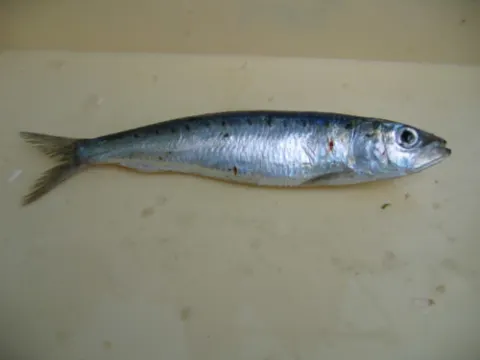
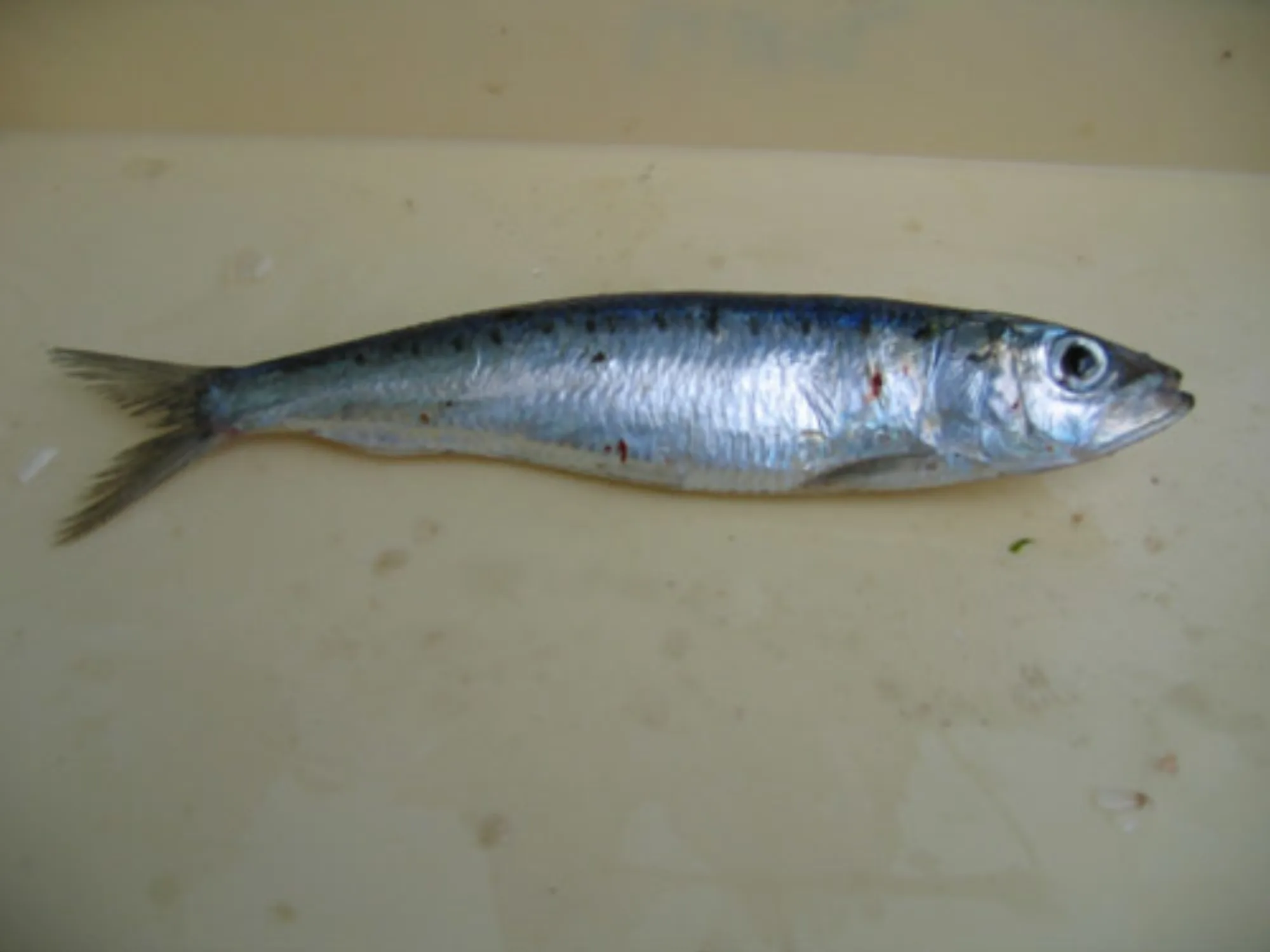
Small, elongated and herring-like, the Pilchard has green or olive upper parts, golden sides and a silvery belly. It usually measures 15 to 25 cm, although it can reach 27.5 cm. Its scales are arranged irregularly, and it lacks a row of dark blotches along its sides. Young fish are among those commonly called sardines.
Pilchards travel in schools and migrate through the northeastern Atlantic, the Mediterranean and the Black Sea. Their range runs from Iceland and southern Norway and Sweden to Senegal in West Africa. They are largely coastal, though they sometimes venture 100 km out to sea. In daylight they mostly stay 25 to 55 m deep, while at night they generally move to between 10 and 35 m below the surface. In the Mediterranean, they head offshore in autumn, favouring deeper, cooler water with more constant salinity than inshore waters.
Their food includes both animal and plant plankton, with copepods and their larvae making up much of the animal portion. Adults feed on these small animals near the surface at night, while juveniles also feed during the day. Spawning begins in winter in open water, and females produce several batches of eggs over a long breeding period. Larvae, juveniles and some adults head inshore in early spring, with other adults making the journey later in the year. Important fisheries operate across much of the Pilchard's range, and fishing has heavily affected it in the Mediterranean. Its biomass has declined, possibly because fishing pressure and unfavourable environmental conditions have reduced the number of older fish.
Written from the English Wikipedia article European pilchard (CC BY-SA 4.0).
- Records
- 3,416
- Countries
- 13
- Atlas places
- 1
These are open occurrence records, so they show where people looked for and recorded the Pilchard as much as where it lives. Cells are up to 25 km across, and every location is generalised to its cell.
Generalised encounter areas, not exact locations. Each shape is a grid cell coloured by how likely the species is there.
- Very likelyNetherlands25 km zone · medium confidence · 843 records · updated 80 days ago
- Very likelyDenmark25 km zone · medium confidence · 765 records · updated 80 days ago
- Very likelyBelgium25 km zone · high confidence · 406 records · updated 80 days ago
- Very likelyFrance25 km zone · medium confidence · 403 records · updated 80 days ago
- Very likelyGermany25 km zone · medium confidence · 307 records · updated 80 days ago
- Very likelyUnited Kingdom25 km zone · medium confidence · 247 records · updated 80 days ago
- Very likelyCroatia25 km zone · high confidence · 143 records · updated 80 days ago
- Very likelyNorway25 km zone · medium confidence · 129 records · updated 80 days ago
- Very likelySweden25 km zone · medium confidence · 113 records · updated 80 days ago
- LikelySpain25 km zone · medium confidence · 29 records · updated 80 days ago
Conservation status not assessed here yet, so every location is generalised to its grid cell.