Guianan Brown Capuchin
Sapajus apella
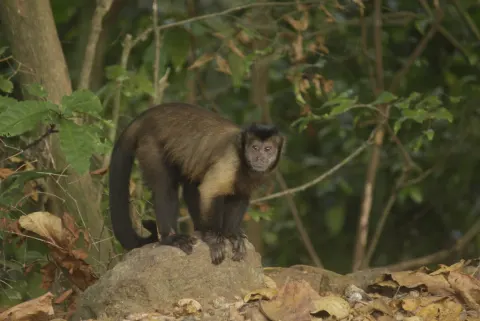
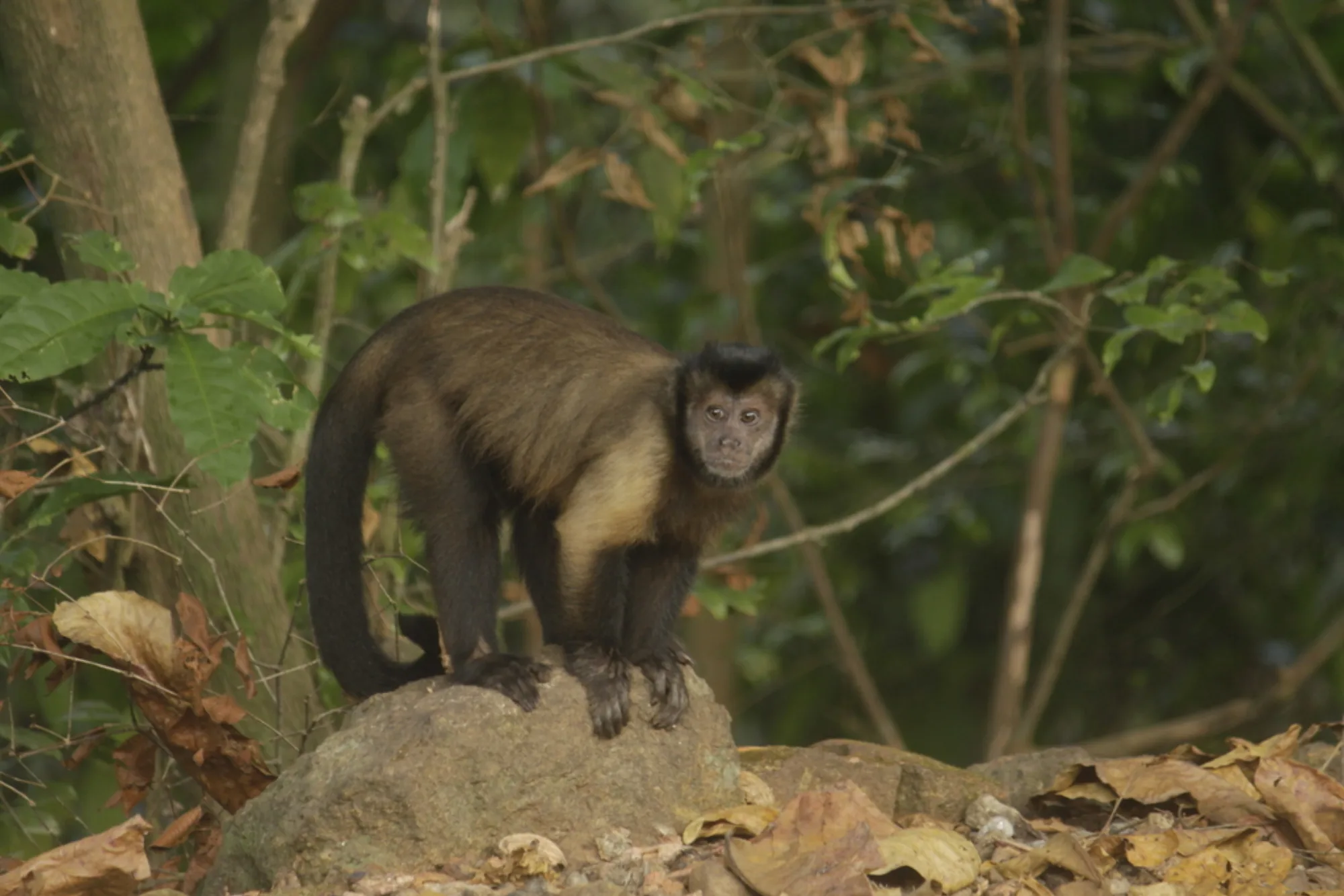
A sturdy South American primate, the Guianan Brown Capuchin has rough, brownish-grey fur, a somewhat paler belly and black hands and feet. Its long, thick tail can grasp branches, while a bundle of long, stiff hair on its forehead can be raised like a wig. Males are generally larger and heavier than females, and head and body length ranges from 32 to 57 centimetres.
In the northern Amazon, it ranges through rainforest in the Guyanas, Venezuela and Brazil, and also occurs in eastern Colombia, Ecuador, Bolivia and Peru. An introduced breeding population is established on Trinidad's northwestern peninsula. It occupies a variety of forests, chiefly tropical rainforest, but also more open, dry, disturbed and secondary forest. Active by day and at home in the trees, it also searches for food on the ground and walks between trees too far apart to jump.
Capuchins forage in groups, and an animal that finds food may whistle to alert the others. They eat fruit and invertebrates, along with foods ranging from leaves and seeds to frogs, lizards and young birds. Some use stones to crack nuts, and young capuchins have been observed watching the most skilled nut crackers. A group may contain several males, with one dominant male; when food is scarce, he and those close to him eat before subordinate monkeys. After 180 days of pregnancy, a female usually gives birth to one young, which she carries on her back and feeds for 9 months. Large birds of prey are important natural enemies, and capuchins may even sound an alarm when a harmless bird flies overhead.
Written from the English Wikipedia article Tufted capuchin (CC BY-SA 4.0).
- Records
- 2,516
- Countries
- 11
- Atlas places
- 6
These are open occurrence records, so they show where people looked for and recorded the Guianan Brown Capuchin as much as where it lives. Cells are up to 25 km across, and every location is generalised to its cell.
Generalised encounter areas, not exact locations. Each shape is a grid cell coloured by how likely the species is there.
- Very likelyFrench Guiana25 km zone · high confidence · 2236 records · updated 86 days ago
- Very likelyArgentina25 km zone · high confidence · 86 records · updated 86 days ago
- LikelyPeru25 km zone · medium confidence · 102 records · updated 86 days ago
- LikelyBolivia25 km zone · medium confidence · 27 records · updated 86 days ago
- LikelyBrazil25 km zone · medium confidence · 25 records · updated 86 days ago
- LikelyColombia25 km zone · medium confidence · 18 records · updated 86 days ago
- LikelySuriname25 km zone · medium confidence · 13 records · updated 86 days ago
- PossibleGuyana25 km zone · medium confidence · 3 records · updated 86 days ago
- PossiblePoland25 km zone · medium confidence · 3 records · updated 86 days ago
- PossibleTrinidad & Tobago25 km zone · medium confidence · 3 records · updated 86 days ago
Conservation status not assessed here yet, so every location is generalised to its grid cell.