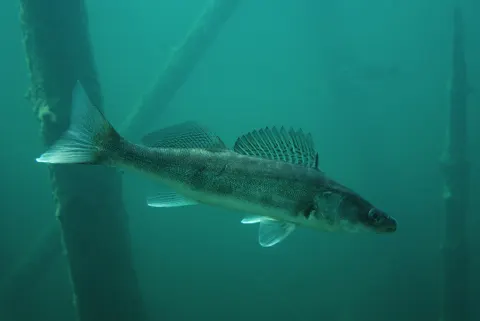
Pikeperch
Sander lucioperca
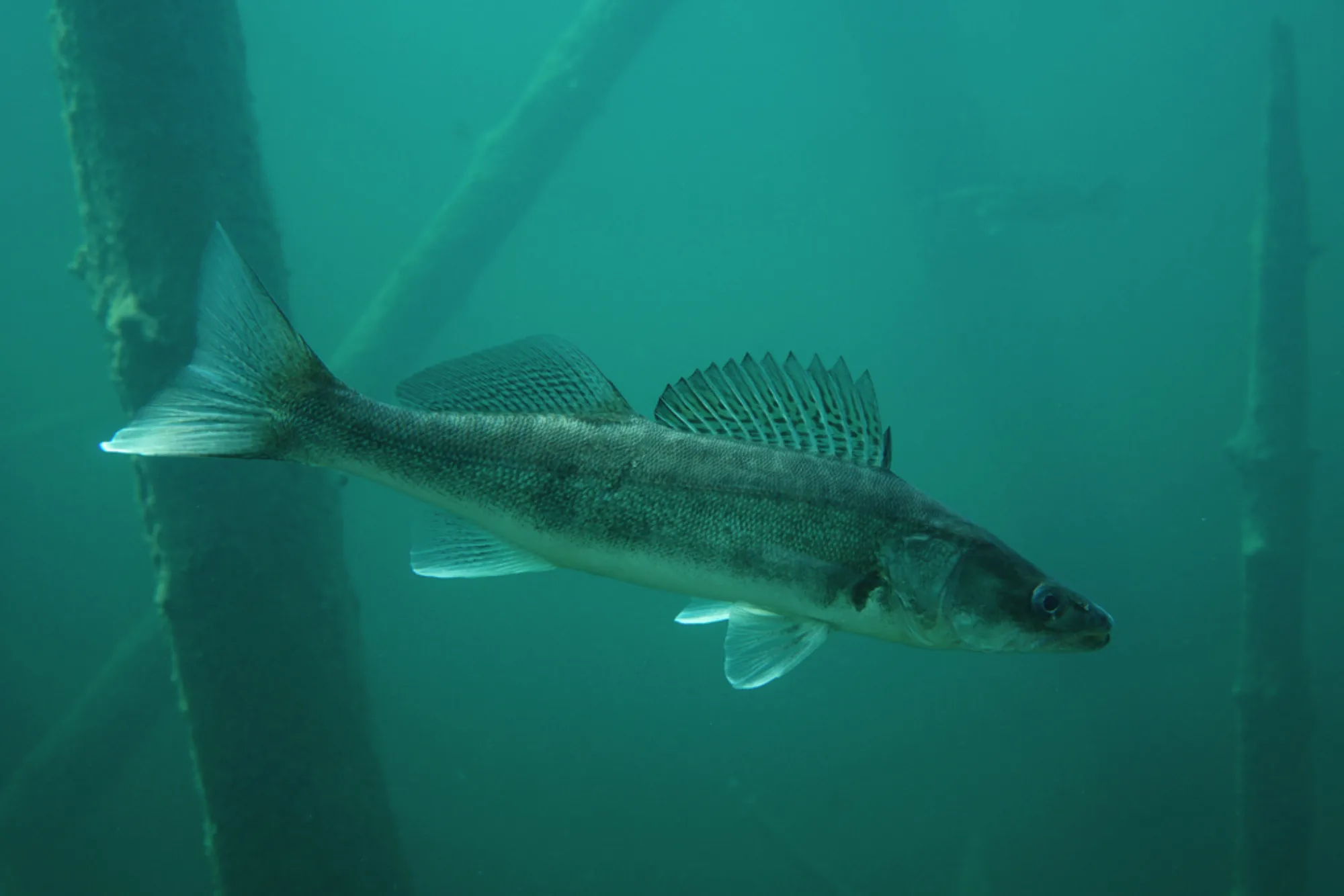
Long and muscular, the Pikeperch has a green-brown back, dark vertical bars along its sides and a creamy-white underside. Its large eyes can look opaque in particularly murky water, while rows of black spots mark the fins on its back and tail. Young fish are silvery and darken as they grow. It is the largest member of the perch family, with a commonly reported length of around 50 centimetres.
Across Eurasia, the Pikeperch ranges from drainages of the North and Baltic seas to those of the Black, Caspian, Aral and Aegean seas, reaching Finland in the north. It has also been introduced to places including Great Britain, southern Europe and North Africa. Look for it in large rivers and lakes, as well as coastal lakes and estuaries where the water is brackish. It thrives in murky, slow-flowing water with sparse vegetation, including canals clouded by boat traffic, but needs plenty of oxygen.
Adults hunt smaller fish that swim in schools, taking prey such as roach, smelt and perch, as well as smaller Pikeperch. Fish living in brackish water may travel up to 250 kilometres upriver to spawn. Breeding normally takes place in April and May, with males making shallow nests in sand or gravel or among exposed plant roots. The male stays to guard the nest and fan the eggs, while the young feed on zooplankton and small animals after leaving it. Other fish and Caspian seals prey on Pikeperch, and parasites can infect their skin, eyes and internal organs. They also disappear quickly from eutrophic areas when oxygen is insufficient, and in the UK anglers must destroy any Pikeperch they catch.
Written from the English Wikipedia article Zander (CC BY-SA 4.0).
- Records
- 80,692
- Countries
- 8
No atlas park has a record of the Pikeperch in or around it yet.
These are open occurrence records, so they show where people looked for and recorded the Pikeperch as much as where it lives. Cells are up to 25 km across, and every location is generalised to its cell.
Generalised encounter areas, not exact locations. Each shape is a grid cell coloured by how likely the species is there.
- Very likelySweden25 km zone · high confidence · 58703 records · updated 80 days ago
- Very likelyFinland25 km zone · high confidence · 9654 records · updated 80 days ago
- Very likelyNetherlands25 km zone · high confidence · 8624 records · updated 80 days ago
- Very likelyFrance25 km zone · high confidence · 2023 records · updated 80 days ago
- Very likelyUnited Kingdom25 km zone · high confidence · 1364 records · updated 80 days ago
- Very likelyBelgium25 km zone · high confidence · 205 records · updated 80 days ago
- LikelyGermany25 km zone · high confidence · 119 records · updated 80 days ago
Conservation status not assessed here yet, so every location is generalised to its grid cell.