Lake Trout
Salvelinus namaycush
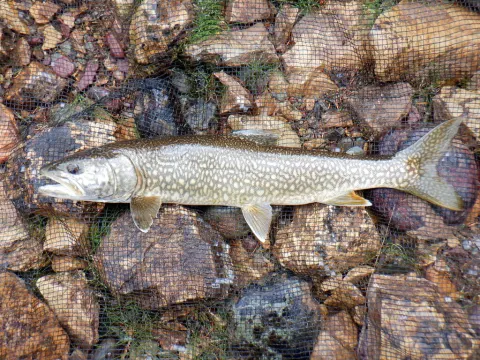
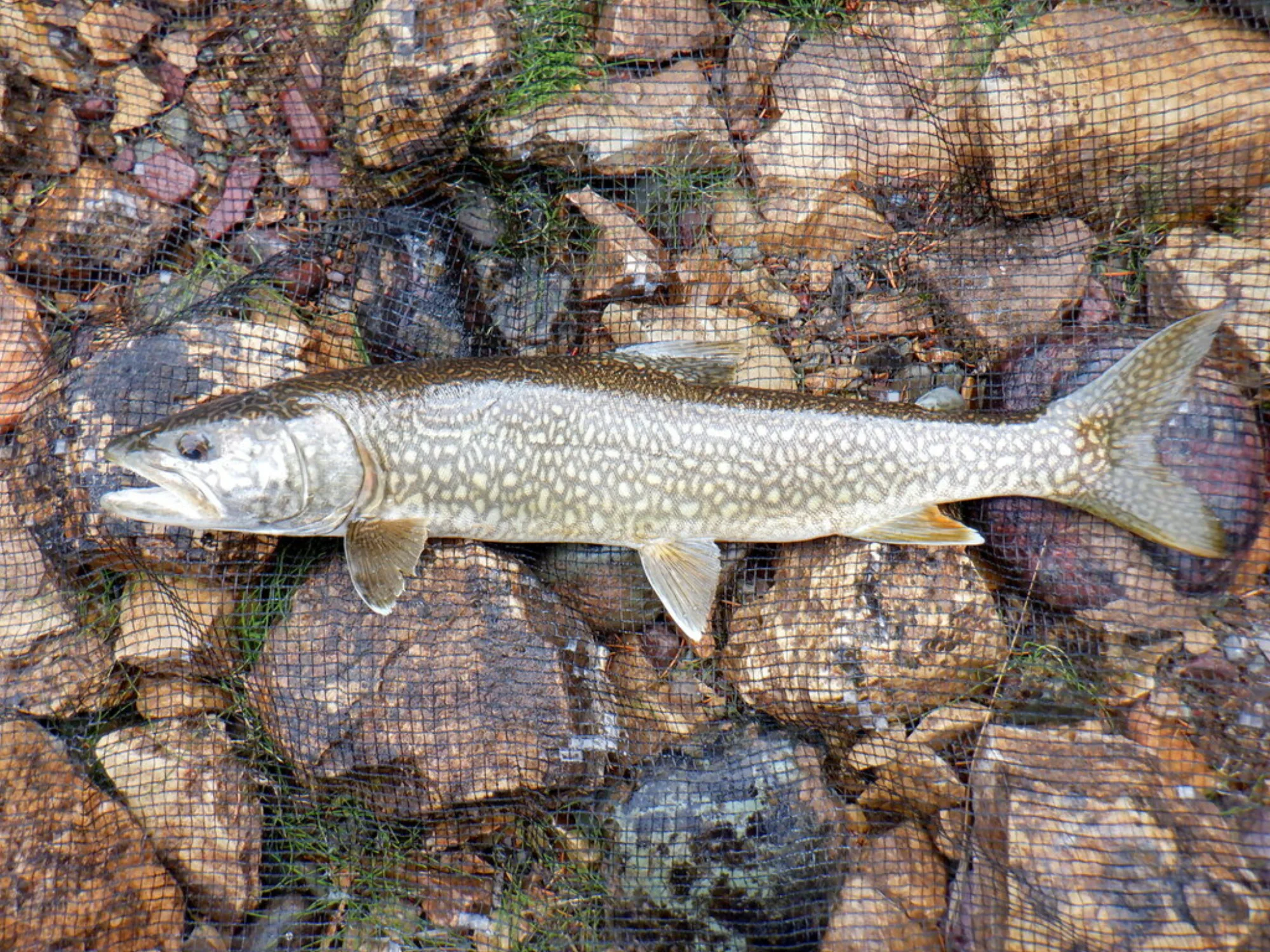
Cold, oxygen-rich lakes are home to the Lake Trout, a freshwater char native to northern North America, principally Canada, as well as Alaska and parts of the northeastern United States. It has also been introduced widely elsewhere in North America and overseas, mainly in Europe but also in South America and parts of Asia. Its elongated body is olive-grey, darker along the back and white underneath, with pale beige or white spots. The yellowish fins sometimes have white tips, while spawning brings a more yellow-orange belly and red tones to the fins. The largest of the chars, it averages 61 to 91 centimetres in length.
In summer, lake trout often occupy open water at depths of 20 to 60 m in lakes that undergo seasonal layering. Their diet depends on what the lake offers: where deep-water forage fish are absent during summer layering, they feed on plankton, but where such fish are present, they eat fish. Plankton-feeding populations tend to be abundant, grow slowly and mature at a smaller size; fish-eating populations are less abundant and grow faster. Lake trout are slow to grow and late to mature, leaving populations especially susceptible to overfishing. In Lake Superior, slimmer common lake trout tend to use shallower water, while the fatter siscowet stay deeper.
Overharvest and hatchery stocking have severely damaged many native populations. Acidification can harm the fish directly and reduce their prey, with long-term effects on populations. In the Great Lakes, lampreys, overharvest and pollution have wiped out or severely reduced stocks. Siscowet numbers also fell as some of their deep-water prey disappeared, although their populations have rebounded since 1970.
Written from the English Wikipedia article Lake trout (CC BY-SA 4.0).
- Records
- 17,682
- Countries
- 7
- Atlas places
- 4
These are open occurrence records, so they show where people looked for and recorded the Lake Trout as much as where it lives. Cells are up to 25 km across, and every location is generalised to its cell.
Generalised encounter areas, not exact locations. Each shape is a grid cell coloured by how likely the species is there.
- Very likelyUnited States25 km zone · high confidence · 13097 records · updated 80 days ago
- Very likelySweden25 km zone · high confidence · 3079 records · updated 80 days ago
- Very likelyCanada25 km zone · high confidence · 907 records · updated 80 days ago
- Very likelySwitzerland25 km zone · high confidence · 486 records · updated 80 days ago
- LikelyItaly25 km zone · medium confidence · 74 records · updated 80 days ago
- LikelyFrance25 km zone · medium confidence · 33 records · updated 80 days ago
- PossibleNorway25 km zone · medium confidence · 6 records · updated 80 days ago
Conservation status not assessed here yet, so every location is generalised to its grid cell.