Dolly Varden
Salvelinus malma
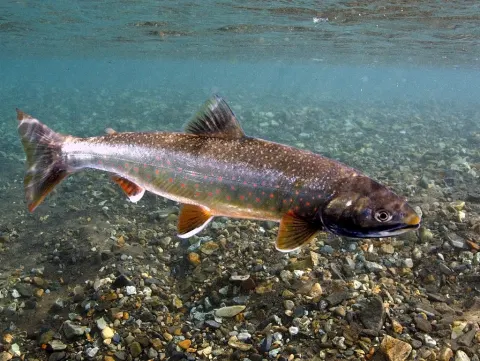
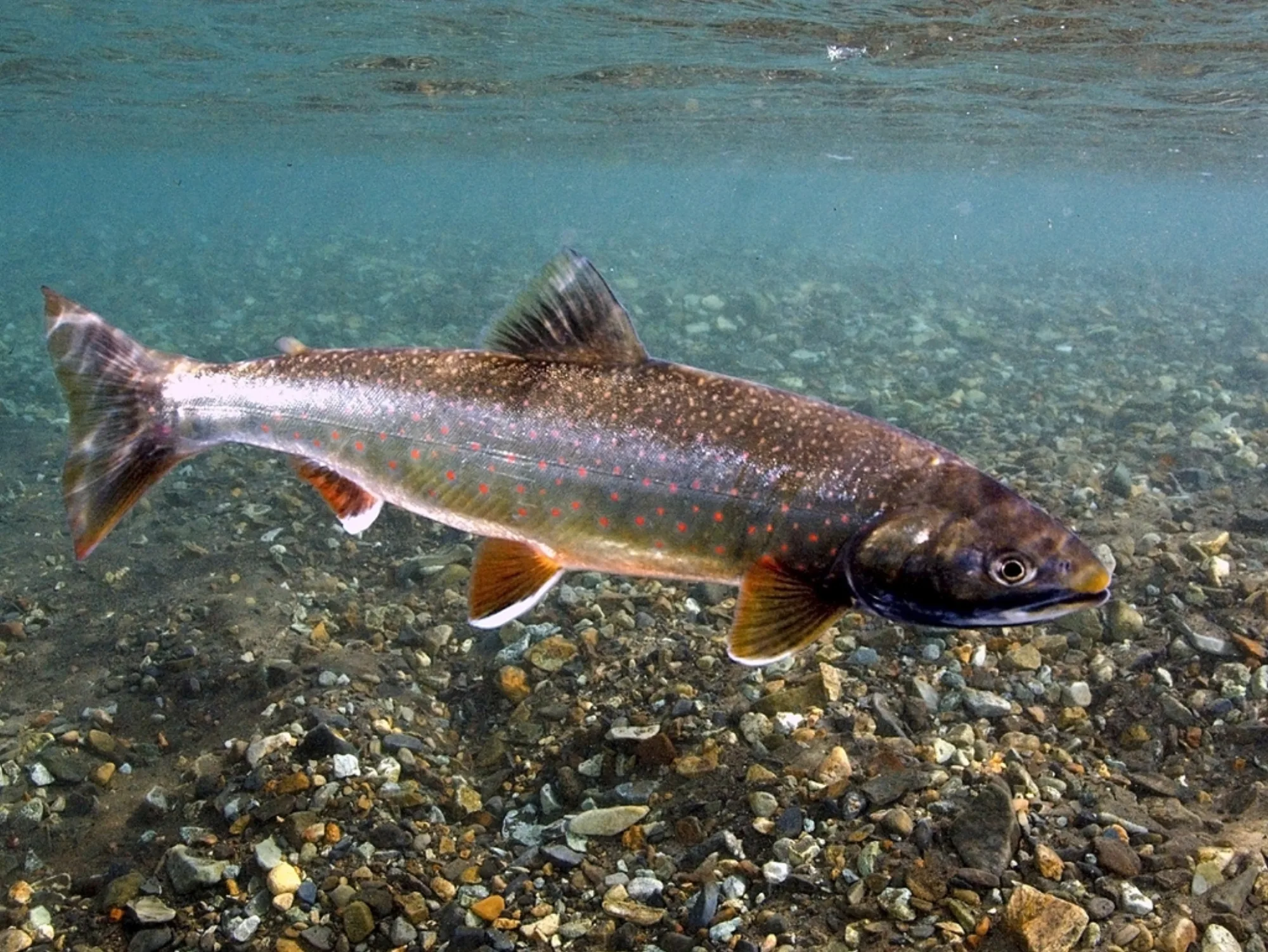
Olive green or muddy grey across its back and sides, the Dolly Varden (Salvelinus malma) is a char with a white belly and scattered pale yellow or pinkish-yellow spots. Small red spots can appear low on its sides, though they are often hard to make out. Its fins are mostly plain, and neither they nor the body have black spots or wavy markings. Identification can be difficult: the fish looks very similar to both bull trout and Arctic char.
Across Asia and North America, Dolly Varden live in cold tributaries that feed the Pacific, as well as in coastal waters. In North America, their range follows the coast north from Puget Sound through British Columbia to the Alaska Peninsula and eastern Aleutian Islands, then reaches the Mackenzie River via the Bering and Arctic seas. In Asia, their range reaches south through the Kamchatka Peninsula to northern Japan. Some populations live in rivers, while others inhabit deep, cold lakes or spend part of their lives at sea.
Sea-run fish leave fresh water to feed in the ocean, saltwater bays and estuaries, then return to fresh water to spawn. Fish living in moderate to large rivers migrate into smaller tributaries to spawn, as do fish from deep lakes. Dolly Varden feed on the eggs and fry of other fish, including salmon, steelhead and cutthroat trout. People also catch them: the fish form a sizable share of subsistence catches in parts of Alaska where salmon are scarce, and anglers pursue them in the U.S. and Canada. Historically, their reputation as predators led to an official extermination programme in Alaska, where bounties were paid for their tails between 1921 and 1941.
Written from the English Wikipedia article Dolly Varden trout (CC BY-SA 4.0).
- Records
- 1,028
- Countries
- 3
- Atlas places
- 2
These are open occurrence records, so they show where people looked for and recorded the Dolly Varden as much as where it lives. Cells are up to 25 km across, and every location is generalised to its cell.
Generalised encounter areas, not exact locations. Each shape is a grid cell coloured by how likely the species is there.
- Very likelyCanada25 km zone · medium confidence · 938 records · updated 81 days ago
- Very likelyRussia25 km zone · medium confidence · 65 records · updated 81 days ago
- Very likelyUnited States25 km zone · medium confidence · 25 records · updated 81 days ago
Conservation status not assessed here yet, so every location is generalised to its grid cell.