Bull Trout
Salvelinus confluentus
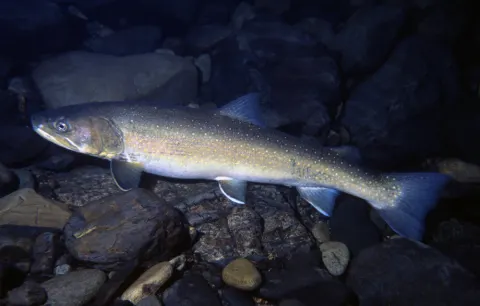
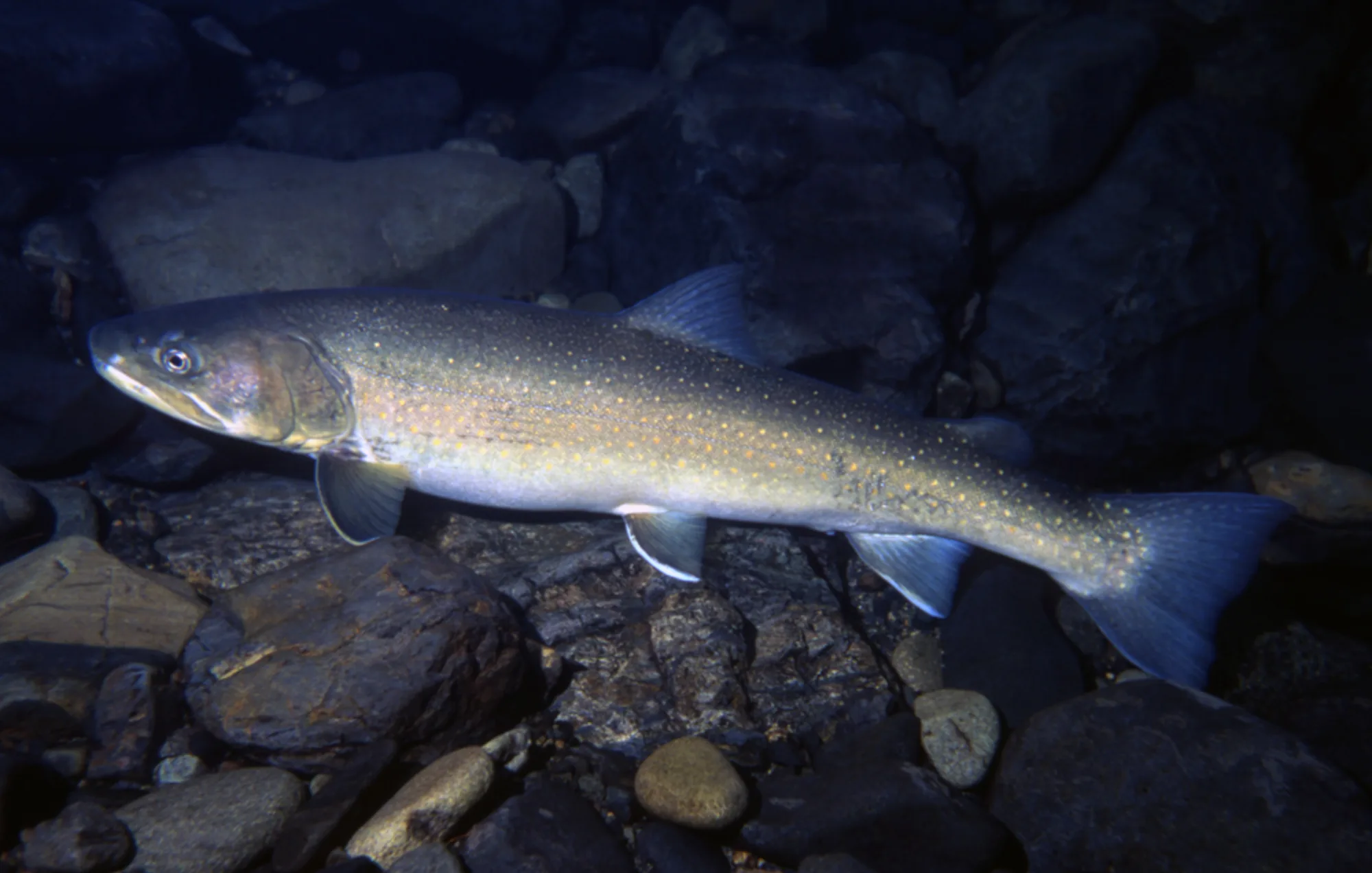
Bull Trout are char native to northwestern North America, with unusually large heads and mouths and white edges at the front of their fins. Yellow, orange or salmon-coloured spots mark the back, while the dorsal fin lacks distinct spots. Some reach 103 cm in length and 14.5 kg in weight, although fish that stay in one stream are typically much smaller than those that migrate.
Their range includes Yukon, Alberta and British Columbia, as well as parts of the northwestern United States. They live in cold, clear mountain and coastal waters, favouring deep pools in lakes and large rivers and the chilly headwaters of mountain streams. Clean gravel, deep pools, submerged snags and cut banks provide the conditions and cover they need. Young fish often inhabit small streams or the edges of large rivers and lakes. Some Bull Trout remain in a single stream throughout their lives, while others travel through rivers, lakes and even the ocean. Mature fish migrate upstream to spawn in the streams where they were born, using clean, cold water and gravel. Outside the spawning season, long journeys can take them towards feeding grounds or away from warm water and low oxygen.
Young Bull Trout eat zooplankton and small bottom-dwelling organisms, especially chironomids. As they grow, other fish become a major part of their diet; in coastal Washington, some also eat salmon eggs and fry. Road building and logging can affect the cold, low-silt water needed for reproduction, while dams can block migration routes. Non-native brook trout can hybridise with Bull Trout, and introduced trout can also compete with them.
Written from the English Wikipedia article Bull trout (CC BY-SA 4.0).
- Records
- 245
- Countries
- 2
- Atlas places
- 2
These are open occurrence records, so they show where people looked for and recorded the Bull Trout as much as where it lives. Cells are up to 25 km across, and every location is generalised to its cell.
Generalised encounter areas, not exact locations. Each shape is a grid cell coloured by how likely the species is there.
- Very likelyUnited States25 km zone · medium confidence · 245 records · updated 80 days ago
- LikelyCanada25 km zone · low confidence · 0 records · updated 80 days ago
Conservation status not assessed here yet, so every location is generalised to its grid cell.