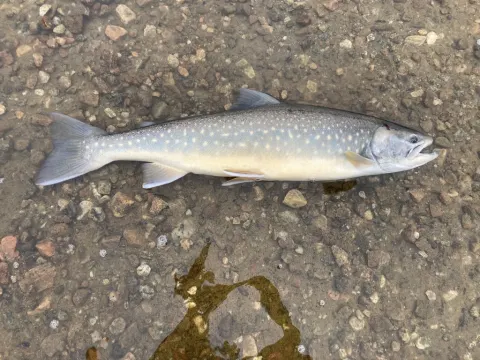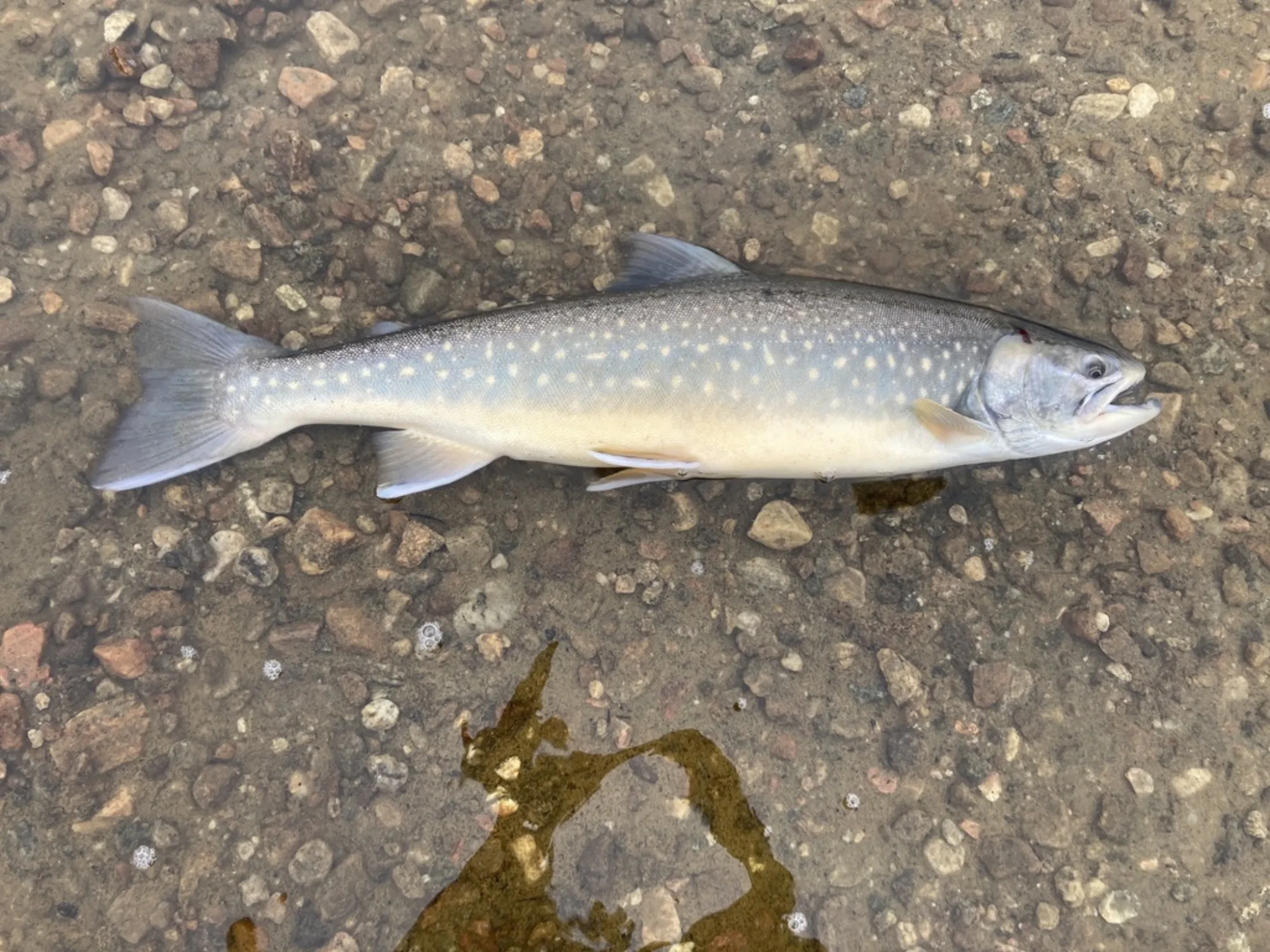
Arctic Charr
Salvelinus alpinus
Cold water is home to the Arctic Charr, a fish related to salmon and trout and found farther north than any other freshwater fish. Its back is dark, while its underside can be red, yellow or white. Colour varies with the season and the conditions in its lake, and fish from different populations can look quite different. Dwarf and giant forms also differ greatly in size, and distinct forms can share a lake or river.
The fish has a largely circumpolar range, with records from Alaska and the Canadian Arctic to Greenland, Iceland, Scandinavia and Siberia. It lives in high lakes and along Arctic and subarctic coasts, with some populations remaining in fresh water and others travelling to sea. In Great Britain and Ireland, it is rare and found mainly in deep, cold glacial lakes. Charr generally use shallow water, though landlocked fish often move deeper in summer to find cooler conditions. Sea-going fish migrate annually, returning to fresh water after about two months to breed and spend the winter.
Its diet changes with the season and place. In late spring and summer it takes insects from the surface, as well as salmon eggs, snails, small crustaceans and smaller fish. In autumn and winter it eats zooplankton and freshwater shrimps, sometimes taking smaller fish too. Charr spawn over rocky lake shallows exposed to heavy waves or in slower river pools with gravel bottoms, and often breed several times during their lives. Acidification threatens populations in Great Britain and Ireland, while predators include polar bears, sea otters and other fish.
Written from the English Wikipedia article Arctic char (CC BY-SA 4.0).
- Records
- 325,630
- Countries
- 5
No atlas park has a record of the Arctic Charr in or around it yet.
These are open occurrence records, so they show where people looked for and recorded the Arctic Charr as much as where it lives. Cells are up to 25 km across, and every location is generalised to its cell.
Generalised encounter areas, not exact locations. Each shape is a grid cell coloured by how likely the species is there.
- Very likelyGreenland25 km zone · high confidence · 167572 records · updated 80 days ago
- Very likelySweden25 km zone · high confidence · 80987 records · updated 80 days ago
- Very likelyCanada25 km zone · high confidence · 70388 records · updated 80 days ago
- Very likelyNorway25 km zone · high confidence · 6683 records · updated 80 days ago
Conservation status not assessed here yet, so every location is generalised to its grid cell.