Brown Trout
Salmo trutta
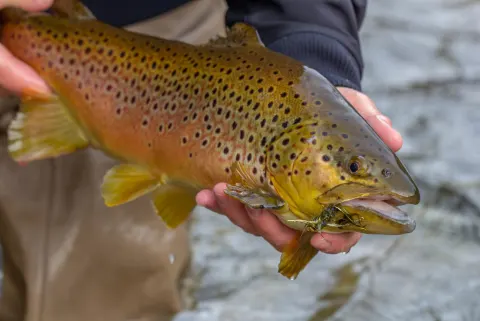
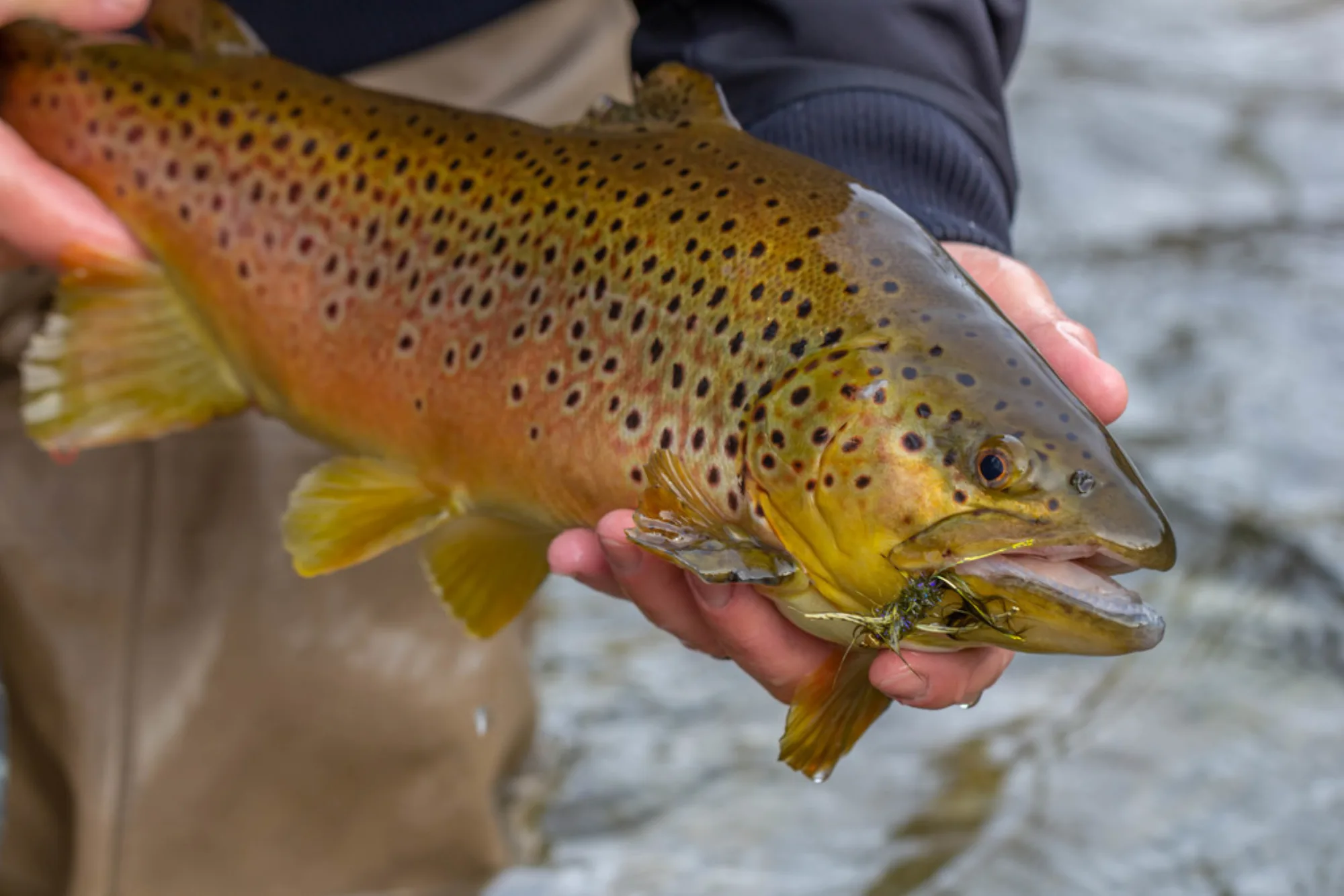
Slender and long-headed, the Brown Trout (Salmo trutta) often has dark and red spots along its sides, though these do not reach the tail. Its freshwater colours vary from silvery with a white belly to brassy reddish-brown fading to cream, with pale halos around the spots. In some places it can grow to 20 kg or more, but adults in many smaller rivers commonly weigh 1.0 kg or less. Its native range stretches from northern Norway and Russian tributaries of the White Sea to the Atlas Mountains, and from Iceland east to tributaries of the Aral Sea. Introduced widely for fishing, it has also established wild populations in many countries beyond that range.
Brown trout occupy large rivers, smaller creeks and alpine streams, as well as large, deep lakes. Look for them around submerged rocks and logs, beneath overhanging vegetation or near undercut banks, where cover offers protection from predators, bright sun and warmer water. Some spend much of their adult lives at sea, returning to fresh water to breed, while river and lake forms migrate within fresh water. All spawn in the gravel beds of cold, well-aerated headstreams. Active by day and night, they feed opportunistically on insects and other invertebrates, fish and frogs, sometimes taking mice or small birds. They may even break the surface to catch low-flying insects.
Some populations face pressure from habitat degradation, overfishing and the genetic effects of stocking. Prolonged summer heat can reduce dissolved oxygen and kill local populations when cooler, deeper or more turbulent water is unavailable. Pollution from agricultural fertilisers can make this problem worse, and global climate change is also a concern.
Written from the English Wikipedia article Brown trout (CC BY-SA 4.0).
- Records
- 1,614,834
- Countries
- 10
- Atlas places
- 1
These are open occurrence records, so they show where people looked for and recorded the Brown Trout as much as where it lives. Cells are up to 25 km across, and every location is generalised to its cell.
Generalised encounter areas, not exact locations. Each shape is a grid cell coloured by how likely the species is there.
- Very likelyNorway25 km zone · high confidence · 1020932 records · updated 80 days ago
- Very likelyFrance25 km zone · high confidence · 334965 records · updated 80 days ago
- Very likelySweden25 km zone · high confidence · 123955 records · updated 80 days ago
- Very likelySwitzerland25 km zone · high confidence · 32544 records · updated 80 days ago
- Very likelyUnited States25 km zone · high confidence · 27893 records · updated 80 days ago
- Very likelySpain25 km zone · high confidence · 25566 records · updated 80 days ago
- Very likelyFrench Southern Territories25 km zone · high confidence · 24270 records · updated 80 days ago
- Very likelyUnited Kingdom25 km zone · high confidence · 23205 records · updated 80 days ago
- Very likelyAustralia25 km zone · high confidence · 1504 records · updated 80 days ago
Conservation status not assessed here yet, so every location is generalised to its grid cell.