Dorado
Salminus brasiliensis
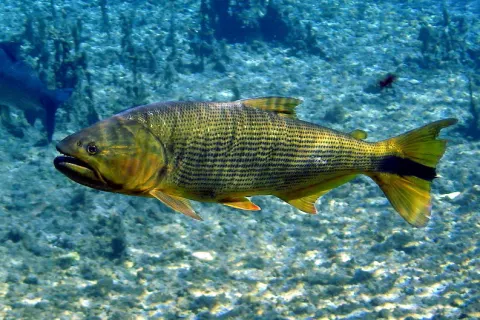
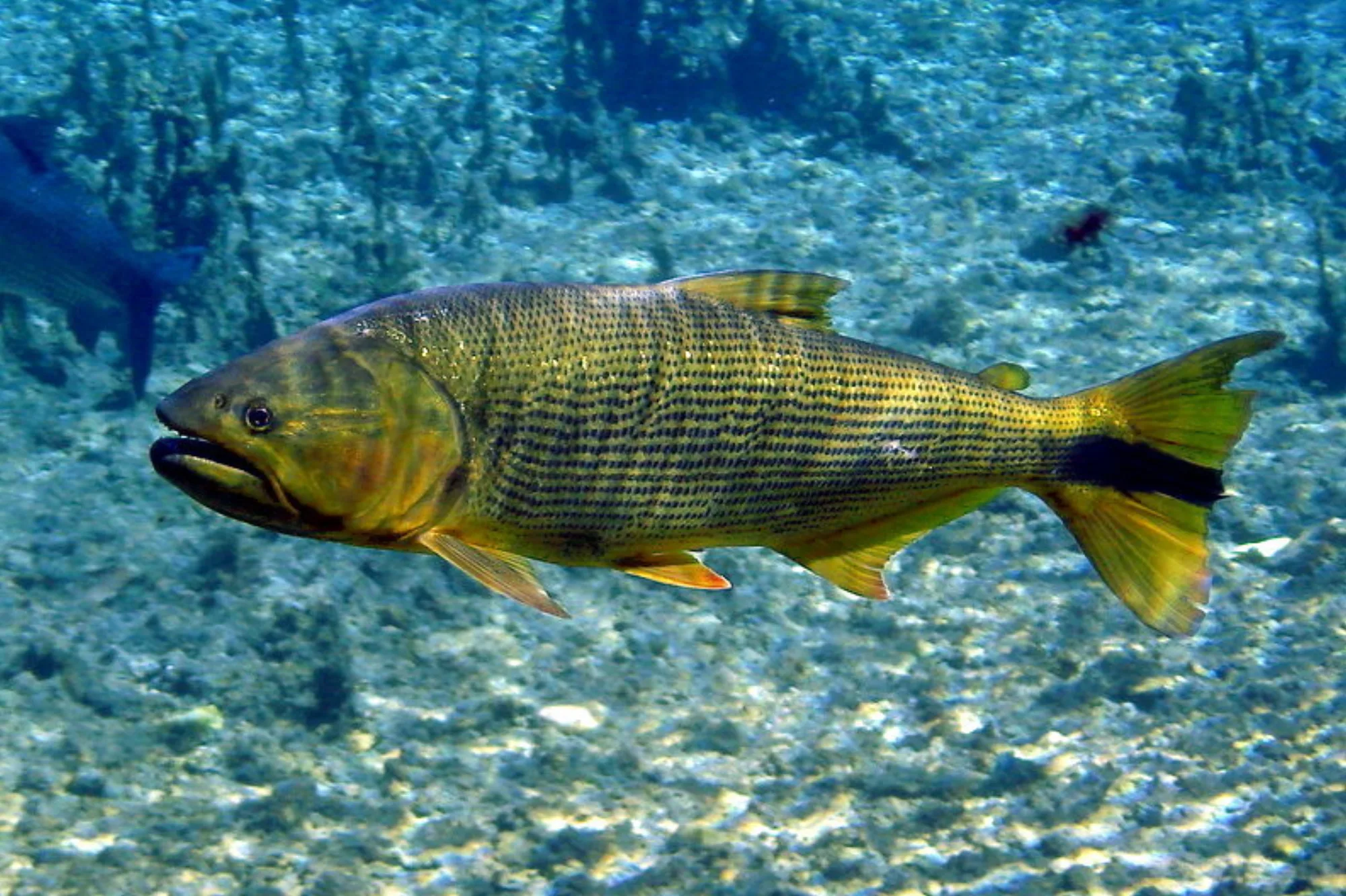
Golden reflections give the Dorado its name and help distinguish this large freshwater predator. Adults are yellow-golden, while younger fish are more silvery, and the large head carries powerful jaws armed with sharp teeth. A typical fish weighs about 3 to 10 kg, although the largest recorded reached 1.3 m and 34 kg. Females grow considerably larger than males, though otherwise they look similar.
The species lives in warm fresh waters across parts of South America, from southern Brazil and Bolivia to Paraguay, Uruguay and northern Argentina. Its native range includes the Pantanal and the Paraguay basin, as well as the Paraná, Uruguay, Chapare, Mamoré and Guaporé basins and the Lagoa dos Patos drainage. It generally favours water between 20 and 28 °C, and moves in response to temperature, season and food. Usually solitary, Dorados travel in groups during migrations and typically swim about 400 km upstream to spawn in spring and summer. Females reach maturity at 4 to 5 years and can release up to 2 million eggs near the surface. Dorados can live for more than 15 years.
At the top of their freshwater food web, adults eat many kinds of fish, including the migratory streaked prochilod. They have also been recorded eating large insects, crustaceans and small animals such as rodents, lizards and birds. Young Dorados start on plankton, then switch to insects and small fish as they grow. Juveniles can resemble Brycon hilarii and stay near its schools, allowing them to surprise smaller fish. Overfishing and dams have contributed to the Dorado's decline, with dams restricting its breeding migration.
Written from the English Wikipedia article Salminus brasiliensis (CC BY-SA 4.0).
- Records
- 118
- Countries
- 3
- Atlas places
- 3
These are open occurrence records, so they show where people looked for and recorded the Dorado as much as where it lives. Cells are up to 25 km across, and every location is generalised to its cell.
Generalised encounter areas, not exact locations. Each shape is a grid cell coloured by how likely the species is there.
- Very likelyBrazil25 km zone · medium confidence · 67 records · updated 80 days ago
- Very likelyArgentina25 km zone · medium confidence · 48 records · updated 80 days ago
- LikelyUruguay25 km zone · medium confidence · 3 records · updated 80 days ago
Conservation status not assessed here yet, so every location is generalised to its grid cell.