Fire Salamander
Salamandra salamandra
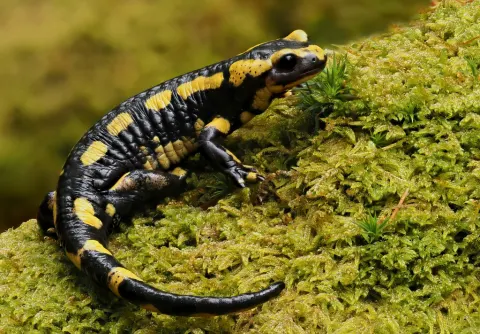
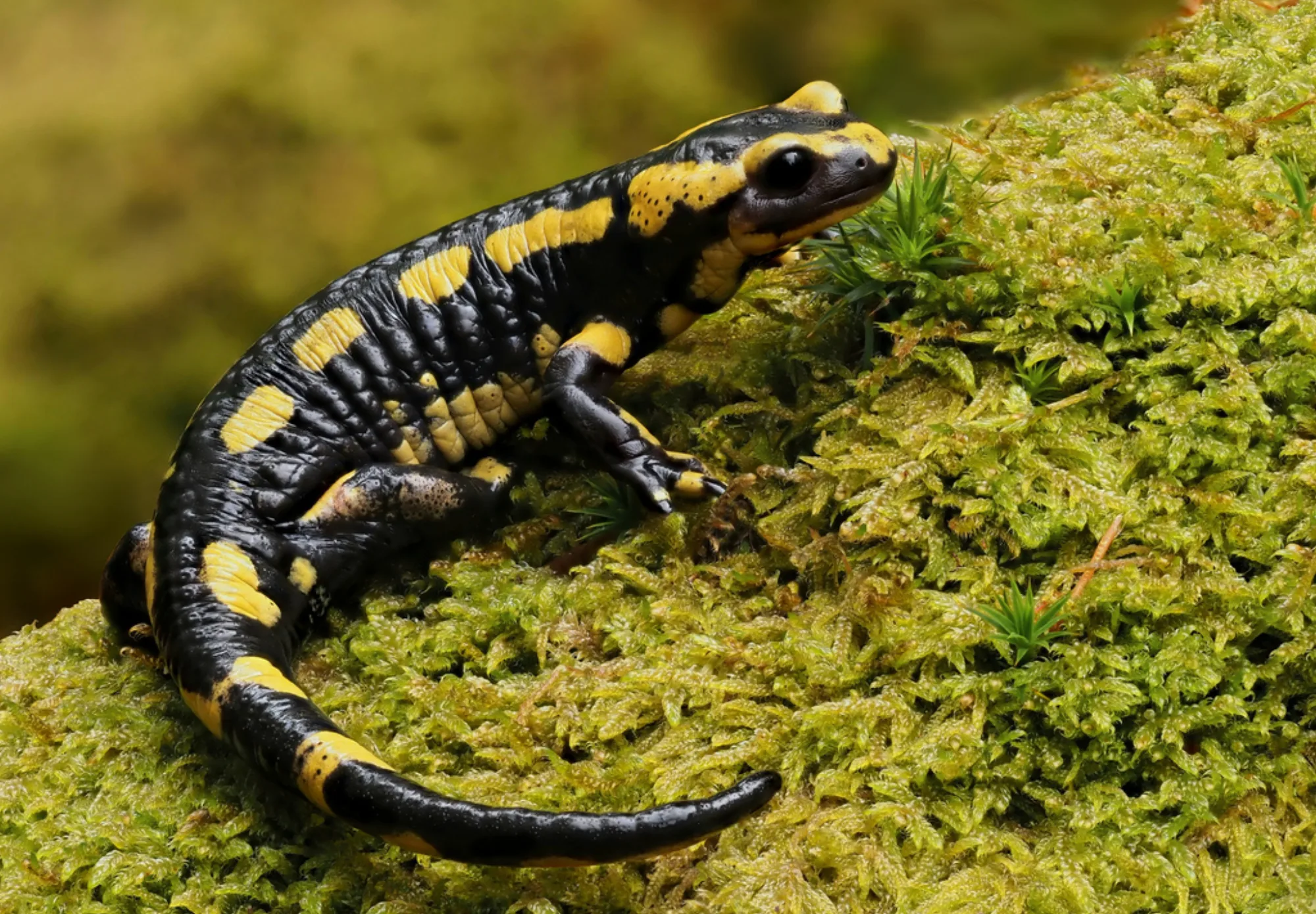
Black skin marked with yellow spots or stripes makes the Fire Salamander recognisable, though the balance of the two colours varies greatly between individuals. Some are almost entirely black, while others are mostly yellow, and red or orange may replace or mingle with the yellow. Its conspicuous colouring warns predators that it is toxic. One of Europe's largest salamanders, it can reach 15 to 25 centimetres in length.
Found across much of southern and central Europe, it is most often seen at altitudes between 250 and 1,000 metres, though it also occurs higher in the Balkans and Spain. In central Europe it favours deciduous woodland, especially in hilly country, where fallen leaves and mossy tree trunks provide places to hide. Small brooks or ponds with clean water are needed for its larvae to develop. It spends much of its time under wood or other cover and is active in the evening and at night, emerging during the day when it rains. Its prey includes insects, spiders, millipedes, centipedes, earthworms and slugs, with newts and young frogs taken occasionally.
Females usually deposit larvae in water as they hatch, although in some subspecies the young develop inside the female until they are fully formed. An introduced chytrid fungus has caused severe population declines in parts of the species' range, spreading through western Europe since it was identified in the Netherlands. In that country, changes in water availability and habitat degradation had already reduced its range before the disease-driven decline. Some affected populations persist in low numbers after outbreaks, and one appears to have recovered.
Written from the English Wikipedia article Fire salamander (CC BY-SA 4.0).
- Records
- 81,951
- Countries
- 28
No atlas park has a record of the Fire Salamander in or around it yet.
These are open occurrence records, so they show where people looked for and recorded the Fire Salamander as much as where it lives. Cells are up to 25 km across, and every location is generalised to its cell.
Generalised encounter areas, not exact locations. Each shape is a grid cell coloured by how likely the species is there.
- Very likelySwitzerland25 km zone · high confidence · 38625 records · updated 86 days ago
- Very likelyFrance25 km zone · high confidence · 28866 records · updated 86 days ago
- Very likelyGermany25 km zone · high confidence · 3784 records · updated 86 days ago
- Very likelyLiechtenstein25 km zone · high confidence · 3385 records · updated 86 days ago
- Very likelyAustria25 km zone · high confidence · 2177 records · updated 86 days ago
- Very likelyItaly25 km zone · high confidence · 1847 records · updated 86 days ago
- Very likelySpain25 km zone · high confidence · 1529 records · updated 86 days ago
- Very likelyPortugal25 km zone · high confidence · 627 records · updated 86 days ago
- Very likelyUkraine25 km zone · high confidence · 503 records · updated 86 days ago
- Very likelyBelgium25 km zone · high confidence · 109 records · updated today
Conservation status not assessed here yet, so every location is generalised to its grid cell.