Saiga
Saiga tatarica
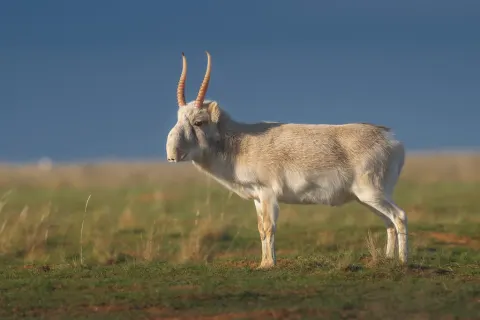
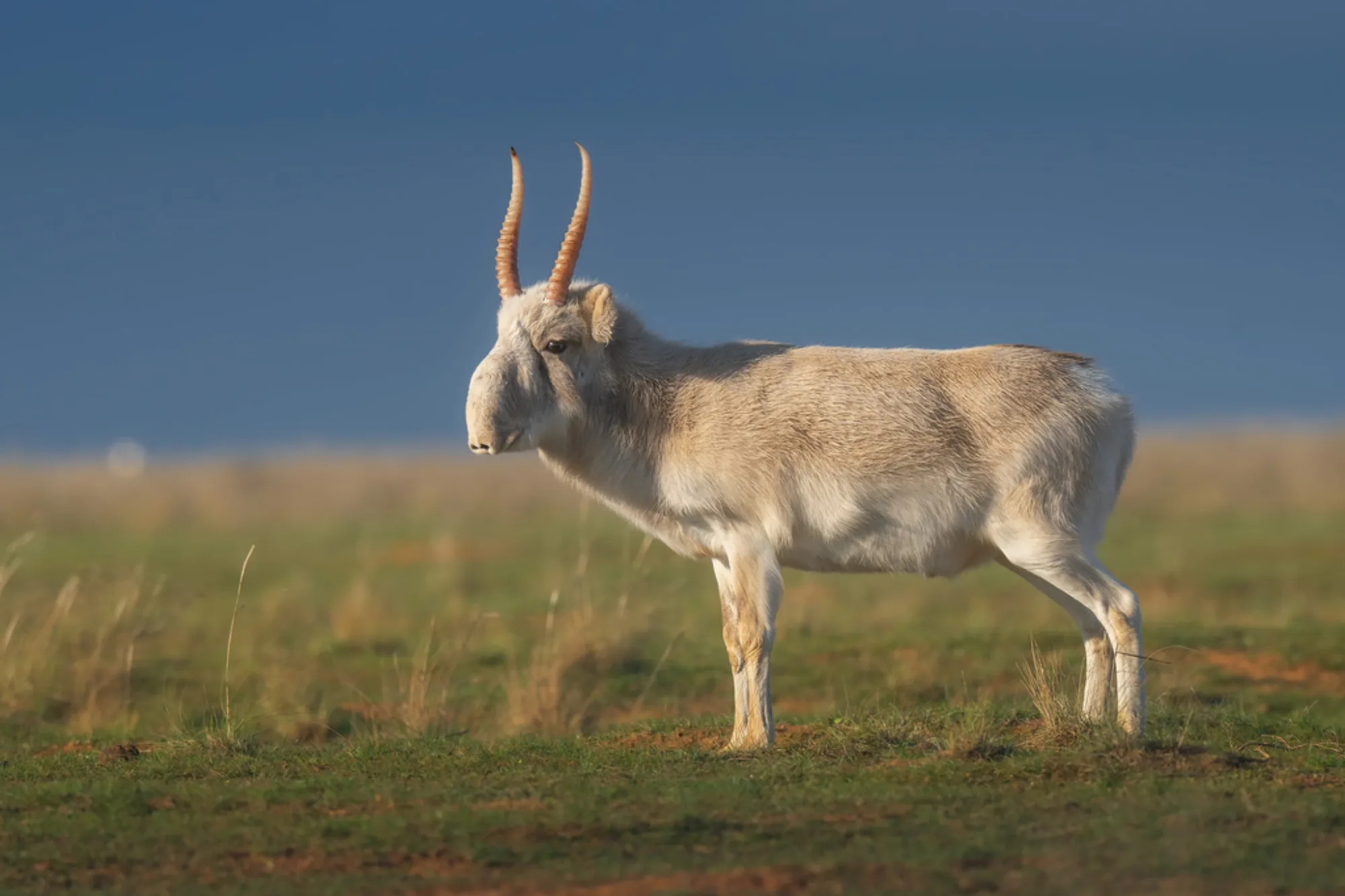
A swollen, downward-pointing nose gives the Saiga its distinctive profile. This antelope has dark cheek markings and a coat that changes with the seasons, from yellow to red in summer to pale greyish-brown in winter. Males carry thick, wax-coloured horns with prominent rings. Saigas stand 61 to 81 cm at the shoulder and weigh 26 to 69 kg.
Kazakhstan holds the vast majority of the world's saigas, with populations also found in parts of Russia and western Mongolia. Some animals from the Ustyurt population move south into Uzbekistan in winter, occasionally reaching Turkmenistan. They gather in very large herds on steppes, grasslands and semideserts, grazing on a range of plants, including some poisonous to other animals. These migrants can travel long distances and swim across rivers, although they avoid steep or rugged ground. In spring, mothers assemble in large numbers to give birth. Wolves prey on saigas, while foxes, eagles and ravens target young animals.
Demand for horns drives poaching and smuggling, and saigas are also hunted for their meat and skin. Farming and settlements have reduced their habitat and restricted access to water and seasonal ranges. Railways, trenches, mines and pipelines can obstruct migration, and herds have starved after becoming trapped within fenced areas. Severe winters can bury the grass beneath snow and leave the animals unable to feed. Disease has also caused mass deaths: in 2015, more than 120,000 saigas in Kazakhstan's Betpak-Dala population were confirmed dead by late May. Warmer, more humid conditions were linked to bacteria entering the animals' bloodstream during that die-off.
Written from the English Wikipedia article Saiga antelope (CC BY-SA 4.0).
- Records
- 4
- Countries
- 2
No atlas park has a record of the Saiga in or around it yet.
These are open occurrence records, so they show where people looked for and recorded the Saiga as much as where it lives. Cells are up to 25 km across, and every location is generalised to its cell.
Generalised encounter areas, not exact locations. Each shape is a grid cell coloured by how likely the species is there.
- Very likelyRussia25 km zone · medium confidence · 4 records · updated 80 days ago
- LikelyKazakhstan25 km zone · low confidence · 0 records · updated 80 days ago
Conservation status not assessed here yet, so every location is generalised to its grid cell.