Secretarybird
Sagittarius serpentarius
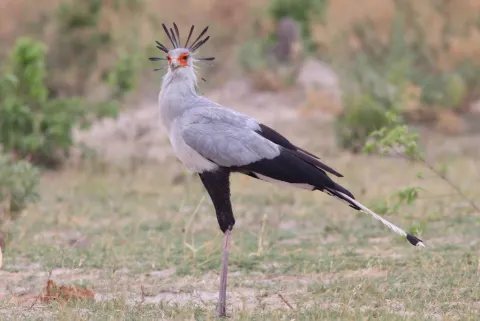
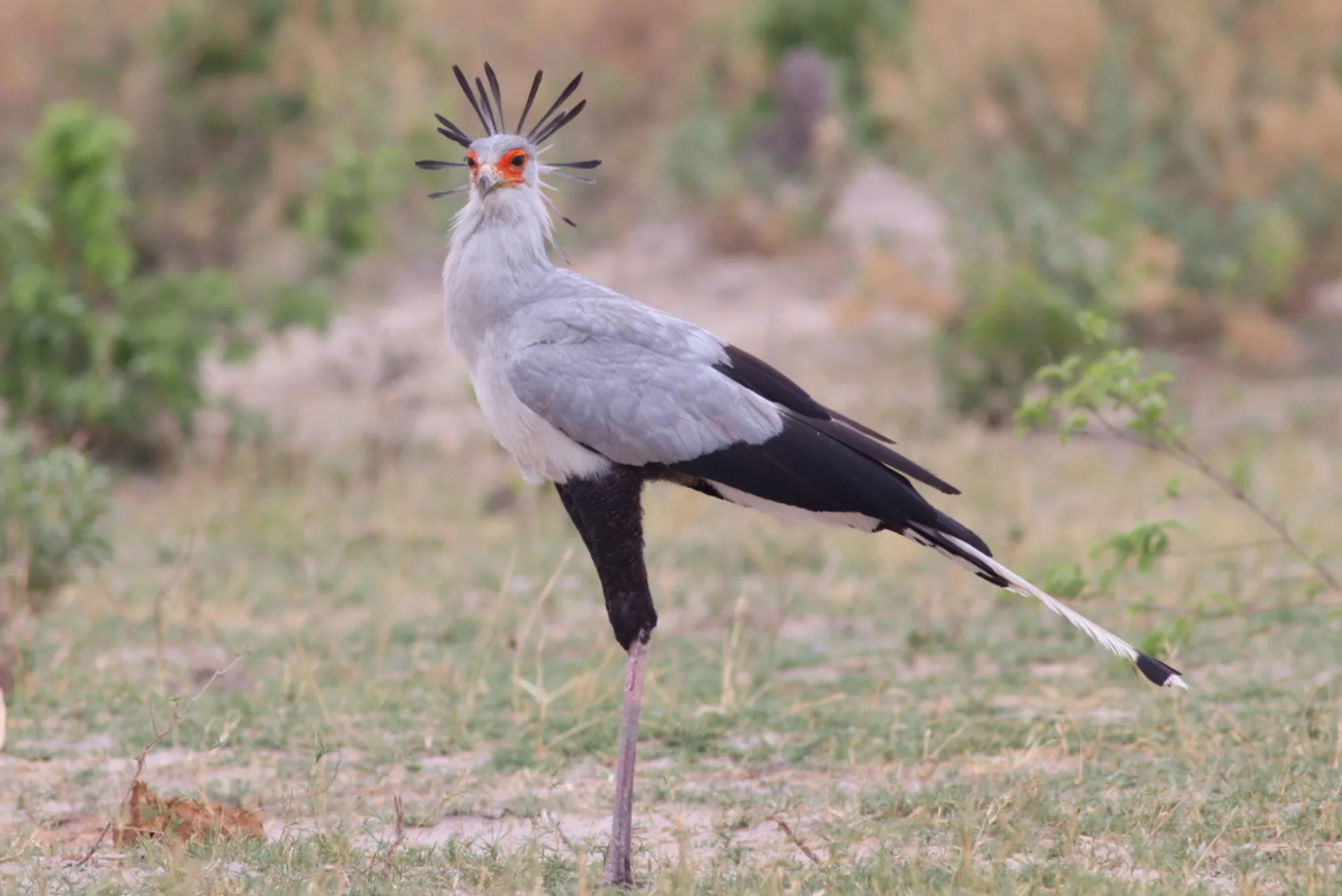
Standing up to 1.3 m tall, the Secretarybird (Sagittarius serpentarius) combines an eagle-like body with long, crane-like legs. Adults are mostly grey, with a red-orange face and a dark crest; their thighs and flight feathers are black. Young birds have browner plumage and yellow facial skin. Native to sub-Saharan Africa, the species ranges from Senegal to Somalia and south to the Western Cape of South Africa. Look for it in open grasslands, savannas and shrubland, especially where the grass is short. It generally stays within its range, but may wander locally in response to rain and the prey that follows.
Secretarybirds spend much of the day on the ground, striding through their habitat in pairs or loose family groups. They often stamp on vegetation to flush out prey, then chase and strike it with their feet. Their varied diet includes insects, rodents, frogs, lizards and snakes. Pairs usually roost together in trees, although they may search for food separately while keeping each other in sight. Breeding can happen throughout the year, with a tendency towards the late dry season. Both birds build a stick nest high in a thorny tree, and both feed the young. A clutch contains one to three eggs, and when food is plentiful all three chicks can survive to leave the nest.
Numbers are declining across the species' range. Roads and development fragment its habitat, while livestock overgraze grasslands. In South Africa, the spread of woody plants and taller vegetation has reduced the open habitat it favours, including in protected areas.
Written from the English Wikipedia article Secretarybird (CC BY-SA 4.0).
- Records
- 35,686
- Countries
- 19
- Atlas places
- 34
- Kruger National Park· South Africa
- Serengeti National Park· Tanzania
- Kgalagadi Transfrontier Park· South Africa
- uKhahlamba-Drakensberg Park· South Africa
- Ngorongoro Conservation Area· Tanzania
- Etosha National Park· Namibia
- Addo Elephant National Park· South Africa
- iSimangaliso Wetland Park· South Africa
- Maasai Mara National Reserve· Kenya
- Tsavo East National Park· Kenya
- Tsavo West National Park· Kenya
- Hwange National Park· Zimbabwe
- Golden Gate Highlands National Park· South Africa
- Kidepo Valley National Park· Uganda
- Samburu National Reserve· Kenya
- Hluhluwe-iMfolozi Park· South Africa
- Karoo National Park· South Africa
- Liuwa Plain National Park· Zambia
- Mountain Zebra National Park· South Africa
- Nairobi National Park· Kenya
- Okavango Delta· Botswana
- Pilanesberg National Park· South Africa
- Tarangire National Park· Tanzania
- Aberdare National Park· Kenya
- Amboseli National Park· Kenya
- Central Kalahari Game Reserve· Botswana
- Chobe National Park· Botswana
- Hell's Gate National Park· Kenya
- Lake Manyara National Park· Tanzania
- Lake Nakuru National Park· Kenya
- Meru National Park· Kenya
- Murchison Falls National Park· Uganda
- Namib-Naukluft· Namibia
- Zambezi National Park· Zimbabwe
These are open occurrence records, so they show where people looked for and recorded the Secretarybird as much as where it lives. Cells are up to 25 km across, and every location is generalised to its cell.
Generalised encounter areas, not exact locations. Each shape is a grid cell coloured by how likely the species is there.
- Very likelySouth Africa25 km zone · high confidence · 18796 records · updated 86 days ago
- Very likelyTanzania25 km zone · high confidence · 7207 records · updated 86 days ago
- Very likelyKenya25 km zone · high confidence · 6467 records · updated 86 days ago
- Very likelyNamibia25 km zone · high confidence · 1240 records · updated 86 days ago
- Very likelyBotswana25 km zone · high confidence · 604 records · updated 86 days ago
- Very likelyZimbabwe25 km zone · high confidence · 349 records · updated 86 days ago
- Very likelyLesotho25 km zone · high confidence · 286 records · updated 86 days ago
- Very likelyZambia25 km zone · high confidence · 239 records · updated 86 days ago
- Very likelyEthiopia25 km zone · high confidence · 211 records · updated 86 days ago
- LikelyUganda25 km zone · medium confidence · 102 records · updated today
Conservation status not assessed here yet, so every location is generalised to its grid cell.