Sambar
Rusa unicolor
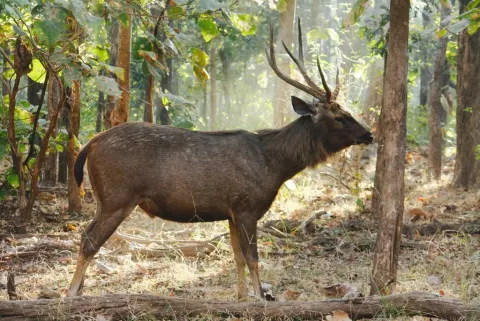
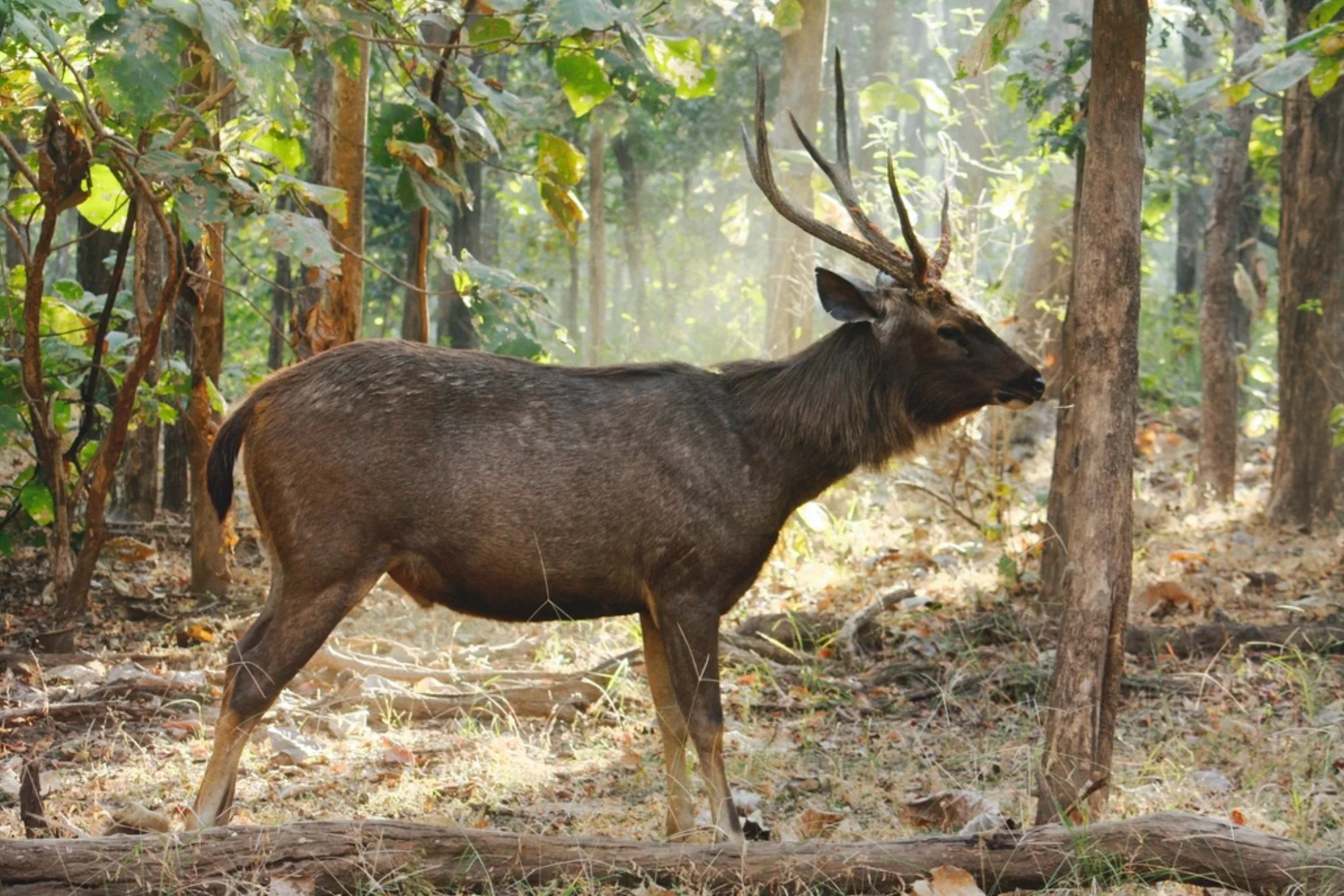
Large and shaggy-coated, the Sambar is a deer native to southern, eastern and southeastern Asia. Its coat ranges from yellowish brown to dark grey, sometimes with chestnut markings on the rump and underparts. Males carry rugged antlers, typically up to 110 cm long in fully adult animals, and have a more prominent mane than females. The tail is generally black above and whitish underneath.
Across its native range, the Sambar lives from the south-facing Himalayan slopes to Sumatra and Borneo, reaching elevations of 3,500 m. Its habitats range from dry and seasonal forests to montane grasslands and tropical rainforest. It favours dense shrubs and grasses and seldom ventures far from water. Sambar are active at night or around dawn and dusk, often gathering near water, where they are good swimmers. Males spend much of the year alone, while females form small herds of up to 16. Their varied diet includes grasses, foliage, fruit and water plants, as well as shrubs and trees.
When danger approaches, a Sambar may stamp its feet and give a ringing call. Females defend their young, and several deer may stand with their rumps touching while calling loudly at dogs. Tigers and Asiatic lions prey on Sambar, while crocodiles, leopards and dholes also take them. Breeding takes place throughout the year, though births peak seasonally, and a female normally has one calf at a time. Populations have fallen substantially as a result of hunting, conflict in some areas and the industrial use of their habitat.
Written from the English Wikipedia article Sambar deer (CC BY-SA 4.0).
- Records
- 28,368
- Countries
- 9
- Atlas places
- 14
- Kosciuszko National Park· Australia
- Bandipur National Park· India
- Ranthambore National Park· India
- Bandhavgarh National Park· India
- Jim Corbett National Park· India
- Nagarhole National Park· India
- Pench National Park· India
- Chitwan National Park· Nepal
- Kanha National Park· India
- Periyar National Park· India
- Tadoba Andhari Tiger Reserve· India
- Eravikulam National Park· India
- Gir National Park· India
- Grampians (Gariwerd) National Park· Australia
These are open occurrence records, so they show where people looked for and recorded the Sambar as much as where it lives. Cells are up to 25 km across, and every location is generalised to its cell.
Generalised encounter areas, not exact locations. Each shape is a grid cell coloured by how likely the species is there.
- Very likelyAustralia25 km zone · high confidence · 27997 records · updated 80 days ago
- LikelyIndia25 km zone · medium confidence · 251 records · updated 80 days ago
- LikelyThailand25 km zone · medium confidence · 40 records · updated 80 days ago
- LikelyNew Zealand25 km zone · medium confidence · 38 records · updated 80 days ago
- PossibleMalaysia25 km zone · medium confidence · 13 records · updated 80 days ago
- PossibleUnited States25 km zone · medium confidence · 13 records · updated 80 days ago
- PossibleVietnam25 km zone · medium confidence · 8 records · updated 80 days ago
- PossibleNepal25 km zone · medium confidence · 5 records · updated 80 days ago
- PossibleSri Lanka25 km zone · medium confidence · 3 records · updated 80 days ago
Conservation status not assessed here yet, so every location is generalised to its grid cell.