Javan Rusa
Rusa timorensis
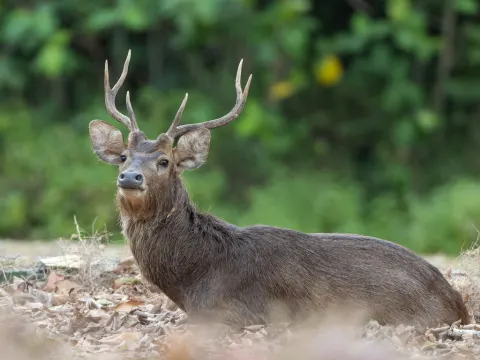
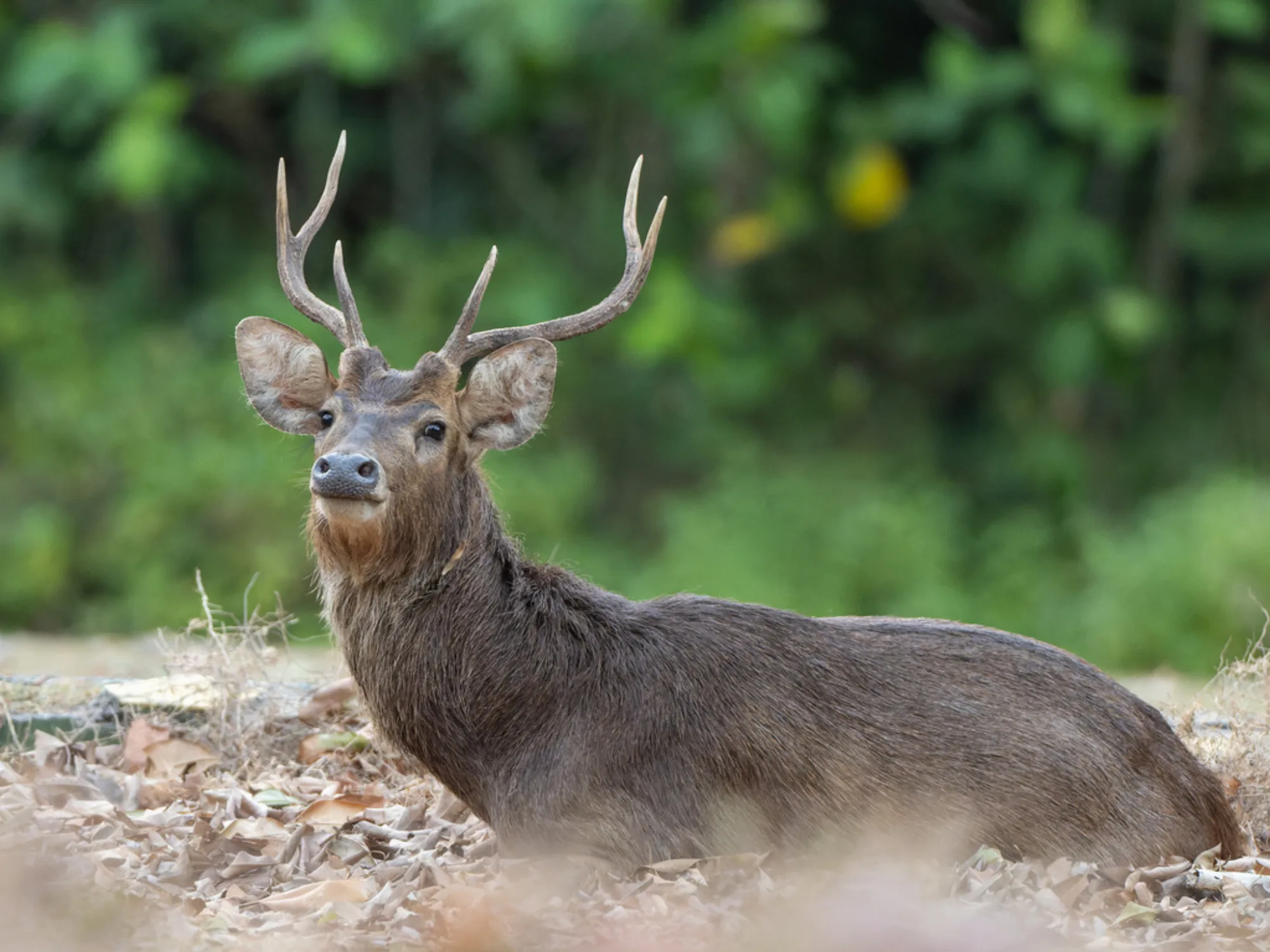
Dark blackish brown with a nearly black back, the Javan Rusa is a large deer native to Indonesia and Timor-Leste. Its grey forehead contrasts with yellowish brown underparts and inner thighs, while its coarse coat grows longer over the chest. It has wide ears and fairly broad antlers whose upper branches point forward. Males are larger than females, and fawns are born without spots.
In its native range, the deer occurs on Java, Bali and Timor, and it has also been introduced to many other places across the Southern Hemisphere. In the West Papuan lowlands, it has spread widely and is common across much of its new range. Javan rusa are nocturnal but also graze during the day, and their caution and keen senses make them difficult to approach. They are seldom seen in the open and often gather in pairs or small groups, though males are frequently alone. An alarmed stag gives a very loud honk, warning other deer nearby. Grass, leaves and fallen fruit make up most of their diet, and they get most of the fluid they need from their food.
Around July and August, stags compete with loud, shrill calls and their antlers. After a gestation of 8 months, a female gives birth to one or two calves at the start of spring. The calves are weaned at 6 to 8 months. Native populations have declined markedly, with poaching and the conversion of land destroying grazing areas among the pressures. In Indonesia's Baluran National Park, invasive thorny acacia has also reduced grazing habitat, causing large numbers of the deer to die.
Written from the English Wikipedia article Javan rusa (CC BY-SA 4.0).
- Records
- 698
- Countries
- 6
- Atlas places
- 5
These are open occurrence records, so they show where people looked for and recorded the Javan Rusa as much as where it lives. Cells are up to 25 km across, and every location is generalised to its cell.
Generalised encounter areas, not exact locations. Each shape is a grid cell coloured by how likely the species is there.
- Very likelyAustralia25 km zone · medium confidence · 601 records · updated 80 days ago
- Very likelyMalaysia25 km zone · medium confidence · 23 records · updated 80 days ago
- LikelyIndonesia25 km zone · medium confidence · 70 records · updated 80 days ago
- PossibleBrazil25 km zone · medium confidence · 2 records · updated 80 days ago
- PossibleMauritius25 km zone · medium confidence · 1 record · updated 80 days ago
- PossibleNew Caledonia25 km zone · medium confidence · 1 record · updated 80 days ago
Conservation status not assessed here yet, so every location is generalised to its grid cell.