Visayan Spotted Deer
Rusa alfredi
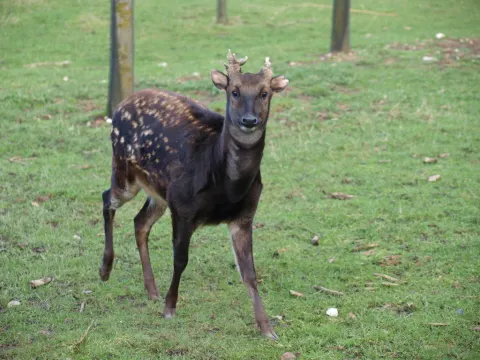
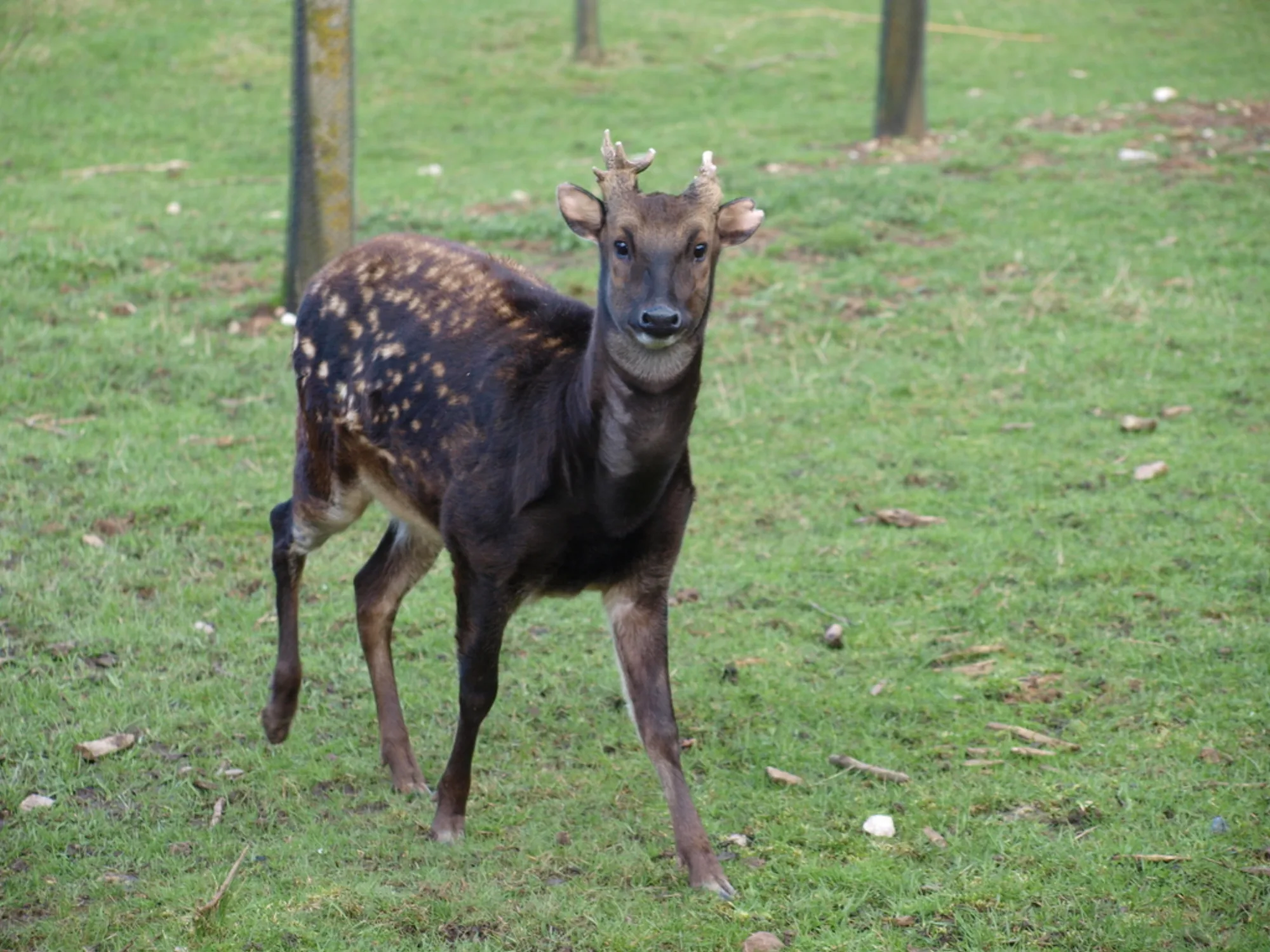
Found only in the rainforests of Panay and Negros, the Visayan Spotted Deer is a small, short-legged creature. It is easily identified by the unique A-pattern of beige spots decorating its deep brown back and sides. This animal stands 70 to 80 cm at the shoulder and possesses cream-colored underparts, with white fur on its chin and lower lip. While its head and neck are a lighter brown than its body, its eyes are circled with pale fur. Males are larger than females and carry thick, bumpy antlers.
These deer are primarily nocturnal, living in dense cogon grasslands as well as primary and secondary forests. They feed on a variety of grasses, leaves, and buds, often visiting burnt-out clearings to find floral ash. While they once lived from the shoreline up to 2,000 m above sea level, their range is now severely restricted. There is no set breeding season, and young have been seen year-round. Mothers typically give birth to a single calf after a gestation of about 240 days, and the young are mature by 12 months of age.
Survival for the species is difficult due to the destruction of its habitat. Logging and the conversion of land for agriculture have caused a devastating drop in numbers, leaving the deer in only 5% of its former range. Hunting also poses a major threat, driven by the pet trade, sport, and the sale of venison to specialty restaurants. Today, small populations survive in remote areas like Mt. Canlaon National Park and the North Negros Forest Reserve, where researchers have used camera traps to document their presence.
Written from the English Wikipedia article Visayan spotted deer (CC BY-SA 4.0).
- Atlas places
- 0
These are open occurrence records, so they show where people looked for and recorded the Visayan Spotted Deer as much as where it lives. Cells are up to 25 km across, and every location is generalised to its cell.
No encounter zones yet
Where and when you can expect to see Visayan Spotted Deer is calculated from observation density. No zones have been computed for this species yet.