Andean Cock-of-the-rock
Rupicola peruvianus
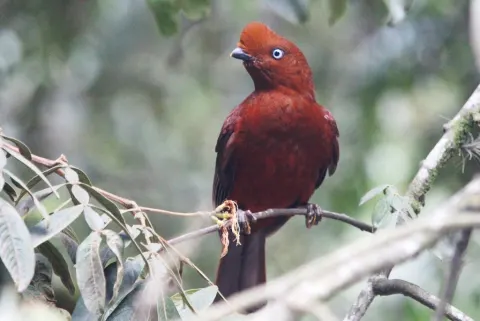
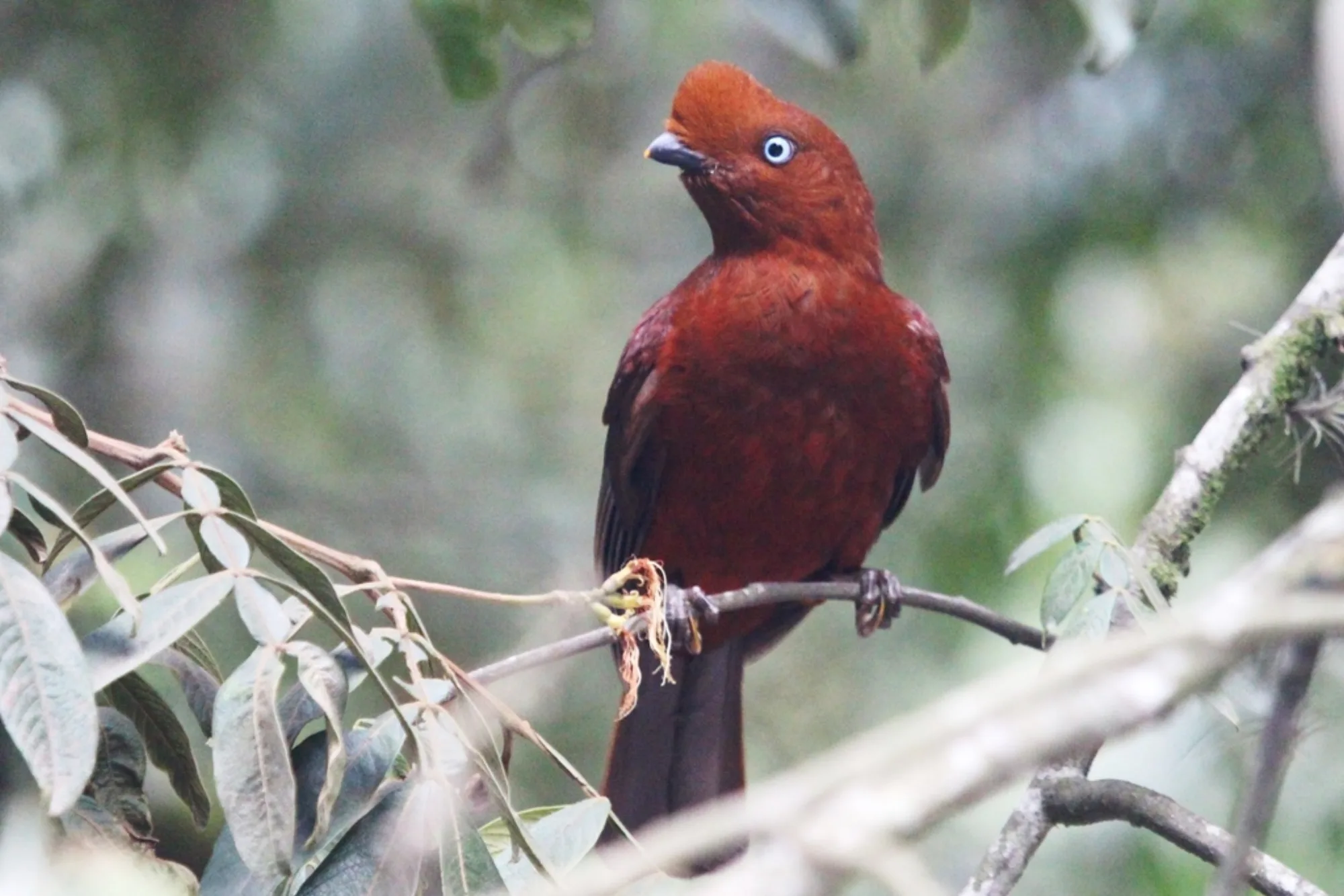
A flash of scarlet or orange may reveal a male Andean Cock-of-the-rock, a large cotinga with a rounded, disk-like crest, black wings and a black tail. The female is browner and less conspicuous, with a smaller crest. About 32 cm long, the bird weighs around 265 grams; males tend to be larger, and the largest specimens can weigh 300 grams. Foraging birds give a loud “tank?” call when disturbed or flying.
Its range follows the cloud forests of the Andes through Venezuela, Colombia, Ecuador, Peru and Bolivia. It favours ravines and forested streams in mountains, mostly at elevations of 500 to 2,400 m. Look in the lower and middle levels of the forest, though the bird also goes higher into fruiting trees and sometimes crosses clearings. Shy and inconspicuous, it may be glimpsed only briefly when flushed or as it flies swiftly down a valley. Fruit and insects make up most of its diet, with lizards and frogs also recorded; the birds have been seen following army ants.
Males gather at communal display sites, known as leks, where they challenge rivals and call to females. They bow, jump and flap their wings, sometimes snapping their bills, while giving squawking and grunting calls. The birds are easily disturbed, making these displays difficult to watch. The female builds a cup-shaped nest of mud and vegetation on a cave entrance or rocky outcrop, then incubates the eggs and raises the young alone. Habitat destruction affects the species, while displaying males can attract predators, including forest-falcons, ocelots and boa constrictors.
Written from the English Wikipedia article Andean cock-of-the-rock (CC BY-SA 4.0).
- Records
- 49,242
- Countries
- 5
- Atlas places
- 3
These are open occurrence records, so they show where people looked for and recorded the Andean Cock-of-the-rock as much as where it lives. Cells are up to 25 km across, and every location is generalised to its cell.
Generalised encounter areas, not exact locations. Each shape is a grid cell coloured by how likely the species is there.
- Very likelyEcuador25 km zone · high confidence · 20666 records · updated 80 days ago
- Very likelyColombia25 km zone · high confidence · 17816 records · updated 80 days ago
- Very likelyPeru25 km zone · high confidence · 10189 records · updated 80 days ago
- LikelyBolivia25 km zone · medium confidence · 312 records · updated 80 days ago
- LikelyVenezuela25 km zone · high confidence · 259 records · updated 80 days ago
Conservation status not assessed here yet, so every location is generalised to its grid cell.