Alpine Chamois
Rupicapra rupicapra
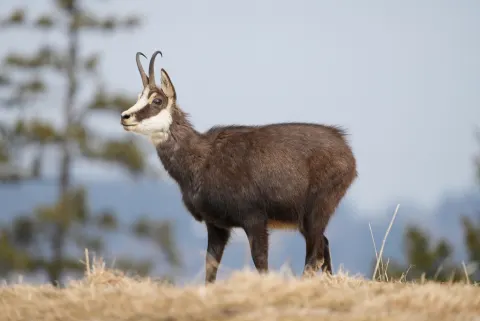
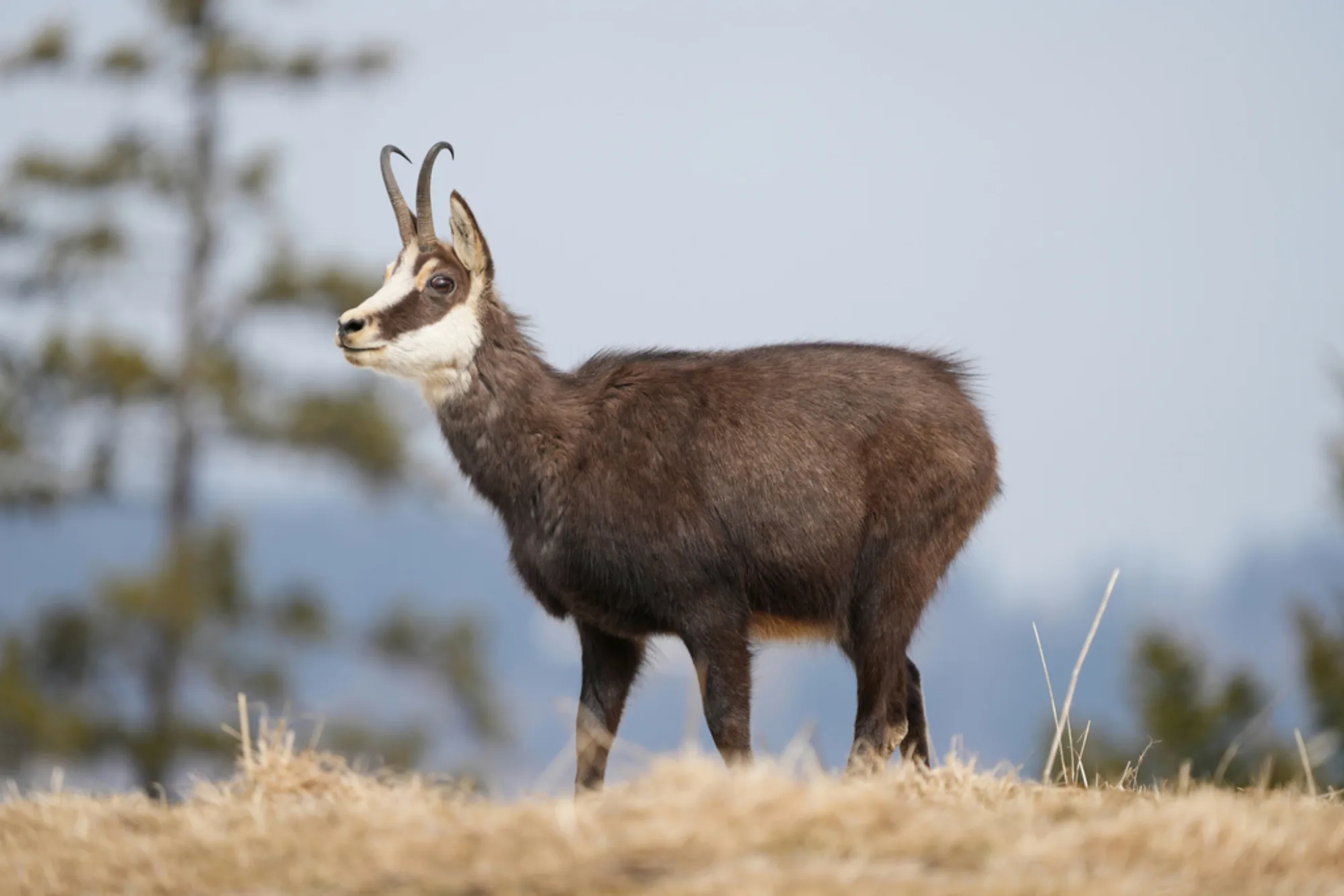
On steep mountain ground, the Alpine Chamois is a small goat-antelope with short horns that curve backwards at their tips. Both sexes have horns, though those of males are thicker. Its coat changes from rich brown in summer to light grey in winter, with white on the sides of the head and rump, dark lines beneath the eyes and a black stripe down the back. An adult stands 70 to 80 cm high, and males are slightly larger than females.
Its native range stretches across the mountains of southern and central Europe, Turkey and the Caucasus, and it has also been introduced to New Zealand's South Island. Chamois favour steep, rugged, rocky terrain, reaching elevations of at least 3,600 m. In Europe they spend summer in alpine meadows above the tree line, then move down to pine-dominated forests around 800 m for winter. They eat highland grasses and herbs in summer, switching to conifers, bark and tree needles in winter. Mainly active by day, they often rest around midday and sometimes forage on moonlit nights.
Females and their young live together in groups that can number 15 to 30, while adult males generally spend most of the year alone. A mother usually gives birth to one kid in May or early June, and other females may try to raise it if its mother dies. Humans are now the main predators, and chamois are hunted for meat. Avalanches and epidemics also cause deaths. To escape predators, chamois rely on speed and stealth, running at up to 50 km/h.
Written from the English Wikipedia article Chamois (CC BY-SA 4.0).
- Records
- 431,543
- Countries
- 15
- Atlas places
- 3
These are open occurrence records, so they show where people looked for and recorded the Alpine Chamois as much as where it lives. Cells are up to 25 km across, and every location is generalised to its cell.
Generalised encounter areas, not exact locations. Each shape is a grid cell coloured by how likely the species is there.
- Very likelySwitzerland25 km zone · high confidence · 279531 records · updated 86 days ago
- Very likelyFrance25 km zone · high confidence · 83186 records · updated 86 days ago
- Very likelyItaly25 km zone · high confidence · 60886 records · updated 86 days ago
- Very likelyAustria25 km zone · high confidence · 7650 records · updated 86 days ago
- LikelyGermany25 km zone · high confidence · 237 records · updated 86 days ago
- PossibleMontenegro25 km zone · medium confidence · 10 records · updated today
- PossiblePoland25 km zone · medium confidence · 10 records · updated today
- PossibleCroatia25 km zone · medium confidence · 8 records · updated today
- PossibleNew Zealand25 km zone · medium confidence · 8 records · updated today
- PossibleSlovenia25 km zone · medium confidence · 8 records · updated today
Conservation status not assessed here yet, so every location is generalised to its grid cell.