Barasingha
Rucervus duvaucelii
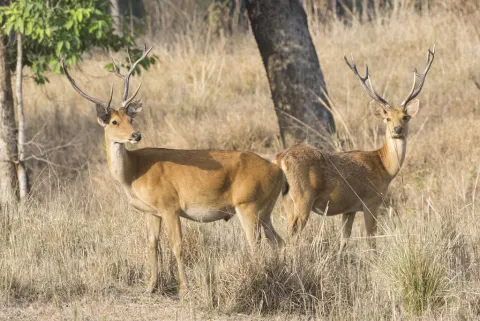
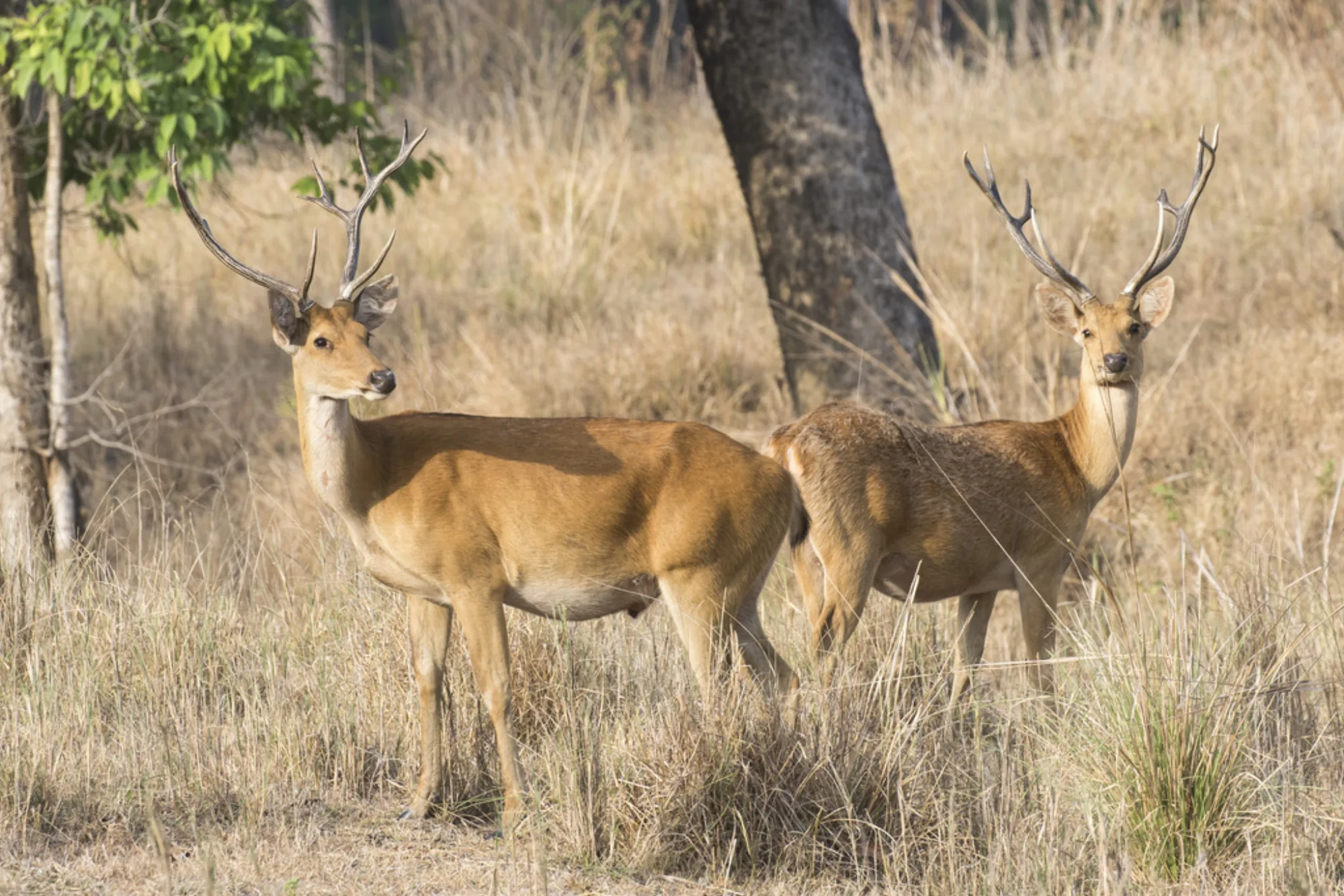
Commonly known as the swamp deer, the Barasingha is a large species distinguished by its complex antlers. While other Indian deer possess fewer branches, mature stags of this variety usually carry 10 to 14 tines, and sometimes as many as 20. This trait earned them their Hindi name, which translates to twelve-horned. These deer stand up to 46 in at the shoulder and display a yellowish brown woolly coat that turns a bright rufous-brown during the summer months. White spots run along the spine, and a mane decorates the neck.
These grazers inhabit the Indian subcontinent, though their range is now fragmented across northern and central India and parts of southwestern Nepal. They are primarily found in floodplains, marshes and flat grasslands, often staying near the edges of forests. Their diet consists of grasses and various aquatic plants. Unlike more cautious relatives, they appear relatively relaxed and spend much of their day feeding in herds. These groups typically average between 8 and 20 members, though they can swell to 60 individuals. Breeding occurs from September to April, resulting in the birth of a single calf.
Survival is difficult as their former range has been drastically reduced. Large areas of their natural wetlands were converted into cropland, leaving only isolated fragments of suitable territory. Even within protected zones, they face threats from shifting river dynamics and people entering the land to harvest timber, grass and fuel. Outside these refuges, poaching for meat and antlers remains a serious danger. Despite these pressures, conservation efforts in places like Kanha National Park have helped some populations recover from the brink of disappearance.
Written from the English Wikipedia article Barasingha (CC BY-SA 4.0).
- Records
- 4
- Countries
- 1
- Atlas places
- 0
These are open occurrence records, so they show where people looked for and recorded the Barasingha as much as where it lives. Cells are up to 25 km across, and every location is generalised to its cell.
Generalised encounter areas, not exact locations. Each shape is a grid cell coloured by how likely the species is there.
- Very likelyIndia25 km zone · medium confidence · 4 records · updated 4 days ago
Conservation status not assessed here yet, so every location is generalised to its grid cell.