Volcano Rabbit
Romerolagus diazi
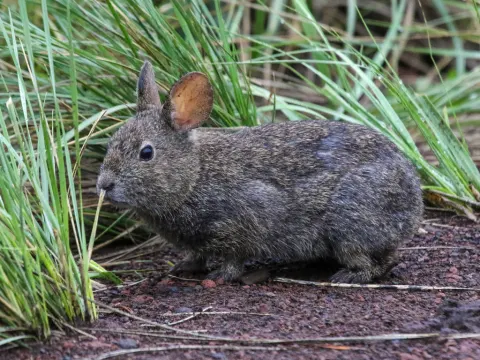
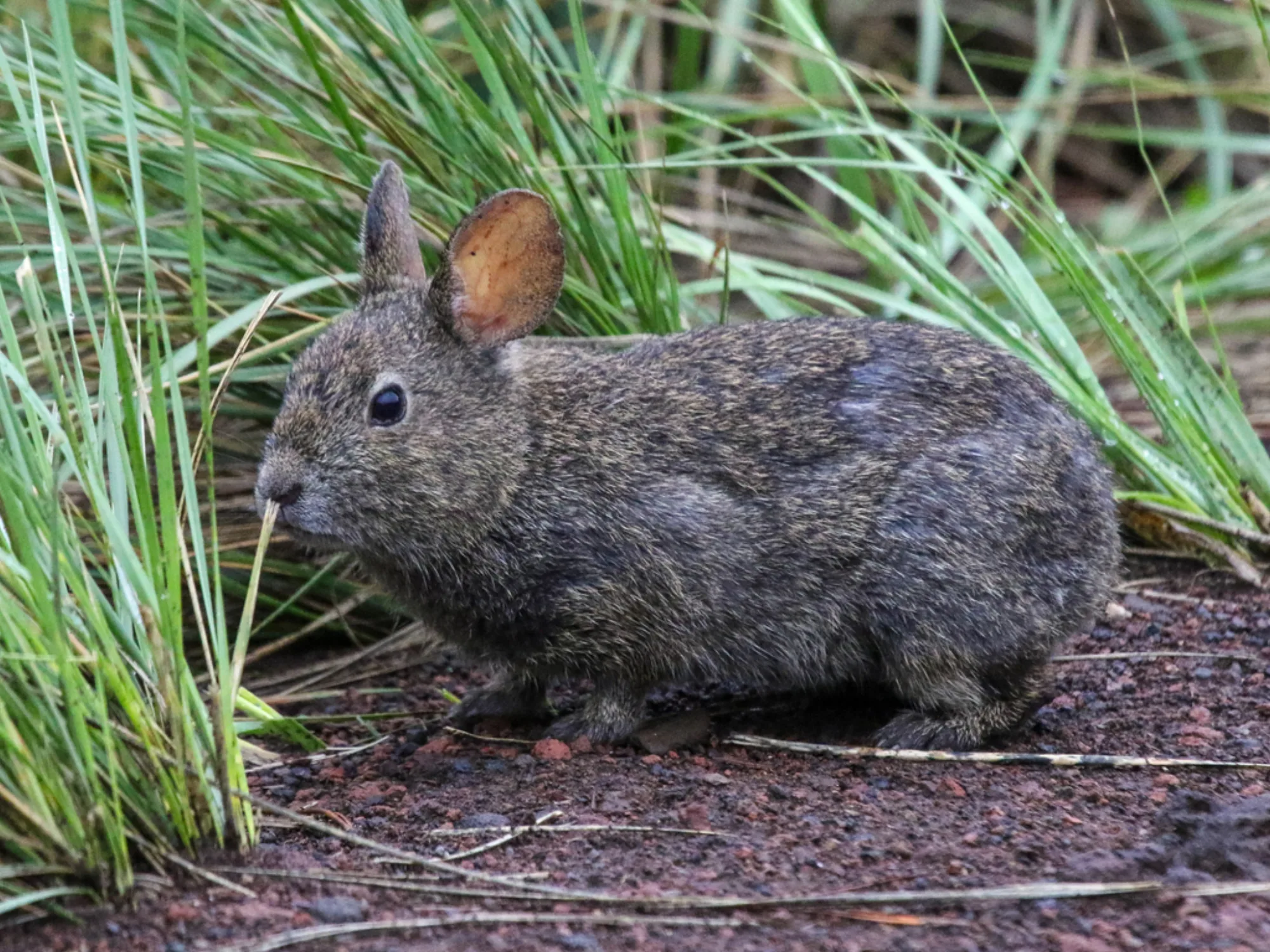
Small and round-eared, the Volcano Rabbit has short legs and dense, yellowish-brown fur that blends with the volcanic soil. Adults measure 23.4 to 31.1 centimetres in total length and weigh 386 to 602 g. Its coat is softer underneath and more buff around the nose, eyes and bases of the ears. Found southeast of Mexico City, this rabbit lives on volcanic slopes in alpine scrub and thickly vegetated pine and alder forests. It favours tall, dense bunchgrasses, which provide cover as well as food. The rabbits are commonly found at elevations of 3,150 to 3,400 metres, though they can occur higher and lower.
Volcano rabbits live in groups of two to five, with activity peaking around dawn and in the evening. They make well-used paths through the grasses and dig burrows with entrances beneath dense clumps or in cracks in the soil. When danger approaches, a rabbit gives a high-pitched call to warn its group. Grasses form the main part of the diet, supplemented by other plants, including flowers, seeds, roots, leaves and bulbs. Females produce up to three young per litter, in shallow ground nests lined with grass, plant fragments and fur. Nests are built from April to September.
The rabbit's habitat has been broken into isolated patches by human disturbance. Farming and urban expansion, logging, grass harvesting and livestock grazing all put pressure on its range. Hunting and fires can harm rabbits even inside national parks, while feral dogs around villages may prey on them. Rising temperatures may also push the species to higher elevations where habitat is less suitable.
Written from the English Wikipedia article Volcano rabbit (CC BY-SA 4.0).
- Records
- 40
- Countries
- 1
No atlas park has a record of the Volcano Rabbit in or around it yet.
These are open occurrence records, so they show where people looked for and recorded the Volcano Rabbit as much as where it lives. Cells are up to 25 km across, and every location is generalised to its cell.
Generalised encounter areas, not exact locations. Each shape is a grid cell coloured by how likely the species is there.
- Very likelyMexico25 km zone · medium confidence · 40 records · updated 80 days ago
Conservation status not assessed here yet, so every location is generalised to its grid cell.