Willie Wagtail
Rhipidura leucophrys
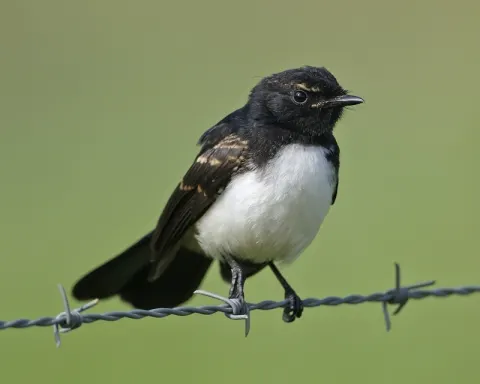
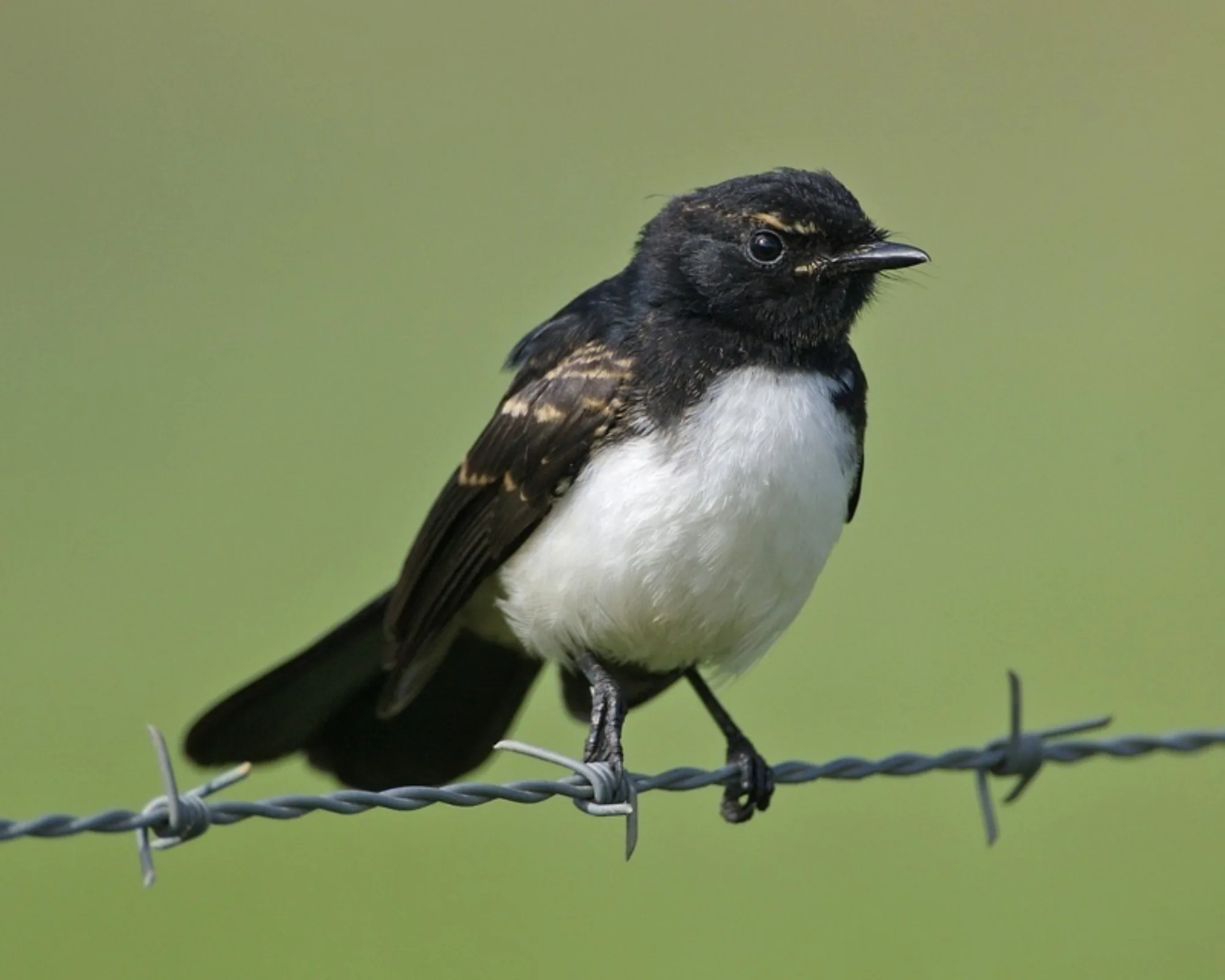
A black-and-white fantail with a restless tail, the Willie Wagtail measures 19 to 21.5 cm in length. Its head, wings and tail are black, contrasting with white underparts, eyebrows and markings beside the bill. Males and females look alike, while young birds have duller plumage with a brown tinge. Its calls range from a rapid, scolding alarm to more melodious sounds.
The bird occurs across most of Australia and New Guinea, with its range extending through eastern Indonesia and the Bismarck Archipelago to the Solomon Islands. Look for it near water in grassland dotted with trees or in partly open woodland, though it avoids dense forest. It also hunts on lawns and in gardens, parks and sporting grounds. Usually seen alone or in pairs, it spends much of its time on the ground and flicks its tail even while perched. It catches flying insects and sometimes follows people or grazing animals to seize small creatures disturbed in the grass. Fiercely territorial, it may harass birds much larger than itself, including kookaburras and wedge-tailed eagles.
Pairs usually stay together for life and breed from July to December, sometimes raising up to four broods. Their cup-shaped nest, made from grass, bark and other fibres bound with spider web, can be placed on a branch, rafter or eave. Both parents feed the chicks, which leave the nest after around 14 days. Despite the adults' vigorous defence, many eggs and young are lost to predators, including butcherbirds, currawongs, feral cats and rats. Nests near homes can also be destroyed by children.
Written from the English Wikipedia article Willie wagtail (CC BY-SA 4.0).
- Records
- 738,218
- Countries
- 4
- Atlas places
- 7
These are open occurrence records, so they show where people looked for and recorded the Willie Wagtail as much as where it lives. Cells are up to 25 km across, and every location is generalised to its cell.
Generalised encounter areas, not exact locations. Each shape is a grid cell coloured by how likely the species is there.
- Very likelyAustralia25 km zone · high confidence · 731388 records · updated 86 days ago
- Very likelyPapua New Guinea25 km zone · high confidence · 3543 records · updated 86 days ago
- Very likelyIndonesia25 km zone · high confidence · 2749 records · updated 86 days ago
- LikelySolomon Islands25 km zone · high confidence · 538 records · updated today
Conservation status not assessed here yet, so every location is generalised to its grid cell.