New Zealand Fantail
Rhipidura fuliginosa
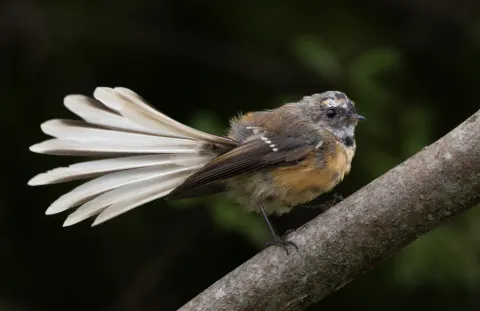
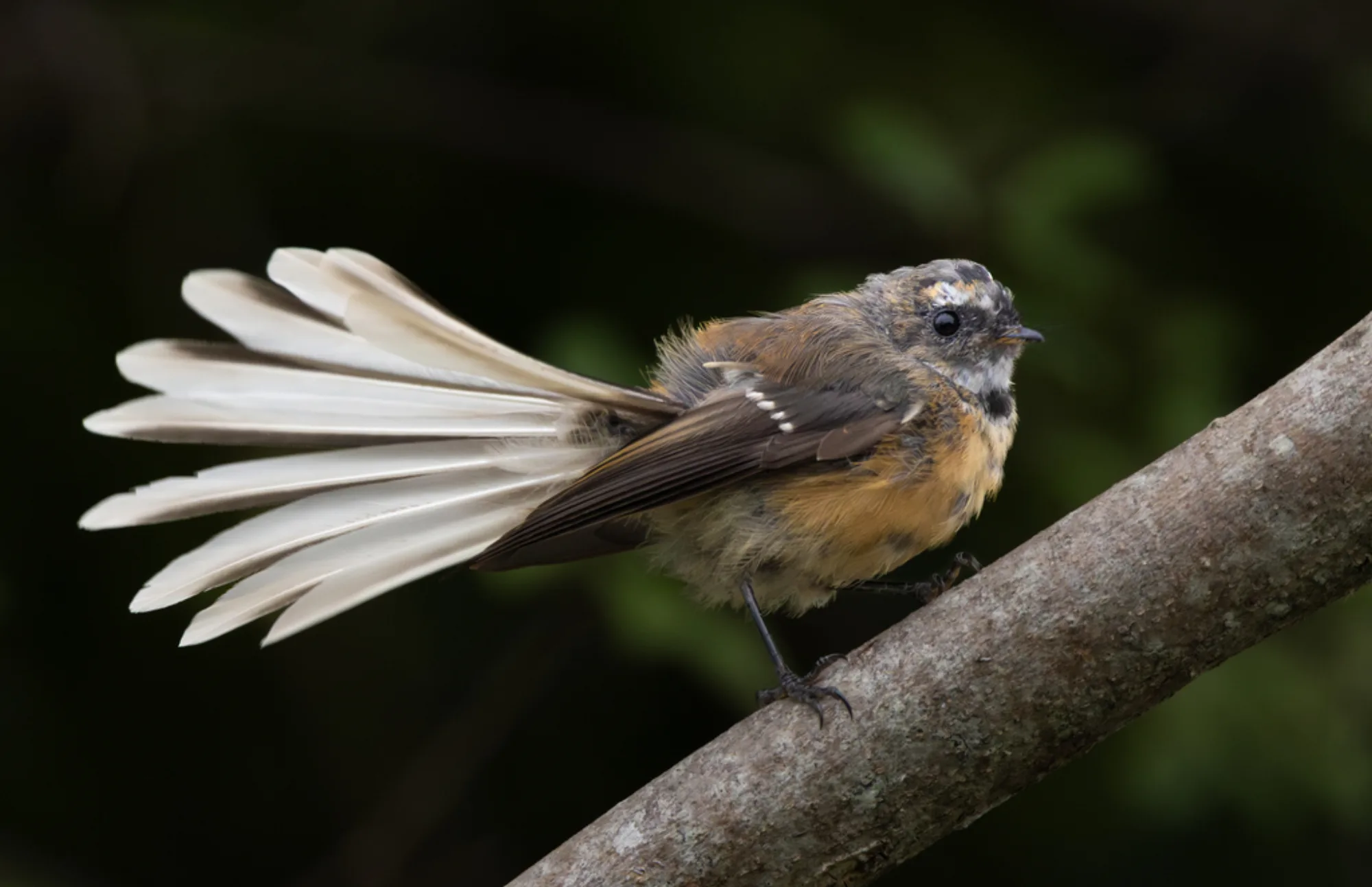
A small bird with a tail often spread into a fan, the New Zealand Fantail is an active hunter of insects. It grows to 16 cm long, with the tail accounting for half its length. Most have grey to grey-brown upperparts, yellowish-orange underparts, a white throat and a dark band across the chest. White markings sit above the eye, while the outer tail feathers are pale and the central ones dark. An uncommon black form is dark almost all over, with a white spot behind the eye; young birds are browner than adults, with less distinct markings.
Fantails live on New Zealand's North and South Islands and the Chatham Islands, and can be seen in forested areas and suburban gardens. They are rarely still during daylight, moving from perch to perch as they watch for flying insects. They often come within a few metres of people, catching small insects disturbed by walking or digging. In cold weather, fantails huddle together for warmth. Listen for an almost metallic cheek, often repeated in a chatter.
On the North Island, nesting runs from August through March; on the South Island, it starts in September and ends in January. On the Chatham Islands, nesting lasts from October to January. Both adults build a compact cup of moss, bark and fibre, usually in a tree fork, and often finish it with spider's web. They share incubation and feeding, and usually raise two or more broods in a season. Nests can be parasitised by cuckoos or taken by predators: in a monitored group of urban Wellington nests, just over one in four suffered predation. Ship rats were less likely to prey on nests placed on thin branches than on thick ones.
Written from the English Wikipedia article New Zealand fantail (CC BY-SA 4.0).
- Records
- 206,870
- Countries
- 4
- Atlas places
- 11
- Fiordland National Park· New Zealand
- Mount Aspiring National Park· New Zealand
- Arthur's Pass National Park· New Zealand
- Tongariro National Park· New Zealand
- Westland Tai Poutini National Park· New Zealand
- Abel Tasman National Park· New Zealand
- Aoraki / Mount Cook National Park· New Zealand
- Catlins Conservation Park· New Zealand
- Paparoa National Park· New Zealand
- Rakiura National Park· New Zealand
- Blue Mountains National Park· Australia
These are open occurrence records, so they show where people looked for and recorded the New Zealand Fantail as much as where it lives. Cells are up to 25 km across, and every location is generalised to its cell.
Generalised encounter areas, not exact locations. Each shape is a grid cell coloured by how likely the species is there.
- Very likelyNew Zealand25 km zone · high confidence · 197179 records · updated 86 days ago
- Very likelyAustralia25 km zone · high confidence · 9683 records · updated 86 days ago
- UncommonNorfolk Island25 km zone · medium confidence · 5 records · updated today
- RareVanuatu25 km zone · medium confidence · 3 records · updated today
Conservation status not assessed here yet, so every location is generalised to its grid cell.