Cownose Ray
Rhinoptera bonasus
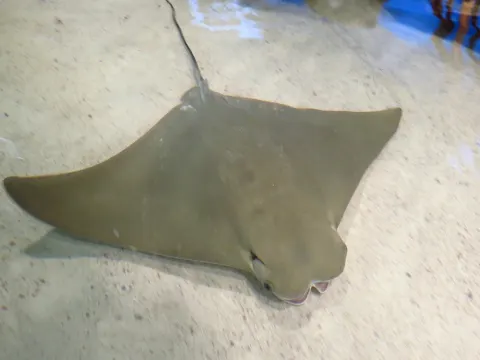
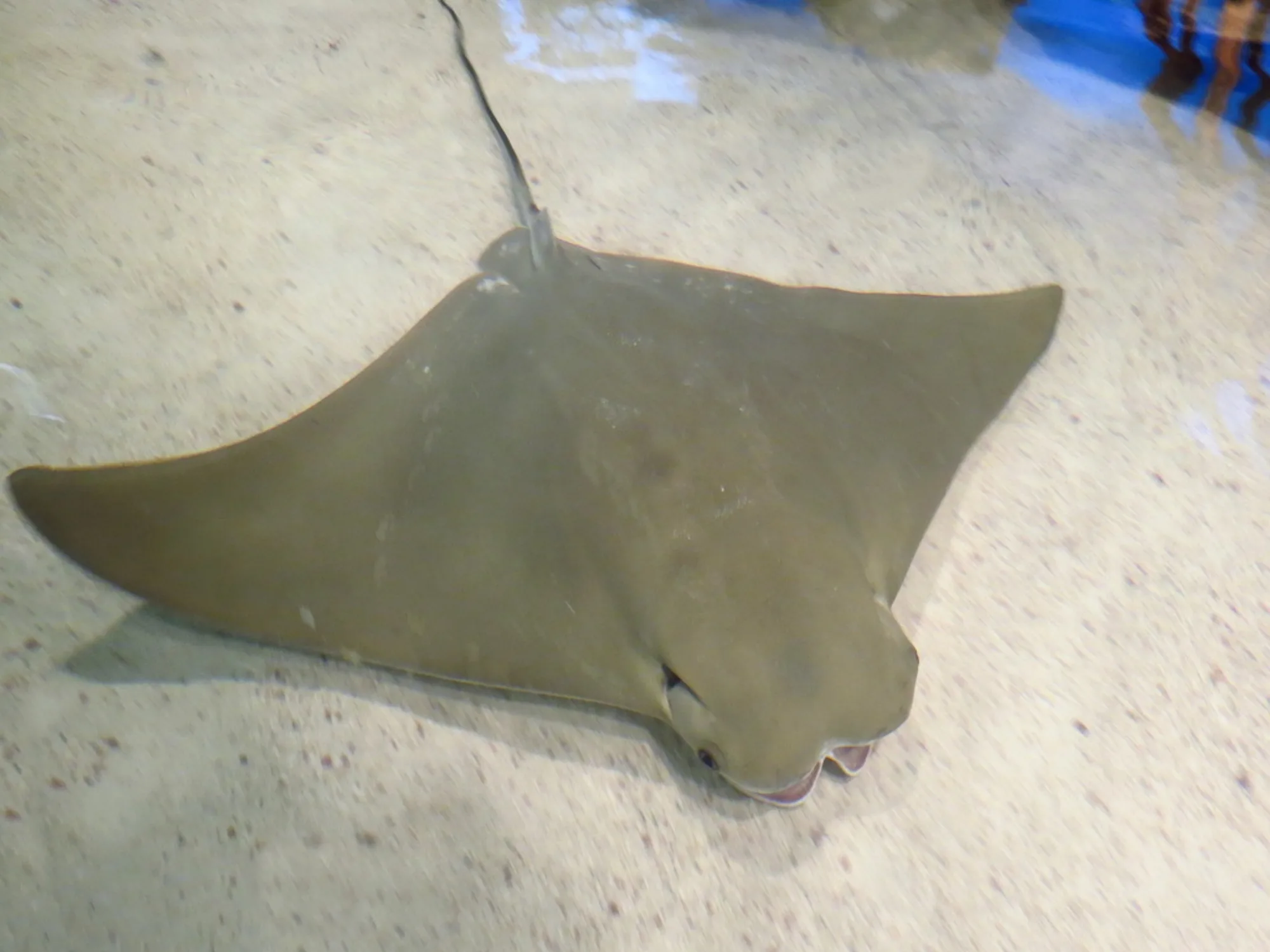
Two lobes at the front of its broad head give the Cownose Ray a shape that recalls a cow's nose. Its back is typically brown, while its underside is pale white or yellow. Males often grow to about 0.76 m across, and females typically reach about 0.9 m. At the surface, the tips of its fins can be mistaken for a shark's fin. If threatened, the ray can defend itself with a barb near the base of its tail.
From New England to southern Brazil, Cownose rays inhabit a broad stretch of the western Atlantic as well as the Caribbean. They favour shallow coastal waters and estuaries and can tolerate a wide range of salinities. Social and migratory, they often travel in large schools grouped by size and sex, heading towards northern waters in late spring before returning south as autumn draws on. Chesapeake Bay is a place to see them in late spring and summer, when they gather near the surface to breed and use the area as a nursery. On the ocean bottom, they feed on hard-shelled animals, favouring scallops and clams, often in the early morning or late afternoon when waves are calm. Their jaws crush shells, while suction helps them capture prey.
Breeding takes place from April through October, and young develop inside their mother before being born live. Gestation is believed to last 11 to 12 months, and females do not reach maturity until about 7 to 8 years old. Commercial fishing and overfishing threaten the species, partly because rays have been blamed for damaging oyster beds. Their late maturity and long gestation make it difficult for populations to recover from overfishing.
Written from the English Wikipedia article Cownose ray (CC BY-SA 4.0).
- Records
- 23,481
- Countries
- 5
No atlas park has a record of the Cownose Ray in or around it yet.
These are open occurrence records, so they show where people looked for and recorded the Cownose Ray as much as where it lives. Cells are up to 25 km across, and every location is generalised to its cell.
Generalised encounter areas, not exact locations. Each shape is a grid cell coloured by how likely the species is there.
- Very likelyUnited States25 km zone · high confidence · 23460 records · updated 80 days ago
- LikelyMauritania25 km zone · medium confidence · 15 records · updated 80 days ago
- PossibleSenegal25 km zone · medium confidence · 4 records · updated 80 days ago
- PossibleMexico25 km zone · medium confidence · 2 records · updated 80 days ago
- RareColombia25 km zone · low confidence · 0 records · updated 80 days ago
Conservation status not assessed here yet, so every location is generalised to its grid cell.