Helmeted Hornbill
Rhinoplax vigil
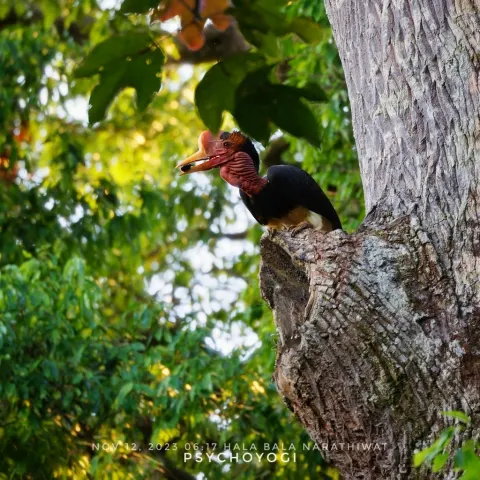
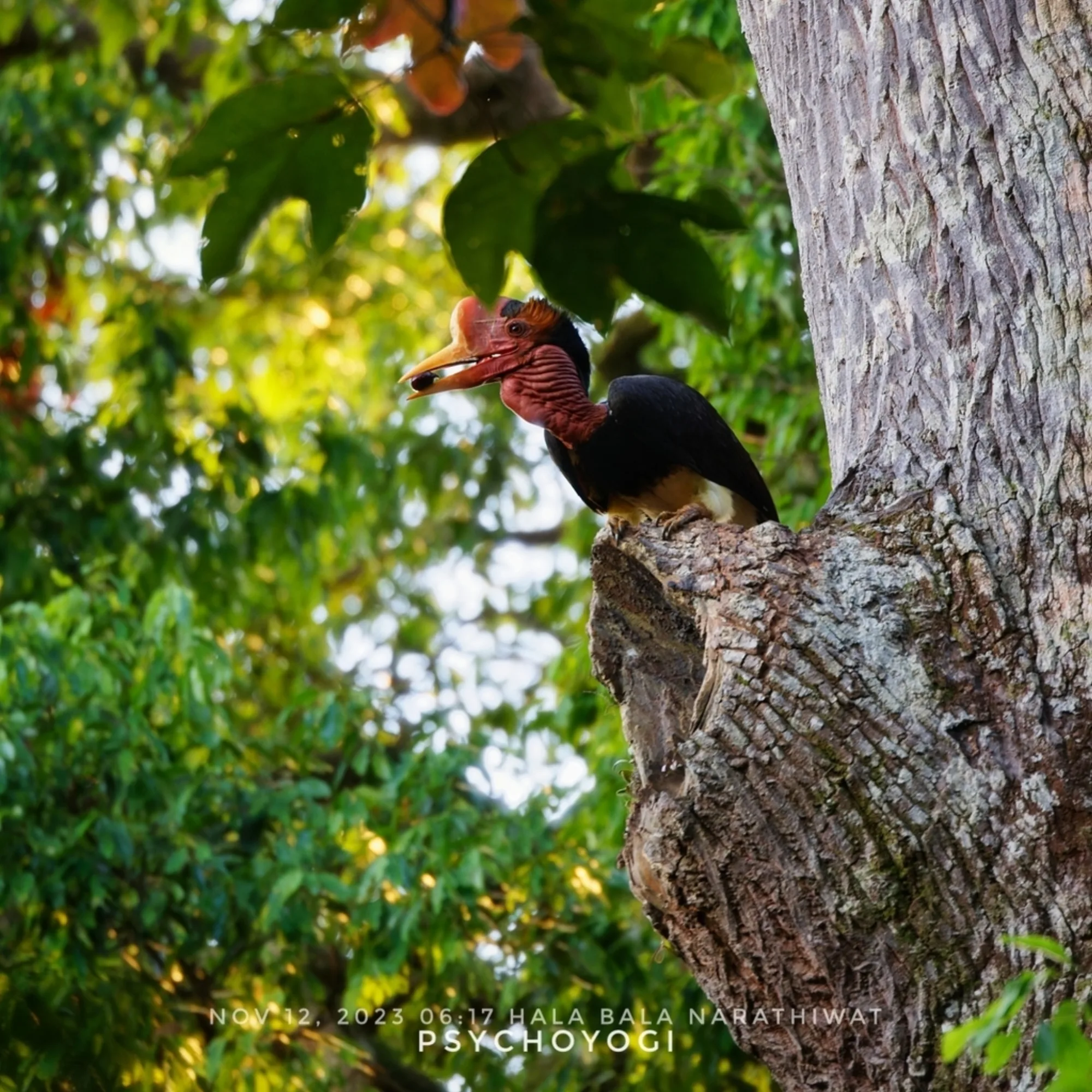
A long white tail, a heavy bill and a helmetlike casque give the Helmeted Hornbill a distinctive outline. Most of its plumage is blackish, with white on the belly and legs and a dark stripe towards the end of each tail feather. Two central tail feathers extend well beyond the others, adding 50 cm to a body length of 110 to 120 cm. The bill and casque are yellow, though red colouring covers much of the helmet and reaches onto the bill. Females have a pale blue to greenish bare throat patch, while the male's is red.
Listen for a series of loud, spaced hoots that gather speed and end in a laughing cackle. The call can carry 2 to 3 km and continue for minutes at a time. The bird is found in forests, with a range that includes Myanmar and Thailand, the Malay Peninsula, Sumatra and Borneo. It feeds mostly on the fruit of strangler figs and is thought to be territorial and to have one mate. Males defend territory in the air, flying at one another and colliding with their casques.
Breeding takes place once a year, with a single chick. Mother and chick remain inside a sealed tree cavity until the young bird is five months old. This nesting behaviour leaves them especially exposed to poaching and deforestation, while hunting and habitat loss have also put pressure on the species. The casque provides hornbill ivory, a valuable material for carving, and traders buy hornbill heads for sale.
Written from the English Wikipedia article Helmeted hornbill (CC BY-SA 4.0).
- Records
- 13
- Countries
- 2
No atlas park has a record of the Helmeted Hornbill in or around it yet.
These are open occurrence records, so they show where people looked for and recorded the Helmeted Hornbill as much as where it lives. Cells are up to 25 km across, and every location is generalised to its cell.
Generalised encounter areas, not exact locations. Each shape is a grid cell coloured by how likely the species is there.
- Very likelyMalaysia25 km zone · medium confidence · 10 records · updated 80 days ago
- LikelyIndonesia25 km zone · medium confidence · 3 records · updated 80 days ago
Conservation status not assessed here yet, so every location is generalised to its grid cell.