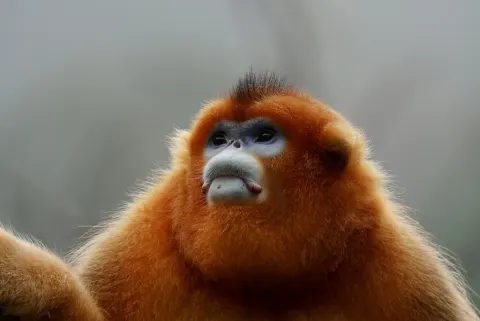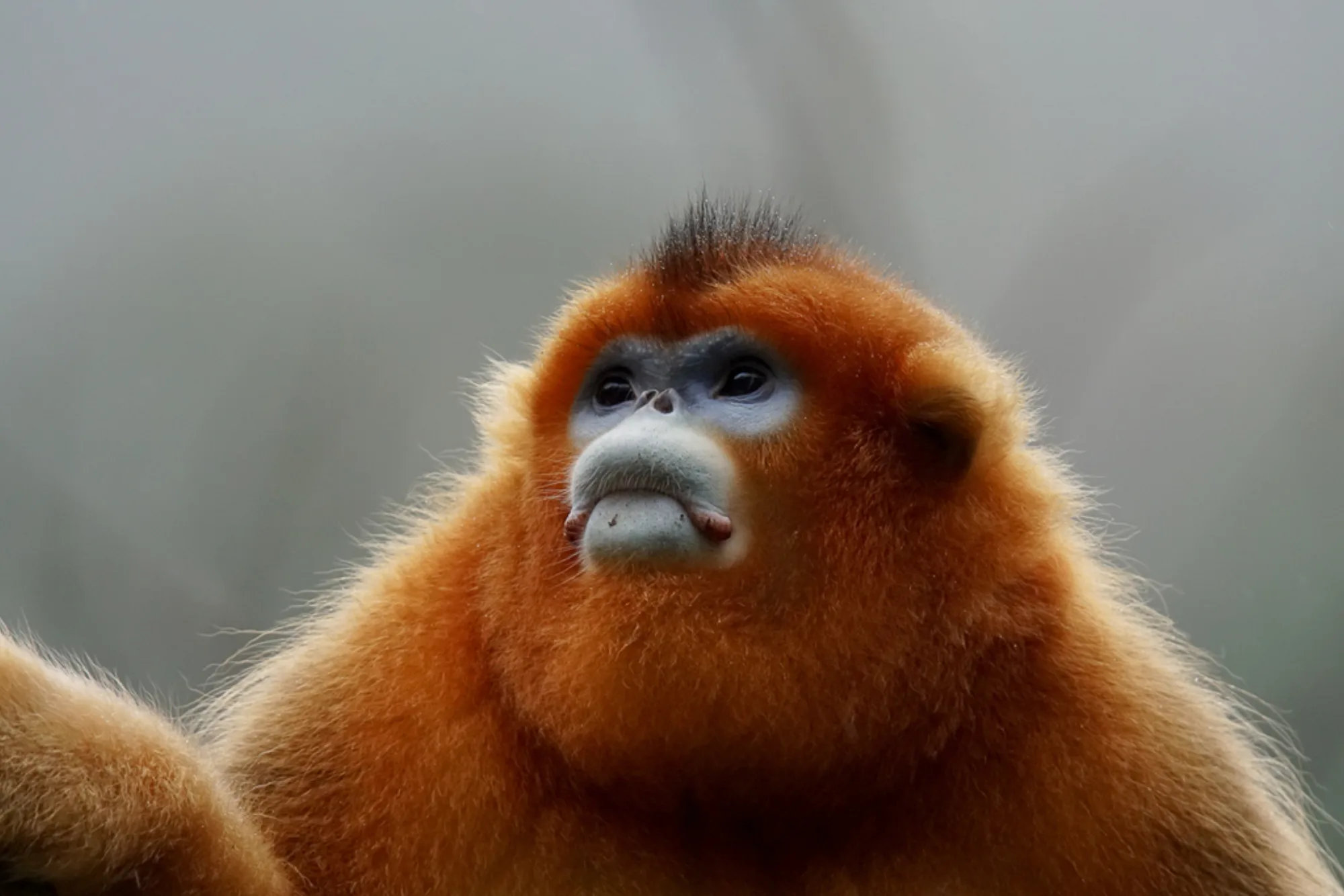
Golden Snub-nosed Monkey
Rhinopithecus roxellana
Long golden hairs sweep across the back and shoulders of an adult male Golden Snub-nosed Monkey, contrasting with deep brown on its arms and outer thighs. Females are smaller, with shorter golden hairs on the back and shoulders. This Old World monkey lives in temperate mountain forests in central and southwestern China, at elevations of 1,500 to 3,400 m. Its range includes Sichuan, Gansu, Shaanxi and Hubei, where snow is frequent. Forests change with altitude, from broadleaf trees lower down to mixed and then coniferous woodland higher up.
Active by day, the monkeys spend about 97% of their time in the canopy, though they sometimes forage on the ground. Groups range from 5 to 10 individuals to bands of about 600, with several smaller family units forming larger gatherings. Each family unit has one adult male, several adult females and their offspring. Females form close associations with one another, and group members help protect the young when danger threatens. At night, monkeys often sleep together in the lower canopy, sheltering from the cold and wind above. Births take place from March to June, and mothers may have help caring for their young.
Food changes with the seasons, but lichens are the main part of the diet overall, alongside young leaves, fruit or seeds, buds, bark and flowers. At Shennongjia Nature Reserve, lichens make up much of the diet from November to April, while fruit or seeds become more available in summer. Habitat loss threatens the species: harvesting dead trees removes a rich source of lichens, reducing both habitat quality and food availability.
Written from the English Wikipedia article Golden snub-nosed monkey (CC BY-SA 4.0).
- Records
- 4
- Countries
- 1
No atlas park has a record of the Golden Snub-nosed Monkey in or around it yet.
These are open occurrence records, so they show where people looked for and recorded the Golden Snub-nosed Monkey as much as where it lives. Cells are up to 25 km across, and every location is generalised to its cell.
Generalised encounter areas, not exact locations. Each shape is a grid cell coloured by how likely the species is there.
- Very likelyChina25 km zone · medium confidence · 4 records · updated 80 days ago
Conservation status not assessed here yet, so every location is generalised to its grid cell.