Ribbon Eel
Rhinomuraena quaesita
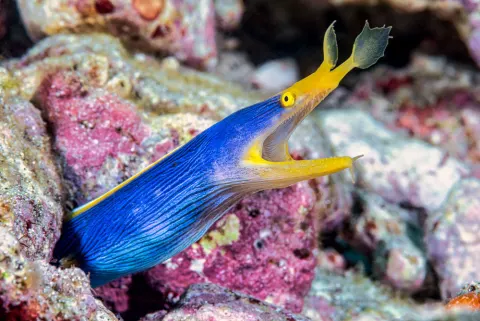
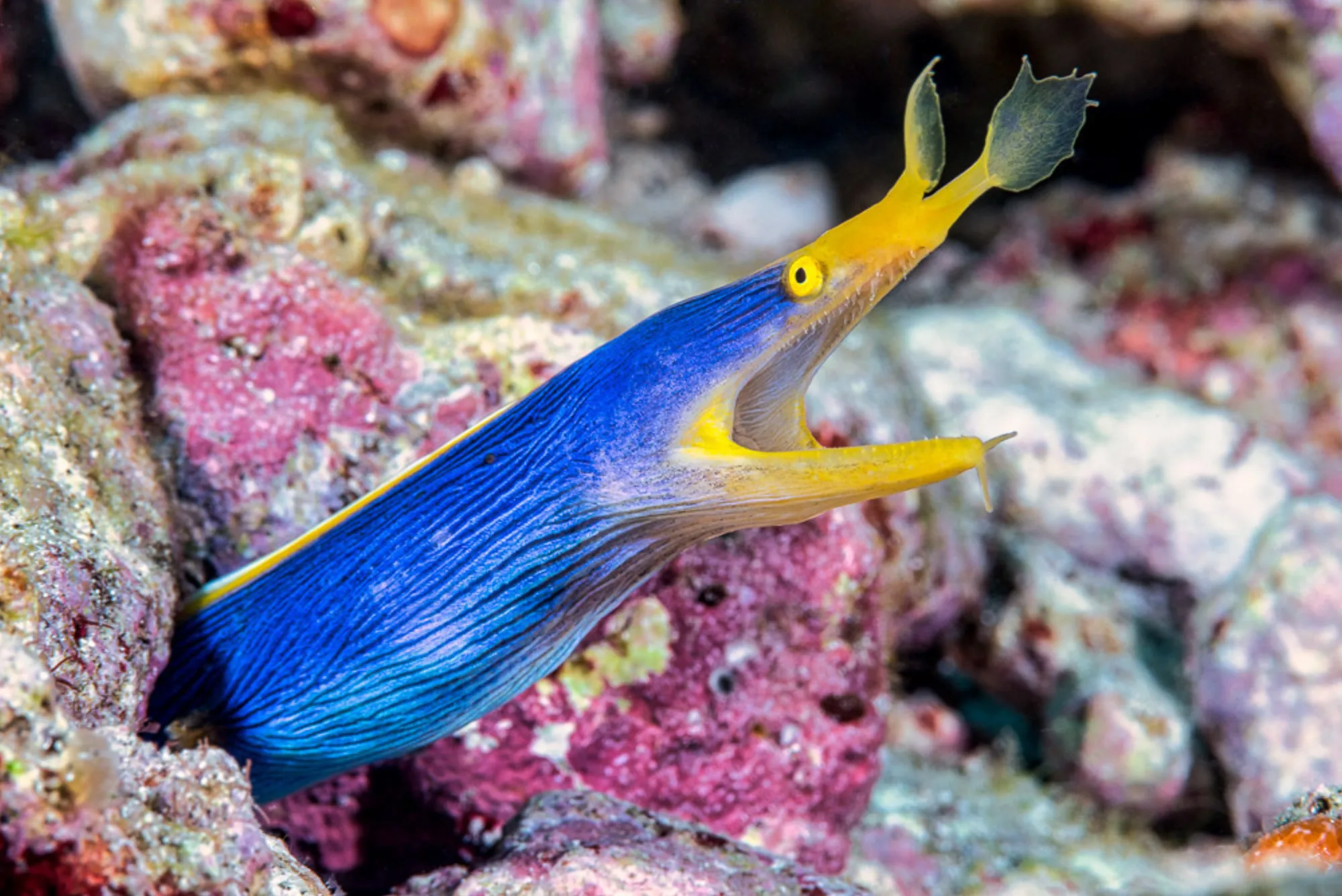
Look for a long, slender body, a high dorsal fin, enlarged nostrils and a wide-open mouth: these are the features that help distinguish the Ribbon Eel, a moray found in the Indo-Pacific. Young and subadult eels are chiefly black with a yellow dorsal fin, while adult males have blue and yellow faces. Adult females are yellow throughout or have some blue towards the tail. Males measure 65 to 94 cm, while females can reach 130 cm.
Ribbon eels inhabit tropical waters across the Indian and Pacific Oceans, with a range extending eastward from East Africa as far as French Polynesia and north to southern Japan; they are also found around Australia. They favour relatively shallow water, at depths of 1 to 57 meters, and use sand burrows and reefs. In Indonesian waters, divers see them with their heads and the front of their bodies projecting from crevices among sand and rubble, including on coral reefs. Active during the day, they can live for up to twenty years in their natural habitat. Ribbon eels change from male to female, and females lay eggs. The species has also spawned in a few public aquaria in Europe and North America.
Coral bleaching and damage to marine habitats from climate change or pollution pose potential threats, especially in the shallow reef habitats these eels favour. Habitat changes could leave the eels with too little food to support their survival and breeding. Overfishing is another concern, reducing both eel numbers and the prey available to them. Ribbon eels are also captured for the aquarium industry, and many have been observed refusing food after being placed in home aquariums.
Written from the English Wikipedia article Ribbon eel (CC BY-SA 4.0).
- Records
- 115
- Countries
- 14
- Atlas places
- 2
These are open occurrence records, so they show where people looked for and recorded the Ribbon Eel as much as where it lives. Cells are up to 25 km across, and every location is generalised to its cell.
Generalised encounter areas, not exact locations. Each shape is a grid cell coloured by how likely the species is there.
- Very likelyIndonesia25 km zone · medium confidence · 50 records · updated 80 days ago
- Very likelyPhilippines25 km zone · medium confidence · 25 records · updated 80 days ago
- Very likelyFiji25 km zone · medium confidence · 19 records · updated 80 days ago
- Very likelySouth Africa25 km zone · medium confidence · 7 records · updated 80 days ago
- Very likelyCosta Rica25 km zone · medium confidence · 4 records · updated 80 days ago
- LikelyPapua New Guinea25 km zone · medium confidence · 3 records · updated 80 days ago
- LikelyRéunion25 km zone · medium confidence · 3 records · updated 80 days ago
- LikelyNew Caledonia25 km zone · medium confidence · 2 records · updated 80 days ago
- LikelyMauritius25 km zone · medium confidence · 1 record · updated 80 days ago
- PossibleMalaysia25 km zone · medium confidence · 1 record · updated 80 days ago
Conservation status not assessed here yet, so every location is generalised to its grid cell.