Indian Rhinoceros
Rhinoceros unicornis
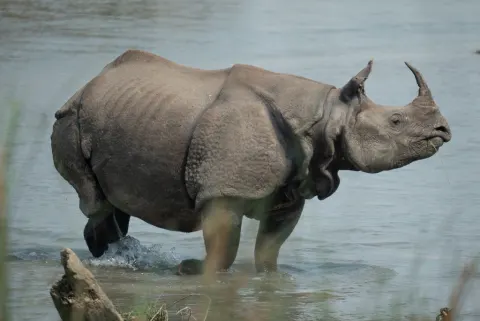
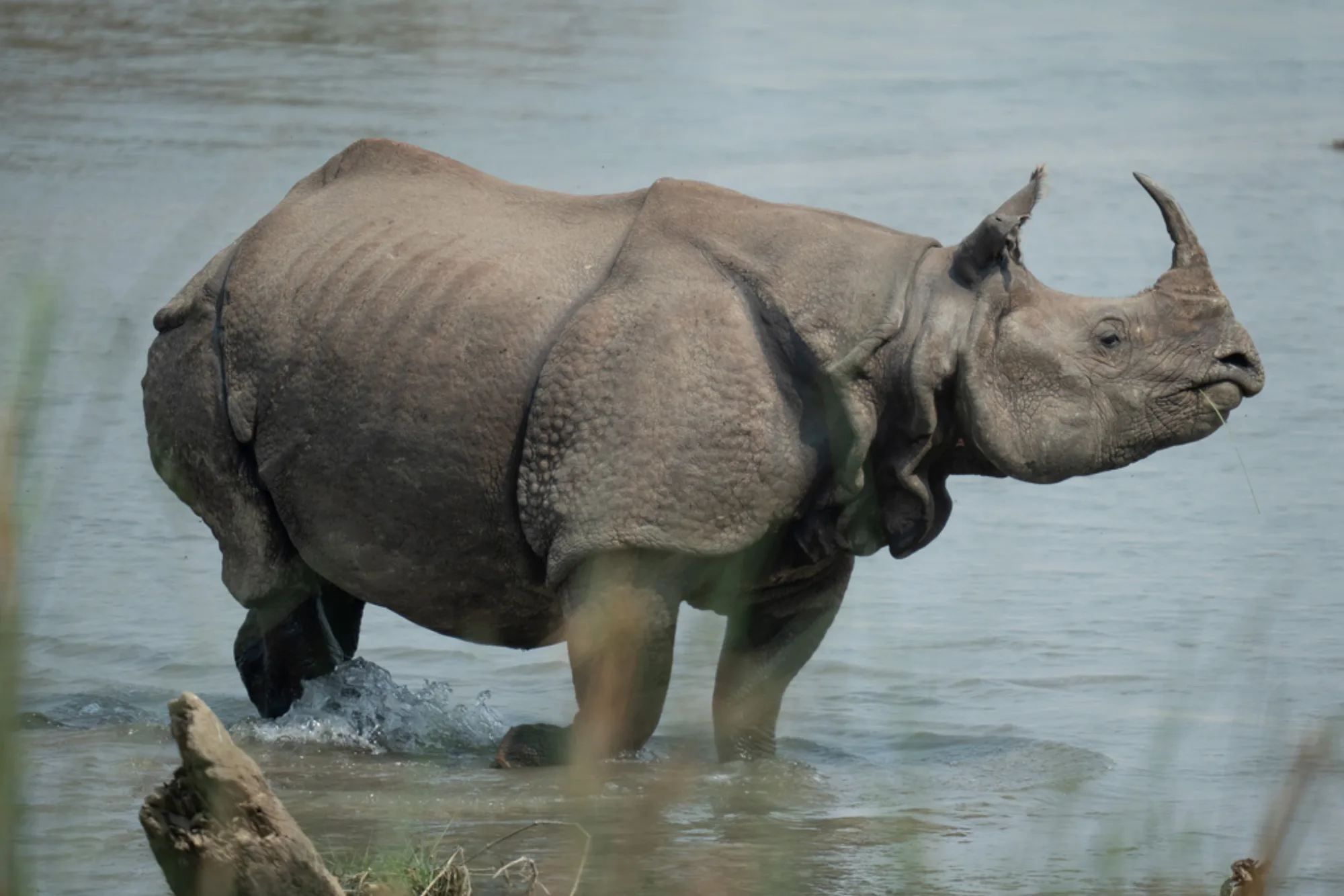
Grey-brown skin, pinkish folds and a single horn give the Indian Rhinoceros its distinctive appearance. Its shoulders and upper legs carry wart-like bumps, while its body has very little hair. The largest rhino in Asia, it lives in pockets of northern India and southern Nepal, including protected areas on the Indo-Gangetic Plain. It inhabits the alluvial grasslands of the Terai and Brahmaputra basin, and can also occur in cultivated areas, pastures and secondary forests surrounded by human-dominated landscapes.
Rhinos are most active in the early morning, late afternoon and at night, resting through the heat of the day. They bathe regularly and are excellent swimmers. Bulls are usually solitary, while females may be accompanied by their calves; young rhinos can also form groups. At wallows, gatherings can include a dominant male with females and calves. Grass makes up almost all of their diet, supplemented by leaves, twigs, flowers, fruit and aquatic plants. They feed in the morning and evening. A female gives birth to one calf after about 15.7 months, and a mother may stay close to her calf for up to four years.
Hunting and agricultural development greatly reduced the rhino's range, and its remaining populations are fragmented. Poaching for the horn remains a threat to several important populations. Habitat degradation and increased flooding have killed rhinos and restricted their range. In some areas, invasive plants, livestock grazing and the loss of grasslands and wetlands have also damaged habitat. With over 70% of the population at Kaziranga National Park, a catastrophe at that single site could have a devastating impact.
Written from the English Wikipedia article Indian rhinoceros (CC BY-SA 4.0).
- Records
- 170
- Countries
- 2
- Atlas places
- 4
These are open occurrence records, so they show where people looked for and recorded the Indian Rhinoceros as much as where it lives. Cells are up to 25 km across, and every location is generalised to its cell.
Generalised encounter areas, not exact locations. Each shape is a grid cell coloured by how likely the species is there.
- Very likelyIndia25 km zone · medium confidence · 101 records · updated 80 days ago
- Very likelyNepal25 km zone · medium confidence · 69 records · updated 80 days ago
Conservation status not assessed here yet, so every location is generalised to its grid cell.