Cane Toad
Rhinella marina
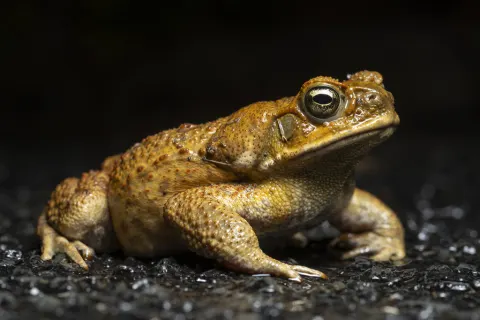
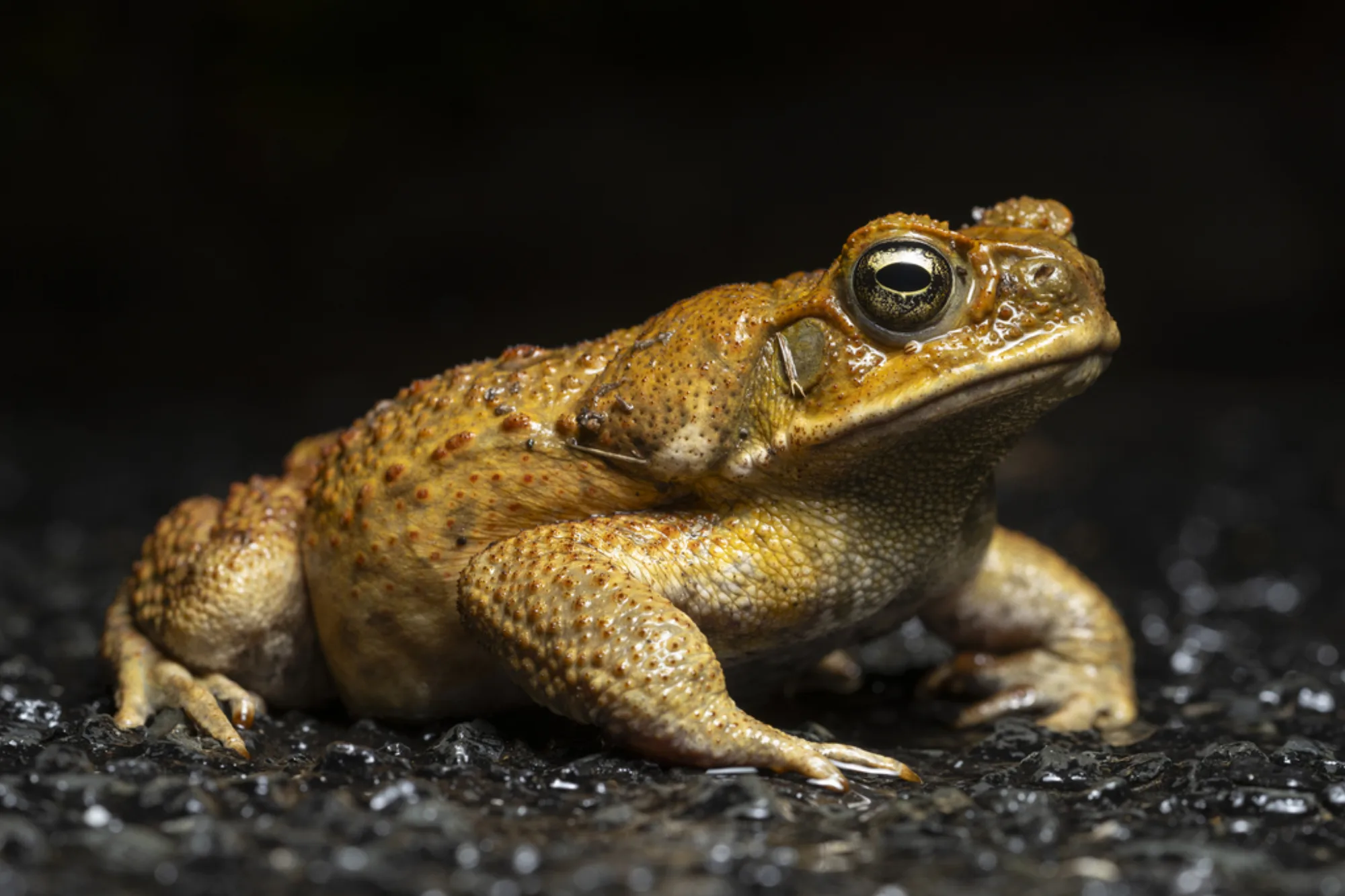
Large and stocky-looking, the Cane Toad (Rhinella marina) has dry, warty skin and ridges that run from above its eyes down its snout. Adults average 10 to 15 cm in length, and their patterned skin ranges in colour from grey and yellowish to shades of brown. Their eyes have golden irises and horizontal pupils, while the cream-coloured underside sometimes bears dark blotches. Behind each eye sits a large poison gland, and the skin is toxic too.
Native to the Americas, the toad's range extends between South Texas, including the Rio Grande Valley, and the central Amazon and southeastern Peru, with populations on islands near Venezuela. People have introduced it to Australia, Florida, the Philippines, many Caribbean islands and numerous Pacific islands. It favours open grassland and woodland, and often uses places changed by people, including gardens and drainage ditches. In its native range it also lives in subtropical forest, though dense foliage can restrict its spread. Despite one of its other names, marine toad, it does not live in the sea.
Cane toads use sight and smell to find food, taking everything from insects and other invertebrates to small mammals, reptiles, birds and other amphibians. They also eat plants, pet food and household refuse. Females lay thousands of eggs in long strings of jelly in water, and the small black tadpoles tend to gather in groups. Breeding takes place year-round in tropical regions, but in subtropical areas it coincides with warmer, wetter periods. Predators include snakes, eels, birds and meat ants, while young toads are especially exposed because they lose their earlier toxic defences before their poison glands are fully developed. Tadpole cannibalism also contributes to the low proportion that survive to adulthood.
Written from the English Wikipedia article Cane toad (CC BY-SA 4.0).
- Records
- 45,222
- Countries
- 14
- Atlas places
- 6
These are open occurrence records, so they show where people looked for and recorded the Cane Toad as much as where it lives. Cells are up to 25 km across, and every location is generalised to its cell.
Generalised encounter areas, not exact locations. Each shape is a grid cell coloured by how likely the species is there.
- Very likelyAustralia25 km zone · medium confidence · 43278 records · updated 80 days ago
- Very likelyBrazil25 km zone · high confidence · 591 records · updated 80 days ago
- Very likelyUnited States25 km zone · high confidence · 575 records · updated 80 days ago
- Very likelyPeru25 km zone · high confidence · 192 records · updated 80 days ago
- Very likelyPalau25 km zone · high confidence · 121 records · updated 80 days ago
- Very likelyColombia25 km zone · medium confidence · 92 records · updated 80 days ago
- Very likelySamoa25 km zone · high confidence · 75 records · updated 80 days ago
- Very likelyMartinique25 km zone · high confidence · 64 records · updated 80 days ago
- Very likelyPhilippines25 km zone · medium confidence · 53 records · updated 80 days ago
- Very likelyEcuador25 km zone · medium confidence · 51 records · updated 80 days ago
Conservation status not assessed here yet, so every location is generalised to its grid cell.