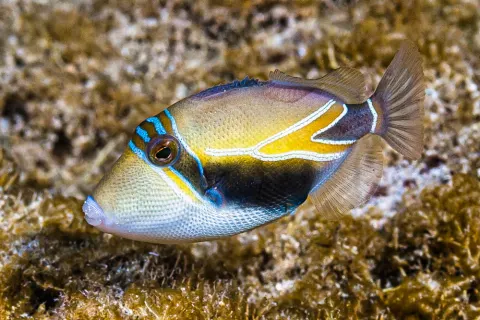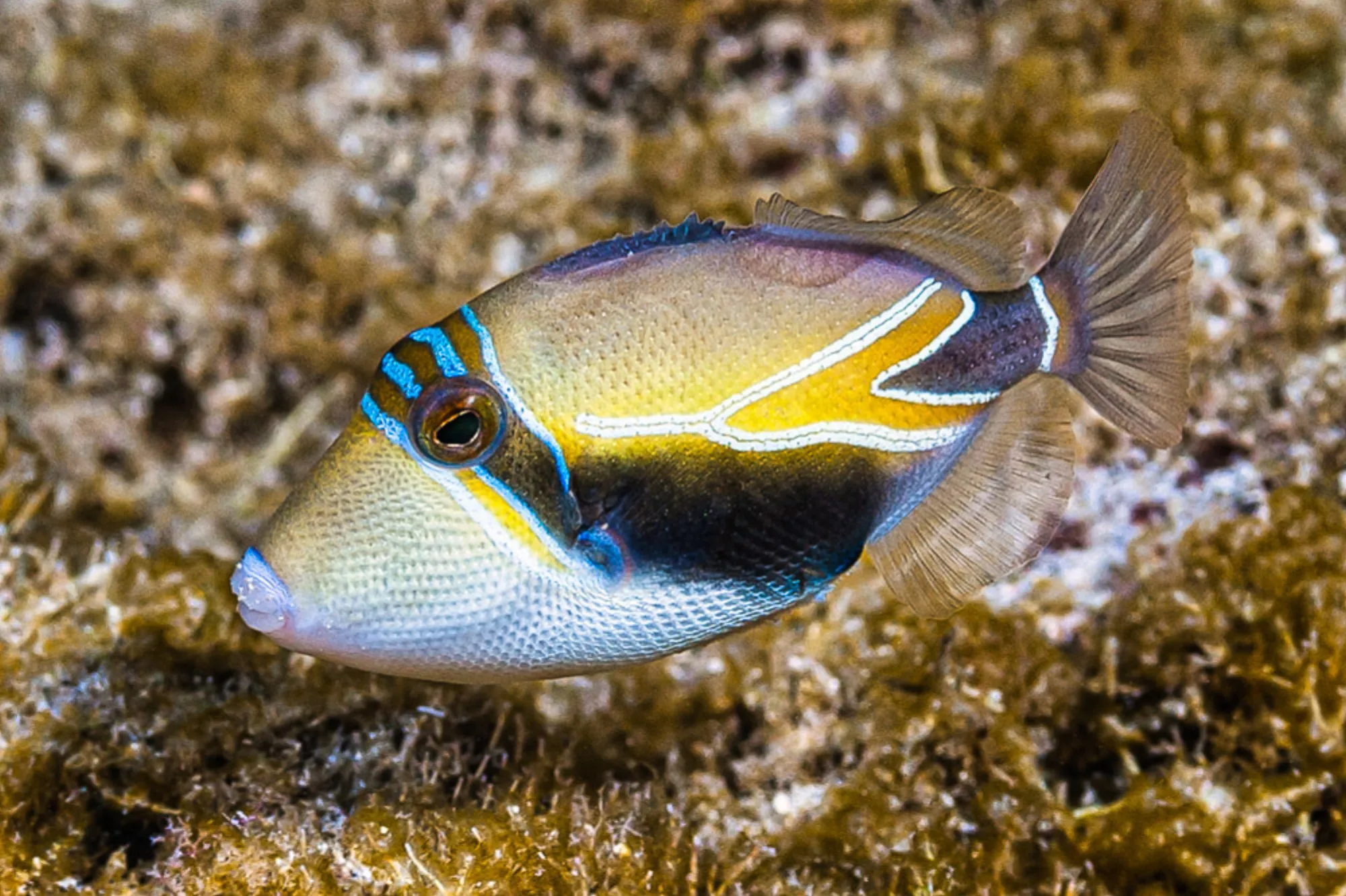
Wedge-tail Triggerfish
Rhinecanthus rectangulus
A large snout and blue lips give the Wedge-tail Triggerfish a pig-like profile. Orange-brown colouring runs along its back and towards the front, contrasting with a white belly, while its tail fin has a cloudy appearance. It grows to about 30 cm and can be confused with the lagoon and picasso triggerfish.
This triggerfish lives on coral reefs across the Western Pacific, in the eastern central Pacific, throughout the Indian Ocean and in the southeast Atlantic. It occurs at depths of 0 to 50 meters. When feeding, it stays near its home or searches shallow reefs away from living coral. Much of its food is algae scraped from surfaces, but it also eats crustaceans, including isopods from sandy ocean floors. It can hover and move in many directions, including backwards, and spends its time hunting, foraging and defending territory. If a predator approaches while it shelters in a crevice, a locked upright spine helps keep it from being pulled out.
The fish makes grinding, drumming, grunting and snapping sounds. Grinding can be heard during feeding and may signal ownership of a territory or help attract females, while snapping is often observed during territorial conflicts. Direct information on its breeding is limited, though its behaviour is thought to overlap with that of the picasso triggerfish, whose males and females defend areas used for feeding and spawning. Global warming threatens the coral reefs where it lives and can reduce oxygen levels, although one study found that the fish can tolerate high levels of hypoxia.
Written from the English Wikipedia article Reef triggerfish (CC BY-SA 4.0).
- Records
- 2,991
- Countries
- 33
- Atlas places
- 2
These are open occurrence records, so they show where people looked for and recorded the Wedge-tail Triggerfish as much as where it lives. Cells are up to 25 km across, and every location is generalised to its cell.
Generalised encounter areas, not exact locations. Each shape is a grid cell coloured by how likely the species is there.
- Very likelyUnited States25 km zone · high confidence · 1582 records · updated 80 days ago
- Very likelyNorthern Mariana Islands25 km zone · medium confidence · 272 records · updated 80 days ago
- Very likelyAmerican Samoa25 km zone · medium confidence · 254 records · updated 80 days ago
- Very likelyU.S. Outlying Islands25 km zone · medium confidence · 240 records · updated 80 days ago
- Very likelySeychelles25 km zone · medium confidence · 212 records · updated 80 days ago
- Very likelyGuam25 km zone · medium confidence · 102 records · updated 80 days ago
- LikelyFrench Polynesia25 km zone · medium confidence · 57 records · updated 80 days ago
- LikelyPhilippines25 km zone · medium confidence · 40 records · updated 80 days ago
- LikelyNew Caledonia25 km zone · medium confidence · 34 records · updated 80 days ago
- LikelyWallis & Futuna25 km zone · medium confidence · 31 records · updated 80 days ago
Conservation status not assessed here yet, so every location is generalised to its grid cell.