Lesser Rhea
Rhea pennata
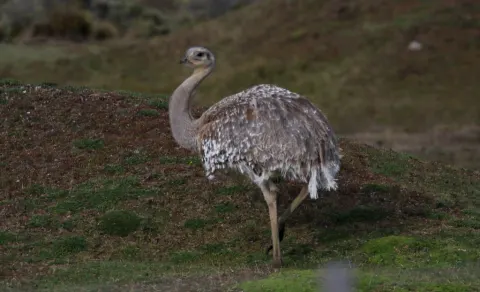
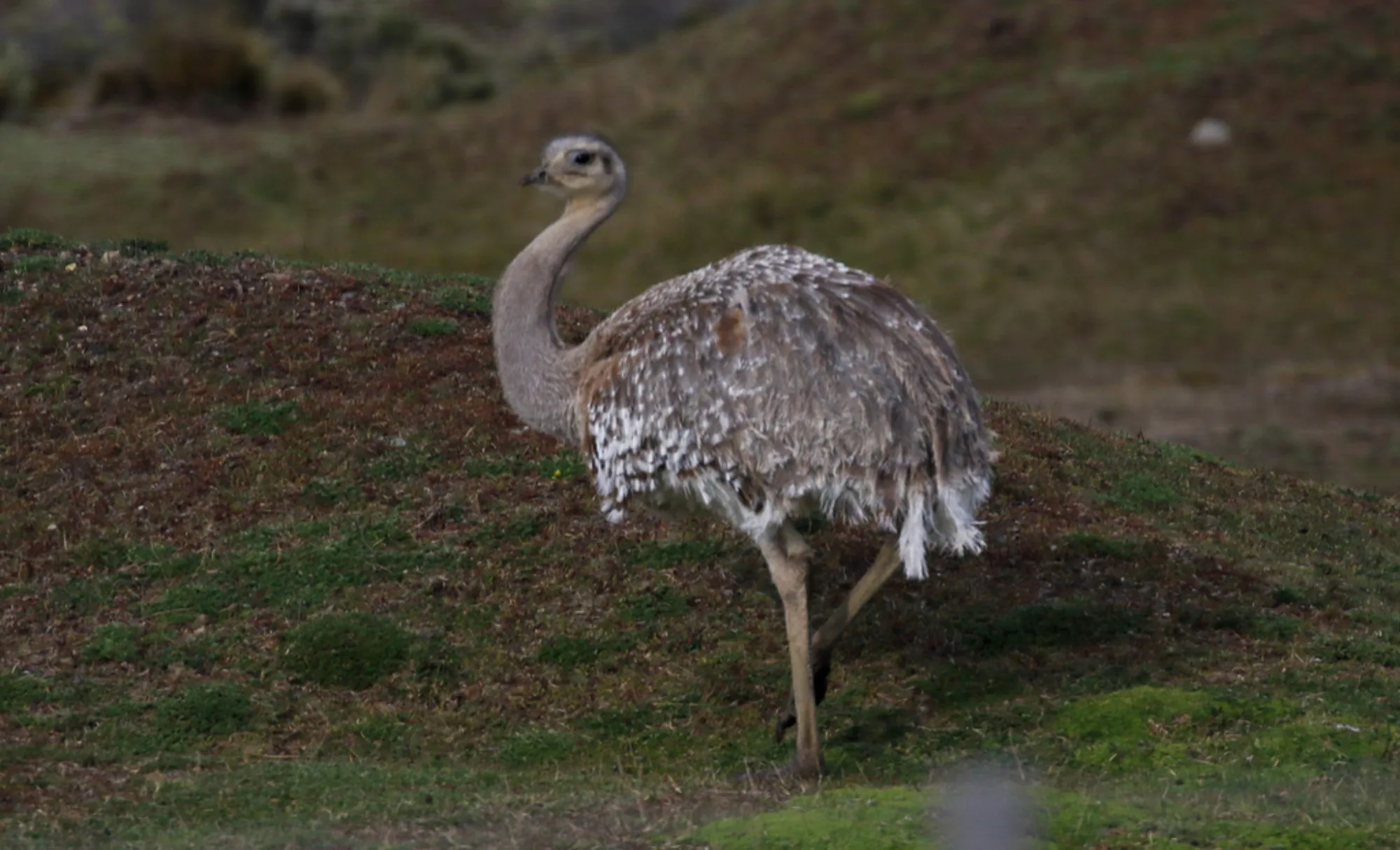
Long legs, a long neck and brown-and-white spotted plumage give the Lesser Rhea its distinctive outline across open country. This large, flightless bird stands 90 to 100 cm tall and has a small head and bill. Although it cannot fly, it runs well and can reach 60 km/h, fast enough to outrun predators. It is usually quiet, but chicks whistle and males searching for a female give a booming call.
The bird lives in South America's Altiplano and Patagonia, across Argentina, Bolivia, Chile and Peru. Look for it in open scrub among grasslands, as well as in brushlands and marshland. Outside the breeding season, it gathers in mixed groups of 5 to 30 birds of different ages. Its diet is mainly plant food, especially saltbush and cactus fruits, along with grasses, roots, seeds and leaves. It also occasionally eats small animals, including lizards, beetles and grasshoppers.
Several females may lay eggs in a shared clutch, while the male incubates them and provides all the parental care. Incubation lasts 30 to 44 days, and a clutch can contain 6 to 50 eggs. Some eggs remain outside the nest, where they rot and draw flies that the male and, later, the chicks eat. The southern population remains widespread and can be fairly common locally, but the two northern populations may together number only in the hundreds. Hunting, egg collecting and the division of habitat as land is converted to farms or cattle pasture are the main threats to those northern birds.
Written from the English Wikipedia article Darwin's rhea (CC BY-SA 4.0).
- Records
- 16,419
- Countries
- 4
- Atlas places
- 2
These are open occurrence records, so they show where people looked for and recorded the Lesser Rhea as much as where it lives. Cells are up to 25 km across, and every location is generalised to its cell.
Generalised encounter areas, not exact locations. Each shape is a grid cell coloured by how likely the species is there.
- Very likelyChile25 km zone · high confidence · 8301 records · updated 80 days ago
- Very likelyArgentina25 km zone · high confidence · 7954 records · updated 80 days ago
- LikelyBolivia25 km zone · medium confidence · 83 records · updated 80 days ago
- LikelyPeru25 km zone · high confidence · 81 records · updated 80 days ago
Conservation status not assessed here yet, so every location is generalised to its grid cell.