Greater Rhea
Rhea americana
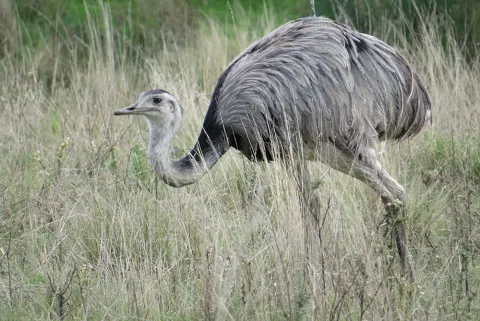
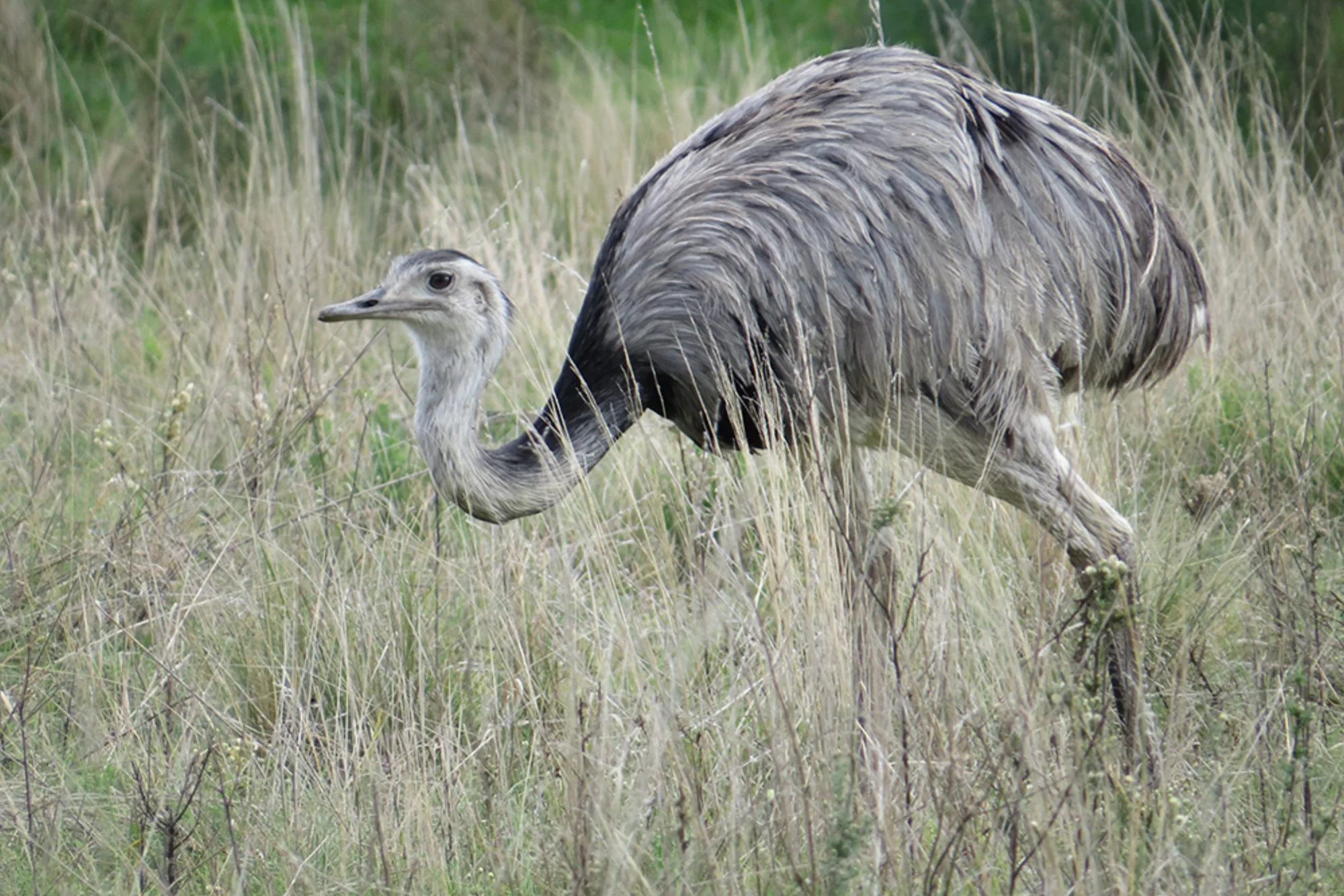
Across the open country of eastern South America, the Greater Rhea moves on long, strong legs beneath a long neck. No native bird in the Americas is larger than this flightless species, whose adults weigh 20 to 27 kg and usually stand about 1.5 m tall. Its fluffy, ragged-looking feathers range from grey to brown, and males are generally darker and larger than females. Long wings help the bird balance through tight turns when running, and a chased rhea may flee in a zigzag.
Its native range includes Argentina, Bolivia, Brazil, Paraguay and Uruguay, and a feral population also lives in Germany. Grasslands, savanna, scrub forest and grassy wetlands are among the places it inhabits, generally favouring areas with some tall vegetation. It prefers lower elevations and stays near water during the spring and summer breeding season. Outside that season, rheas form flocks of 10 to 100 birds and tend to be less watchful when gathered together. Their diet is mainly broad-leaved foliage, with seeds and fruit in season, but they also eat insects and a variety of small animals. The birds swallow pebbles that help grind up tough plant food.
During breeding, females lay eggs in nests attended by males, then move on to mate with other males. Several females can use the same nest, a shallow scrape hidden from view. Males incubate the eggs and care for the hatchlings, although some receive help from subordinate males. Increased hunting and the conversion of grasslands to farmland and ranchland are believed to be driving a decline, while crop burning has also contributed. Farmers sometimes hunt and kill rheas where they eat crops; feral dogs also kill young birds, and cougars prey on adults.
Written from the English Wikipedia article Greater rhea (CC BY-SA 4.0).
- Records
- 26,379
- Countries
- 6
- Atlas places
- 5
These are open occurrence records, so they show where people looked for and recorded the Greater Rhea as much as where it lives. Cells are up to 25 km across, and every location is generalised to its cell.
Generalised encounter areas, not exact locations. Each shape is a grid cell coloured by how likely the species is there.
- Very likelyBrazil25 km zone · medium confidence · 12537 records · updated 80 days ago
- Very likelyArgentina25 km zone · medium confidence · 8891 records · updated 80 days ago
- Very likelyUruguay25 km zone · high confidence · 2906 records · updated 80 days ago
- Very likelyBolivia25 km zone · high confidence · 1185 records · updated 80 days ago
- Very likelyParaguay25 km zone · high confidence · 748 records · updated 80 days ago
- Very likelyGermany25 km zone · high confidence · 112 records · updated 80 days ago
Conservation status not assessed here yet, so every location is generalised to its grid cell.